Xiyue Temple of Huashan Mountain
Located at the foot of Huashan Mountain, the Xiyue Temple is about 120 km (75 mi) east of downtown Xi’an. It was built in China’s Western Han Dynasty (202 BC - 9 AD), to honor the god of Huashan Mountain. Since then, a total of 56 emperors have visited the temple for blessings, and 9 among them have attended grand sacrificial ceremonies here.
Referred to as “Little Forbidden City”, the Xiyue Temple boasts majestic and attractive buildings in a Chinese imperial style. All the main buildings in the temple are axially symmetrical from south to north; they are in crimson, bright yellow, and blueish green, all typical colors of royal architecture in the Forbidden City in Beijing; and the temple further has a well-designed layout with halls in the front and official residences at the rear. By virtue of its impressive exterior and precious collections, the Xiyue Temple attracts many shutterbugs and history lovers.
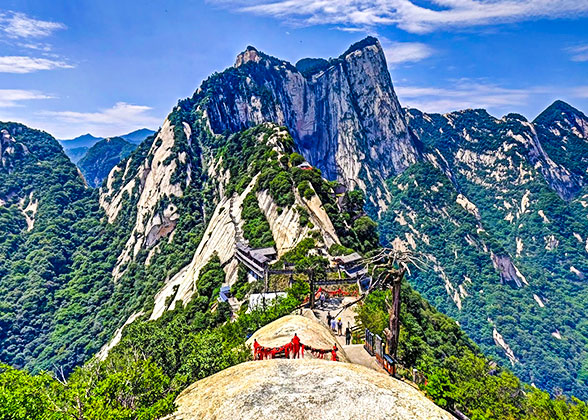
Facing closely to Mount Huashan, the Xiyue Temple has often been chosen as the first or last stop during people’s Huashan tours. Nowadays, it has become a good place to admire traditional Chinese royal architecture, enjoy the sight of Mt. Huashan to its south, and pray for a happy and healthy life.
As the first main building to view after you enter the temple, the majestic Meridian Gate features five gateways. Similar to that in the Forbidden City, it was also built according to strict hierarchy. Only the emperor can enter through its middle gateway; officials and imperial members enter through gateways flanking the middle one, and the outermost ones are for other companions.
Looking up along the crimson wall, you’ll see the magnificent Five-Phoenix Pavilion whose overhanging edges are like flying phoenixes.
The area behind the gate and pavilion, with many ancient steles, is called “Little Stele Forest”. Among all the steles in the temple, there are two famous for emperors’ handwriting. Unfortunately, the one with the reputation of “World No.1 Stele” was destroyed in a war. It was the highest when erected, with the height of about 15 meters (50 feet), and now only the base part is left.
The name of Lingxing originates from a god named Lingxing who domains the heaven. Lingxing Gate is a wooden building with three glaze-decorated linked archways. Bucket arches of the building are carved with nine lively dragon heads. In the style of a royal palace, the three linked archways are constructed with red pillars, yellow glazed tiles, and green and blue patterns. Behind the gate, a stone archway with vivid sculptures will catch your eyes, from a stone lion holding a treasured vase to soaring dragons and phoenixes, and immortals.
As the main hall of the temple, this majestic building was constructed on a T-shaped platform and by the highest imperial standard. It’s in the Haoling Palace where emperors offer sacrifices to the god of Huashan Mountain and pray for good harvests and peaceful lives of people. Why don’t you also pray for good fortune and a happy life from the mountain god? Just make your dearest wish in this sacred place.
The three-story Long Live Pavilion, the highest building in the temple, is typically the last stop for tourists in the temple. Located at the northernmost part of the temple, this high pavilion provides a panoramic perspective to overlook all the other buildings in the temple, and also to admire the lofty Huashan Mountain in the south. The scene is even more imposing on a cloudy day, and with the sea of clouds floating on the mountain top, the entire temple seems to be a palace complex in an otherworldly aura.
After visiting all the main buildings in the temple, some people would return the same way they come. Nevertheless, it’s highly suggested to ascend the rectangular bounding wall to the entrance to gain one more different sightseeing experience. When you wander on the 10-meter-high (30-feet) wall, the four exquisite Corner Towers are undoubtedly highlights. As watchtowers of the temple, they not only enjoy unobstructed observation angles, but also are roofed with three layers of staggered edges, one of the most elaborate designs in the temple.
Firstly, you can take a high-speed train from Xi’an North Railway Station to Huashan North Railway Station for about 30 minutes. After getting off the station, you’re advised to spend about 1 dollar on a taxi ride to the temple, which lasts for about 10 minutes.
 See also: How to Travel from Xi’an to Huashan
A taxi ride from Huashan Tourist Center to the entrance to the temple takes you about 15 minutes, and costs about 1.5 dollars.
You may like:
Huashan Mountain Weather
Jade Spring Temple of Huashan Mountain
Huashan Mountain Plank Walk
Dangerous Passes on Huashan Mountain
Classical Routes for Huashan Mountain Hike
Guide to Hiking Huashan Mountain at Night
Huashan Mountain Travel Tips
Huashan Mountain Cable Car
Referred to as “Little Forbidden City”, the Xiyue Temple boasts majestic and attractive buildings in a Chinese imperial style. All the main buildings in the temple are axially symmetrical from south to north; they are in crimson, bright yellow, and blueish green, all typical colors of royal architecture in the Forbidden City in Beijing; and the temple further has a well-designed layout with halls in the front and official residences at the rear. By virtue of its impressive exterior and precious collections, the Xiyue Temple attracts many shutterbugs and history lovers.
Facing closely to Mount Huashan, the Xiyue Temple has often been chosen as the first or last stop during people’s Huashan tours. Nowadays, it has become a good place to admire traditional Chinese royal architecture, enjoy the sight of Mt. Huashan to its south, and pray for a happy and healthy life.
What to See & What to Do in Xiyue Temple
1. Meridian Gate and Five-Phoenix Pavilion
Looking up along the crimson wall, you’ll see the magnificent Five-Phoenix Pavilion whose overhanging edges are like flying phoenixes.
The area behind the gate and pavilion, with many ancient steles, is called “Little Stele Forest”. Among all the steles in the temple, there are two famous for emperors’ handwriting. Unfortunately, the one with the reputation of “World No.1 Stele” was destroyed in a war. It was the highest when erected, with the height of about 15 meters (50 feet), and now only the base part is left.
2. Lingxing Gate with “Nine Dragon Heads”
3. Pray for Blessings in Haoling Palace - Main Hall of Xiyue Temple
4. Admire Huashan Mountain on Long Live Pavilion
5. Ascend and Wander on the Bounding Wall
Ticket Fares & Opening Hours of Xiyue Temple
| Ticket Fare | Free |
|---|---|
| Opening Hours | 8:00 - 18:00 in slack season from December to February; 7:00 - 19:00 in peak season from March to November. |
| Recommended Duration of Visit | 1 - 2 hours |
How to Get to Xiyue Temple from Xi’an?
See also: How to Travel from Xi’an to HuashanHow to Get to Xiyue Temple from Huashan Mountain?
Recommended Tours

 You may like:
Huashan Mountain Weather
Jade Spring Temple of Huashan Mountain
Huashan Mountain Plank Walk
Dangerous Passes on Huashan Mountain
Classical Routes for Huashan Mountain Hike
Guide to Hiking Huashan Mountain at Night
Huashan Mountain Travel Tips
Huashan Mountain Cable Car
- Last updated on Jun. 29, 2026 by Alex Jin -