Taoism

 Taoism
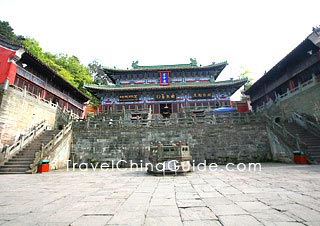
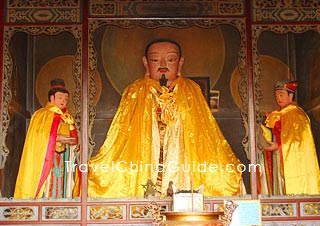
Temple in Gansu Province Taoism is a genuinely Chinese religion. Some hold the opinion that without understanding Taoism, there can be no understanding of Chinese culture.

 Doctrines of Taoism
Lao Zi was the creator of Taoism. According to the Shi Ji, or Records of the Historian, by Sima Qian , Lao Zi was named Li Er, with Dan as his alias. He was a reputed thinker around 6th century B.C. There are many legends about Lao Zi but few historical records. He left a 5, 000-word book and went on his ox from Hangu Pass and to where nobody knows! Lao Zi's 5,000 words are rather concise compared to his profound ideological system but there were numerous books interpreting the true meaning of his book.

Tao, originally, meant 'road' and then implied 'to rule' and 'principle'. Lao Zi used Tao to propound his ideological system; therefore his school of thinking is called Taoism. At the time Lao Zi created Taoism, it was simply a school of philosophy. It was during the Eastern Han Dynasty that Taoism became a religion.

Tao is the origin of the eternal world. It is boundless in time and space. Ordinary people can become gods when they have Tao. Taoism pursues immortality and preservation of health; its uttermost goal is to become an immortal being. Taoism claims this can be obtained through cultivating one's moral character and perfecting one's moral integrity.

A phrase from Taoism is to say an ordinary man can become immortal if he does good 3,000 times and accomplishes 800 exploits. Of course the number is symbolic. It requires people to do good without making it known to others as the gods will know it naturally, much like the Christian principle expressed in Matthew 6:3-4, "But when you give alms, do not let your left hand know what your right hand is doing, so that your alms may be done in secret; and your Father who sees in secret will reward you."
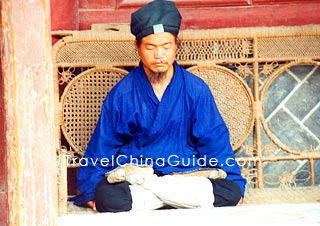
Taoist MonkTao is wu wei, namely Non-action. Non-action is to follow the rule of nature instead of overriding it. By conforming to the natural rules, Tao does nothing but it can do everything. Tao makes everything run smoothly but it does not boast about its own achievement. Those learning Taoism should be pure and take non-action.

Dialectic thinking is abundant in Lao Zi's system. He contended that Tao turned to the opposite during the circulation, like existing and non-existing, up and down, long and short, front and back, fortune and misfortune, strong and weak. Based on his thinking, a proverb was later devised, "Things will develop in the opposite direction when they become extreme." For example, Taoism holds that flexibility can defeat strength. Water was used as a metaphor in Lao Zi to explain the prowess of flexibility. Nothing can be more flexible and soft than water but it can defeat all tough things. Similarly, Taoism emphasizes humbleness and tenderness.

Taoism has its drawbacks. For example, Lao Zi promoted the idea of a return to a small state with a small population; people did not socialize though they lived so near that the barks of dogs could be heard. These ideas prevented social development. Also, Chinese intellectuals resorted to a hermitic way of life whenever they met setbacks; when they were successful, they would say "the less hermitry was to live in the remote areas while the great hermitry was to live in the court". The inner worldly and outer worldly attitudes made the Chinese intellects hover between the active Confucianism and the passive Taoism.

 Development of Taoism
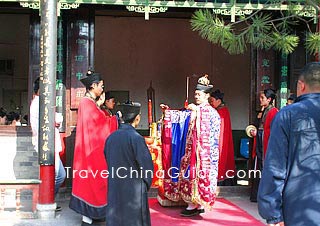
Taoism became a religion during the Eastern Han Dynasty and Lao Zi was respected as the creator of Taoism.

During Three Kingdoms, many scholar-bureaucrats practiced Taoism and it soon became separated into an aristocrat sect and a folk sect. This situation lasted till the Jin Dynasty but doctrines were not strictly adhered to due to the chaotic political background.

Religion can be this colorful and worldly.Sui Emperors professed to Buddhism but still placed importance on Taoism. Ten Taoist temples were constructed in Chang'an (today's Xian) under the order of Emperor Yang, the notorious tyrant of Chinese history.

Tang Emperors regarded themselves as offspring of Lao Zi and Taoism developed rapidly and had a profound repercussion on the subsequent dynasties.

Unlike Buddhism, Taoism does not advocate asceticism. It pursues longevity and holds an open view toward sex. In the heyday of Taoism during the Tang Dynasty, there is no strict restriction on this. Taoist nuns were not uncommon. A poem satirizes that beautiful nuns were used to attract people as a means to compete with Buddhist temples.
In the middle years of the Tang Dynasty, aristocratic women, court maidens, and almes flocked to join the Taoist nuns, which had the effect of making this group more romantic and better endowed from a cultural and artistic point of view. The reasons why women became nuns varied; which meant that their prime purpose was not merely an ascetic life filled with devotion. Many were so beautiful that the temples were filled with people coming to solely to admire them. All these facts were noted in the Tang records. Many poets fell in love with Taoist nuns and many beautiful and sentimental poems were left when their love was unrequited. As Taoist nuns were called Nv Guan and later Nv Guan Zi, became a ci pai, a name of the tunes to which ci poems were composed.

Special institutions were set up by the Ming court to rule over the Taoist affairs. Another big event is the integration of the stories of the Eight Immortals. Over its long history, many legends about Taoist figures emerged and the most well-known are those of the Eight Immortals. A colloquial phrase has it, "like the Eight Immortals crossing the sea, each one showing his or her special feats'. These Eight Immortals are seven men and a woman. The images of the Eight immortals can be seen in many artifacts, from the bridal sedan to cakes, vases, paper-cutting and paintings.

Taoism was suppressed by the Qing rulers as well as by the foreign invaders consequent upon the Opium War. Taoism has been faced with a huge impact from foreign culture but it remains an influential system of thought among the Chinese people.

 Famous Taoist Holy Mountains:
Mt.Wudang, Mt.Longhushan, Mt.Qingcheng, Mt.Qiyun, Mt.Huashan, Mt.Laoshan, Mt.Huangshan, Mt.Hengshan in Hunan, Mt.Hengshan in Shanxi, Mt.Songshan, Mt.Taishan, Mt. Wuyishan,etc.

 Famous Taoist Holy Temples:
Taoist Temple of the Eight Immortals (Ba Xian An) in Xian
Qingyang Temple in Chengdu
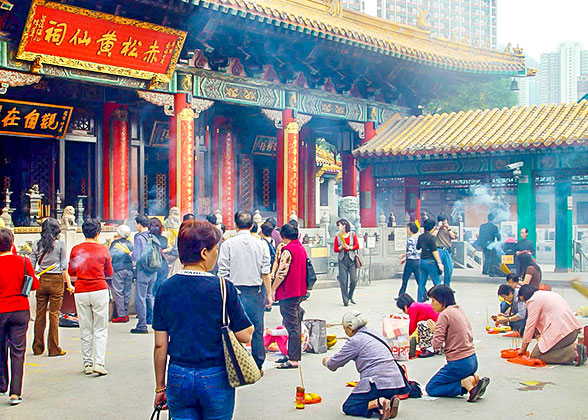
Wong Tai Sin Temple in Hong Kong.
Zixiao (Purple Heaven) Temple on Mt. Wudang in Hubei
Louguan Terrace in Shaanxi.


Travelers' Voices on Taoism

1.

Mar. 9,2009 18:27 Reply

Mr.Jankens(Mexico) said:

Was self defence part of Taoism?

Mar. 18,2009 16:33
Mr.AL(Malaysia) replied:

No, self defence is not part of Taoism, though Tai Chi is part of Taoism. Tai Chi - an exercise that involves various techniques of movement but with the intention of balancing ONE's chi energy and not self defence. Hope that answer your question.

May. 24,2009 20:56
Mr.LOL(AUS) replied:

Tai Chi is a slower version of Martial Arts.

Anyway...........

Taoism is a major religion even thoguh it is not openly recognised

2.

Mar. 21,2009 11:22 Reply

Mrs.Sage(U.S.) said:

DOES ANYONE KNOW ANYTHING ABOUT THE "EIGHT IMMORTALS RUG"? I AM TRYING TO SEE HOW MUCH IT IS WORTH.

May. 6,2009 01:33
Mr.Ray(CN) replied:

I heard of Eight Mortals Table.

May. 6,2009 16:46
Mrs.Sage(U.S.) replied:

Mr. Ray; I am looking for info on the rug or how much it is worth. How do I find out about the table?

May. 6,2009 23:12
Mr.Ray(CN) replied:

As for its cost, I think it all depends on the quality of the wood and the level of the craft.

May. 6,2009 23:10
Mr.Ray(CN) replied:

The Eight Immortals Table that I mentioned is like this (click the link to see the images):

http://image.baidu.com/
i?tn=baiduimage&ct=201326592&cl=2&lm=-1&pv=&word=%B0%CB%CF%C9%D7%C0&z=0

Do you want a one like that? In China, it's easier to find. Are there any stores of Chinese furniture in the US?

3.

Mar. 21,2009 11:31 Reply

Mr.Scholz(Brazil) said:

Can I live in China and join in a daoist temple and live there for the rest of my life?? Im from Brazil.

May. 6,2009 01:32
Mr.Hamlet(UK) replied:

Are you serious? Oh,it's not kidding. Could you understand all the doctrines of Taoism? And would you like to give up your original beliefs?

4.

Jan. 22,2009 15:57 Reply

Mr.Donjie Rutherford Fernandez(Philippines) said:

Are there some more people in china who practices Taoism?

May. 5,2009 05:02
Mr.Zhou(CN) replied:

Yes, there are many people in China who practice Taoism. There are many famous Taoist mountains, such as Wudang Mountain in Hubei and Laoshan Mountain in Qingdao. On the mountain, many Taoist monks live there. There are many Taoist temples there. Taoism influences Chinese culture very deeply. It originated in China.

5.

May. 4,2009 18:44 Reply

Ms.Rivera(usa) said:

I need Help finding out some beliefs?

May. 5,2009 04:59
Ms.Tina(CN) replied:

Practice Taoism very piously and the people can become immortal after he dies.

Comment Reply