History & System of Taoism
History
 |
| Yongle Palace, a Taoist Palace, Yuncheng, Shanxi |
Taoism was formally established in the late Eastern Han Dynasty (25-220). Northern and Southern Dynasties (386-589) saw it become the legitimacy religion like Buddhism in China, because it was supported by some emperors for political reasons. This religion welcomed its silver age from Tang Dynasty (618-907) to Northern Song Dynasty (960-1127). Many sects were formed during this period. Taoist temples were scattered all over the country and Taoist masters came forth in great number. After Yuan Dynasty (1271-1368), it has divided into two major sects: Quanzhen Sect and Zhengyi Sect.
With the support of royal rulers, Taoism gradually developed. In the Ming Dynasty (1368-1644), due to the national conflicts, the court had little energy and financial support to encourage the development of this religion.
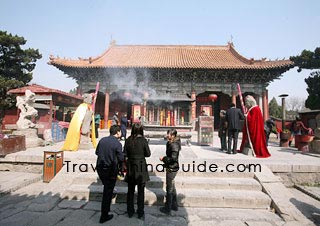 |
| Dai Temple near Mt.Taishan, Shandong |
At present, many people in Hongkong, Macao and Taiwan believe in Taoism. Overseas, Chinese communities have built many Taoist temples all over the world.
System of Taoism Deities
In this religion, the system of deities is very complicated and becomes larger and larger. So it is important to find appropriate ranks for this big growing group.
Ranking standards are in accordance with the degree of Taoism study and contribution. The more profound one's Taoist knowledge is the higher rank he will attain. The most important gods are the San Qing (Three Pure Gods). They are Yu Qing (Jade Pure), Shang Qing (Upper Pure) and Tai Qing (Great Pure). Below the Three Pure Gods, there exist the four holy emperors among whom Yu Huang (Jade Emperor) comes first. 'Houtu Mother', is a female God who dominates child bearing affairs is also included. Some Taoist temples have been specially set up as Houtu temples to worship her. A number of deities come next to them and are in charge of different affairs. Among them, ordinary people may be familiar with God of Wind, God of Rain, God of Fire, God of Town and God of Earth, all closely related to their daily life.
|
|
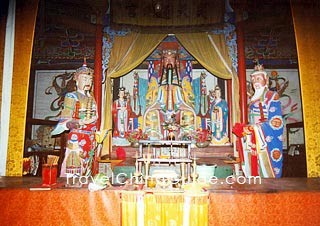
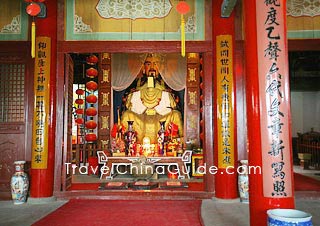
Like this religion itself, the system of Taoism deities is close to people. Once you know the rank rules, it is not too difficult to understand.