Chinese Dragon
The people of China have a long held belief that they are descendents of the dragon, a tradition that is firmly embedded in their culture and one that is encountered across all aspects of Chinese society and in the minds of its people. Whereas in western cultures the dragon is usually regarded as a symbol of malevolence, in China it is held in high esteem for its dignity and power for good.
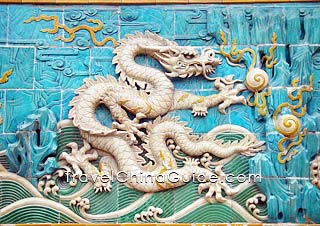 |
| Nine-Dragon Screen, Beihai Park, Beijing  Chinese Dragon Photos Chinese Dragon Photos |
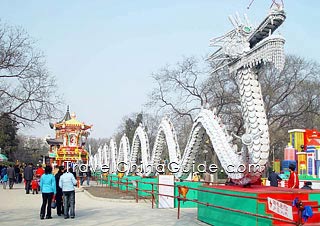 |
| A dragon-shaped lantern |
The image of the dragon has undergone a series of changes over the centuries becoming more and more mighty and beautiful. The original illustration on primitive bronze ware portrays it as ferocious and mysterious; in the Han Dynasty (206BC - 220), it became magnificent and unrestrained; while during the Tang Dynasty (618 - 907), it was personalized as gentle, tamed and graceful. From the Song Dynasty onwards (960 - 1279), the design became delicate and flowery.
There are several different kinds of dragon according to color, which may be yellow, blue, black, white or red. Of these the most highly revered was the yellow one and so each emperor wore a gown decorated with a yellow dragon pattern.
Although there are differences in appearance, the basics are similar. This is because it is a combination of the features of animals with which people were familiar. A dragon has a protruding forehead indicating wisdom and antlers signifying longevity. Its ox's ears denote success in the imperial examination; it has tiger's eyes as a sign of power; eagle's claws showing bravery; while a fish's tail implies flexibility and the horse's teeth are a mark of diligence and so on.
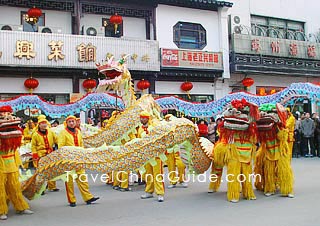 |
| Dragon Dance |
The most vibrant and spectacular way of expressing fondness for the dragon is the dragon dance. This has evolved from what was a ritual rain dance into a popular entertainment performed during the period from Chinese New Year until the Lantern Festival . The second day of the second lunar month is the Han people's special time - 'Dragon Heads-raising Day'. People could not tonsure their hair from the start of the lunar New Year until then. The activities for celebration are still for a good rain. Other big festivals related to the dragon include the Dragon Boat Festival and those of ethnic groups like Zhuang, Yao, Hani, and so on.
Nine Sons of the Dragon - Culture Mirror
It was said that the dragon had nine sons, each of whom was endowed with a unique supernatural power. These appear in many aspects of art as well as forming part of daily life.
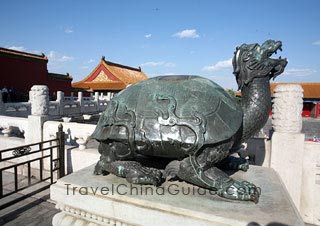
The eldest son appeared as a tortoise, a creature capable of bearing very heavy stone steles. Tortoise statues were erected in ancient temples and courtyards, as people believed that to touch them could bring good luck.
The second son was like a tiger, powerful especially in the courts of justice and its likeness was engraved on the doors of jails to add stateliness.
The third son was just like a lizard but one without a tail. It was thought to forage in dangerous places with the ability to swallow fire. The roofs of palaces were adorned with such dragons as a protection against fire.
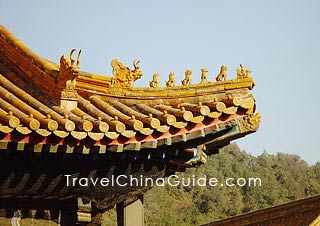 |
| Dragon figures on eaves of ancient building |
The fourth son, resembling a spiral shell bears a likeness to a closed mouth and would be carved or painted on doors as its closed form symbolized safety.
The fifth son had a great love of music and it is depicted as a yellow dragon upon musical instruments such as the Hu Qin of the Han People, Yue Qin of the Yi ethnic group, and tri-chord qin of the Bai ethnic group.
The sixth son was similar to but smaller than its father. It feared cetaceous creatures such as dolphins or whales and upon seeing a cetacean, it would shout loudly in fear. Thus it became a tradition for people put its likeness on clocks with a carved wooden cetacean as the bell-striker in order to increase the sonority of the toll.
The seventh son appeared like a wolf and people who were greedy would be called 'Tao Tie' which was the name of this son.
The eighth son was like a lion with a propensity to sit and enjoy the aroma of joss sticks. This was introduced into the imagery of Chinese Buddhism and would be depicted on Buddha thrones and incense burners.
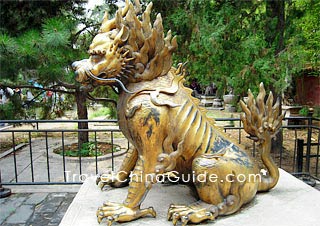
The ninth son bore a likeness to a jackal with its taste for killing, thus it often appeared on sword scabbards. Another tradition says that 'Pixiu', a fierce but auspicious beast, was the ninth son. It had a dragon's head, horse's body, kylin's feet, a long beard and wings but no anus, which was its most distinctive feature and symbolized the bringing and accumulation wealth. In the art of Feng Shui, it also functioned to exorcise undesirable influences. For this reason hosts would have a statue of 'Pixiu' on certain furniture; it was believed that Pixiu made of jade were the most effective for such purposes.
 |
| A bronze kylin |
Other Auspicious Animals
- Phoenix, Tortoise, and Kylin
The dragon, phoenix, tortoise, and kylin are the four most revered animals of ancient China. Of these only the tortoise is real, the others being entirely fictitious; each was a symbol of good fortune and this is why people paid them so much respect.
The phoenix is splendid and regarded as the king of birds. Usually it paired with the dragon and in wedding celebrations it is a wish for a harmonious marriage for the new couple. Once the dragon became a totem of the emperor, the phoenix was accorded a similar significance to empresses. For generations, people have named food, musical instruments, and even girls with the Chinese character 'Feng' (phoenix), in the expectation that they are as splendid as the phoenix.
 |
| Tortoise |
The tortoise is one of the animals that has endured longest on earth and as such is a symbol of longevity and wealth because it is thought that the tortoise evolved while collecting the nimbus of nature. Consequently it is favorable to present a statue of a tortoise to the senior or breed tortoises in a place that can bring enrichment according to the theory of 'Feng Shui'.
The kylin has a compound appearance with dragon's head, antlers, horse's hoofs, an oxtail, wolf's forehead and a colorful scute. It is lively, intelligent, and gentle, but valorous to ward off devils. It is the custom in some regions for people to believe that the kylin will give them a son. So a common theme in paper-cut works and paintings is for this mythical beast to be shown carrying a plump baby. Further Reading:
Mysterious Animals on the Palace Roofs of the Forbidden City
Interesting Animal Statues in the Forbidden City