Hall of Literary Glory (Wenhuadian)
As you pass through the Gate of Unified Harmony (Xiehemen) after crossing the Golden Water Bridges, you'll see the Hall of Literary Glory, Wenhuadian, an auxiliary building in the east of Forbidden City's Outer Court. It had been a royal academic center from 1420 to 1776. Today, it houses the Calligraphy and Painting Gallery.
 |
| Hall of Literary Glory, Forbidden City |
Functioned as the Royal Academic Center
Crown Prince's Study & Workplace (1420-1536)
Completed in 1420, the Hall of Literary Glory served the crown prince as both study and workspace. It was strategically placed in the east and adorned green glazed for the crown prince, as the ancient Chinese believed that the east and green represent growth and vitality.
 Crown Prince's Academic Life
Before each lesson, instructors should submit their handouts to the emperor for approval. The study schedule was rigorous, with days of break only on the first and fifteenth day of each month, or when bad weather struck, particularly during harsh winters. For a naughty young crown prince like Zhu Houzhao (1491~1521), this routine could sometimes feel like an endless grind, prompting him to skip classes now and then.
 |
| Hall of Literary Glory Plaque |
Crown Prince's Teacher: Grand Scholar of the Hall of Literary GloryIn the Ming Dynasty (1368-1644), six officials known as the "Grand Scholars" worked as the emperor's top advisors. Among them, the Grand Scholar of the Hall of Literary Glory served not only as a key advisor but also as the crown prince's tutor.
From 1748 to the late 19th century in Qing Dynasty, this position became the highest minister. A notable figure in this role was He Shen (1750-1799), the most renowned corrupt official in Chinese history, who was listed in the Asian Wall Street Journal's "World's 50 Richest People in the Last Millennium" in 2007.
Emperor's Study Room & Academic Forum (1436-1776)
In 1436, a nine-year-old emperor ascended the throne. Guided by wise civil officials, he embraced the ancient imperial education system rooted in the Han Dynasty (202 BC~220 AC). He delved into Confucian classics and the wisdom of feudal rule within the Hall of Literary Glory, later moving to the new Pavilion of Literary Profundity (Wenyuange) in 1776. Emperor's Academic Life
 |
| Gate of Literary Glory |
The emperor studied in two ways. First, there were grand academic ceremonies three times a month during spring and autumn, focusing on demonstrating the emperor's commitment to learning through elaborate rituals, including sacrifices, announcements, lectures, and feasts.
For daily learning, the emperor had morning classes. Four to six scholars rotated, sharing their knowledge of the classics. These classes also served as a forum for discussing factual issues, making them an efficient and practical part of his daily routine.
Function Today: Calligraphy and Painting Gallery
The Hall of Literary Glory, now the Forbidden City Calligraphy and Painting Gallery, hosts thematic exhibitions drawn from the museum’s exceptional collection of classical Chinese paintings and calligraphic works.
 |
| Inside Calligraphy and Painting Gallery, Forbidden City |
Hall of Literary Glory Latest Exhibition: Divine Steeds
Timed with the Year of the Horse 2026, the Hall of Literary Glory presents its latest exhibition, "Divine Steeds: The World of Horses in the Palace Museum's Painting and Calligraphy Collections." This exhibition explores the horse's pivotal role in ancient Chinese warfare, transport, and daily life, while unveiling its deeper significance as a profound cultural symbol of strength, loyalty, and ambition.
Why were horses such a beloved subject for Chinese artists? The answer gallops back to the Tang Dynasty (618-907). As national power peaked, exquisite steeds from the Western Regions arrived via the Silk Road, igniting a passion for horses that swept through the society, and elevating the horse from mere background to independent in classical Chinese art.
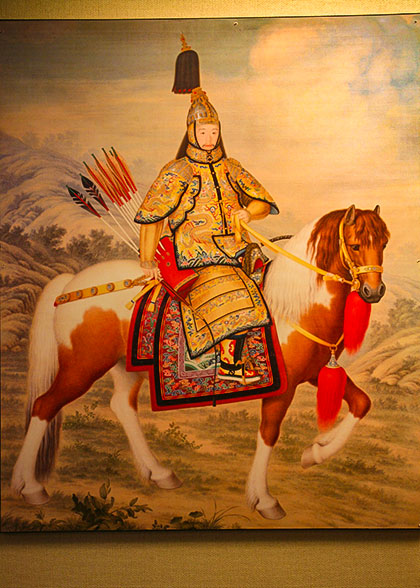 |
| A Horse Painting from 18th Century |
The exhibition guides you through the ancient world of humans and horses across four sections. In "Travel & Leisure," see how people journeyed and enjoyed themselves on horseback. "Grazing & Husbandry" reveals the state-run system of horse breeding, care, and training. "Military Feats" highlights the indispensable role of warhorses in establishing and defending empires. Finally, "Divine Steeds" immerses you in the artistic mastery through which painters captured the noble beauty and spirit of the horse.
From the exhibited works, you'll find horses painted in strikingly different styles. Some are big, solid, and seem ready for battle, reflecting an age that prized martial strength. Others are lean, poised, and elegant, embodying a more scholarly grace. The horse paintings from late 18th century are stunningly lifelike, thanks to the artist's use of Western perspective techniques.
The paintings also hide fascinating insights into ancient daily life. For instance, in the Tang Dynasty scroll One Hundred Horses, monkeys are depicted inside the stables. This is because the ancients believed monkeys could ward off equine plagues.
Many of the paintings are national treasures, and some are being shown to the public for the very first time. With just about an hour, you'll experience a captivating gallop through a millennium of Chinese history and artistic splendor here.
Running from April 22 to June 21, 2026, the exhibition is open from 8:30 to 17:00, with last entry at 16:00. Access is included with your general Palace Museum ticket and needs no booking.
Layout & Building Highlights
The complex spans 90m (295 feet) east-west and 140m (459 feet) north-south, enclosed by walls.
It includes the Gate of Literary Glory (Wenhuamen), Main Hall, east Hall of Benevolence (Benrendian), west Hall of Collective Virtue (Jiyidian), rear Hall of Reverence (Zhujingdian), Pavilion of Literary Profundity (Wenyuange), and adjacent Hall of Transmitted Wisdom (Chuanxindian).
 |
| Cloud-patterned Stone Sculpture |
Gate of Literary Glory: True Dragon Hidden Behind Clouds
Enter through the gate with a yellow-tiled single-eaved gable roof. Beyond lies a marble bridge, preceded by three flights of nine steps. Unique cloud-patterned stone sculptures greet you, a contrast to the dragon designs elsewhere in the Forbidden City, hinting at its former role as the crown prince's residence.
Main Hall of Literary Glory: Take Incense Rituals before Entering
To enter the main hall before the lecture, the emperor should undergo a unique ritual: his clothes are smoked with incense. Inside, two golden cranes grasp black incense sticks, resembling thin candles, donated by foreign countries as treasures. These incense sticks are mandatory for officials to smoke their clothes before delivering lectures to the emperor.
 |
| Admiring the Exhibit in the Main Hall |
Hall of Transmitted Wisdom: Honoring Ancient Sages
The Hall of Transmitted Wisdom dates to 1685, located in the east courtyard of the Hall of Literary Glory. It honors ancient Chinese sages and saints, with sacrifices offered here by officials or the emperor the day before the lecture ceremony. The name "Chuanxin" signifies the transmission of wisdom from these ancestors.
Nearby lies the Dapao Well, known for its sweet water, earning it the title of "Second Best Spring in the Capital".
Pavilion of Literary Profundity: The Largest Royal Library
The Pavilion of Literary Profundity stands as the largest royal library in the Forbidden City. It was constructed in 1776 to house the Complete Library in Four Sections (Si Ku Quan Shu), the most extensive compilation of ancient Chinese literature. Unlike the golden and red hues that dominate other imperial structures, the Pavilion adopts a predominantly cool tone, creating a refreshing contrast.
When Built – History of the Hall of Literary Glory
 |
| Hall of Benevolence, Now a Forbidden City Bookstore |
The Hall of Literary Glory was initially constructed in 1420. It was destroyed by fire during the turmoil of 1644, towards the end of the Ming Dynasty. In 1683, a new version of the Hall of Literary Glory emerged, modeled after the Hall of Martial Valor. This rebuilt structure has stood the test of time until today.
Next:
Go west back to the Taihemen Square, and continue the tour along the central axis. Gate of Supreme Harmony (Taihemen)
Go east to the East Prosperity Gate (Donghuamen) to see the Ancient Architecture Museum.
Go north to visit the Arrow Pavilion. Further Reading: How to visit the Forbidden City