Six Eastern Palaces (Dongliugong)
 |
Six Eastern Palaces Photos Photos |
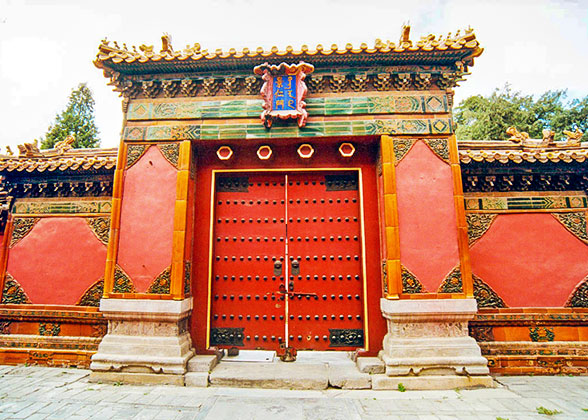
As the name Six Eastern Palaces indicates, this region houses six palaces in the same styles located on the east side of the axis in the Inner Court, which are Palace of Great Benevolence (Jingrengong), Palace of Celestial Favour (Chengqiangong), Palace of Eternal Harmony (Yonghegong), Palace of Great Brilliance (Jingyanggong), Palace of Accumulated Purity (Zhongcuigong) and Palace of Prolonging Happiness (Yanxigong). First built in 1420, these buildings provided living quarters for the imperial concubines. Most were restored during the 17th century and now most have been turned into exhibition halls to display Chinese treasures collected by the imperial family.
The Palace of Great Benevolence faces south. There is a stone screen inside the main entrance, which was said to have dated from the Yuan Dynasty (1271-1368). It has two layers of courtyard with the main building in each yard having penthouses and side halls. It has a pavilion built above a well which was used to wash offerings before they were processed in the Sacred Kitchen. It was the residence for the emperors’ concubines in the Ming Dynasty (1368-144). In the Qing Dynasty (1644-1911), Emperor Kangxi (reign time 1661-1722) was born and lived here temporarily. After that time, it was used by the emperors’ wives.
The Palace of Celestial Favour was named Yongning Gong (Palace of Eternal Tranquility) when it was first built and then given its present name in 1630. It also has two layers of courtyard. It was the residence for high ranked imperial concubines in the Ming Dynasty. In Qing, Emperor Shunzhi’s most favorite wife and Emperor Daoguang’s empress lived here.
 |
| Palace of Great Brilliance |
The Palace of Eternal Harmony was initially called the Palace of Eternal Peace and then changed its name in 1535. It was the residence for imperial concubines in both Ming and Qing Dynasties. Emperor Kangxi’s empress lived here for a long time. It has a well pavilion in the southwest corner. It and Palace of Celestial Favour are now the exhibition halls for more than 15,000 bronze articles, nearly 1,600 of which date from before the Qin Dynasty (221BC-206BC).
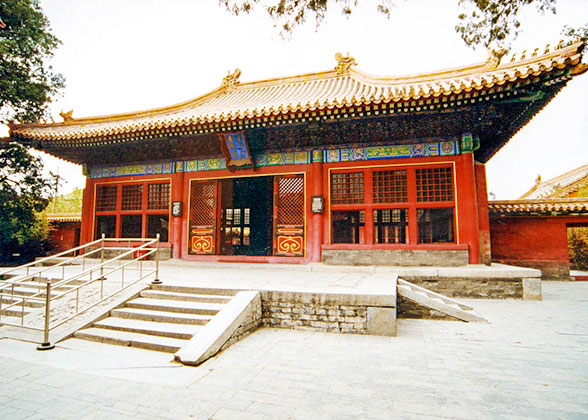
The Palace of Great Brilliance was used as the residence for imperial concubines in the Ming Dynasty. The empress of Emperor Shenzong (reign time 1573-1620) lived here. When it was renovated in 1686 during the reign of Qing Emperor Kangxi, it changed to be used as a library. It is now the exhibition hall to display exquisite gold and silver treasures of the Forbidden City.
The Palace of Purity (also translated as Palace of Gathering Essence) was for imperial concubines and was the place where the crown prince lived during the Ming Dynasty. Emperor Xianfeng (reign time 1850-1861) of the Qing Dynasty spent his childhood here. His empress Ci’an (parallel to Empress Dowager Cixi) lived here from the time she moved to the Forbidden City up till her death. When Emperor Guangxu married his empress, she lived here for a while, as did Qing’s last emperor Puyi. Now, it is the exhibition hall for jade collections.
 |
| Palace of Lasting Happiness |
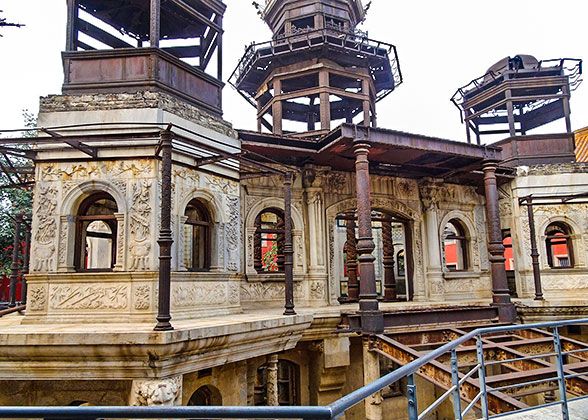
The Palace of Lasting Happiness (Yanxigong) contains an absurd-looking unfinished building in western style. It was called Longevity Palace in the Ming Dynasty and changed its name later in Qing. It was destroyed by fire in 1845 and only the gate survived. It was to have been rebuilt in 1872 but the plan failed. In 1909 during the reign of Emperor Guangxu, the Qing court wanted to build a ‘crystal palace’ on the ruins, a three-decked western building. The walls were two layers of glass with fish swimming between the panes. Each of the palace’s four corners would be connected with a three-decked hexagonal pavilion. As we can see from the abandoned building, its framework is metal and the whole building is mainly built with white marble stones with carvings on the outer wall and porcelain tiles on the inner wall. The exorbitant plan was abandoned due to weak imperial finances. Now it is temporarily used as the exhibition hall for the official kiln porcelain of the Song Dynasty (960-1279) until October 30, 2011.
 Next:
Next:Go northwest to tour the Imperial Garden (Yuhuayuan).
One can also see the Palace of Abstinence (Zhaigong) and the Hall for Ancestry Worship (Fengxiandian) to the south of the Six Eastern Palaces.
 Further Reading: How to visit the Forbidden City
 Reply
Reply 1
1 0ReplyReply10Reply