Hall of Mental Cultivation (Yangxindian)
Built in 1537, the Hall of Mental Cultivation (Yangxindian) stands on the west side of the Palace of Heavenly Purity (Qianginggong). Initially an ordinary hall, it gained prominence as the emperor's administrative hub from 1723. It also played a pivotal role in Chinese history as the venue where Empress Dowager Cixi (1835~1908), a powerful woman, reigned behind a curtain for 48 years.
Closed for nearly a decade for conservation and restoration, the Hall of Mental Cultivation reopens on December 26, 2025, allowing you to explore the emperor's private world authentically restored for the first time in years.
Upon completion in 1537, the Hall of Mental Cultivation served as an occasional palace for emperors to unwind. Emperor Jiajing (1507~1567) even set up an alchemy workshop south of it, seeking the elixir of eternal youth.  Shunzhi's Untimely Demise in the Hall
"Flipping a Sign" in the Hall: A Way to Select Concubine and Minister to Accompany
In 1861, six-year-old Emperor Tongzhi ascended the throne, with the two Empress Dowagers, Cixi (1835~1908) and Ci’an (1837~1881), taking charge in the Hall of Mental Cultivation since he was too young to conduct state affairs. They reigned from behind a curtain for 12 years in the East Warm Pavilion, handing power back to Tongzhi who died a year later. Details of Reigning Behind a Curtain
Next: Here tourists have three choices:
 Far opposite to the Gate of Mental Cultivation, there is Office of Military Strategy, an assistant institution to deal with essential military affairs.
Go east back to the courtyard beween the Gate of Heavenly Purity (Qianqingmen) and the Palace of Heavenly Purity (Qianqinggong), and continue the tour along the central axis.
Go north to the Six Western Palaces (Xiliugong).
Go west to the Palace of Compassion and Tranquility (Cininggong).
 Further Reading: How to visit the Forbidden City
Closed for nearly a decade for conservation and restoration, the Hall of Mental Cultivation reopens on December 26, 2025, allowing you to explore the emperor's private world authentically restored for the first time in years.
History of Hall of Mental Cultivation: From Temporary Stay to Key "Home Office"
1537~1644, Ming Dynasty: Emperor's Leisure Residence & "Alchemy Lab"
|
|


Upon completion in 1537, the Hall of Mental Cultivation served as an occasional palace for emperors to unwind. Emperor Jiajing (1507~1567) even set up an alchemy workshop south of it, seeking the elixir of eternal youth.
1644~1661, Beginning of Qing Dynasty: Emperor Shunzhi's Living Quarter
The Ming emperors usually resided in the Palace of Heavenly Purity, but the first Qing emperor, Shunzhi (1638~1661), saw it as a symbol of a fallen dynasty and opted instead for the Hall of Mental Cultivation. It was here that he lived and ultimately passed away.
Shunzhi's Untimely Demise in the HallTragedy struck repeatedly during Emperor Shunzhi's reign (1644~1661), with the loss of his son, concubine, and wet nurse. Deeply distressed, his health declined rapidly. Just 10 days after his beloved concubine Dong'e passed, he succumbed to smallpox at 24, in the East Warm Pavilion of his chosen home.
1662~1708, Early Qing Dynasty: Emperor Kangxi's Royal Workshop
|
|


From 1662 to 1708, the Hall of Mental Cultivation housed the imperial workshop, gathering top craftsmen and sourcing finest materials like red sandalwood, scented rosewood, and mahogany wood, as well as precious metals, and gemstone inlays. Specializing in furniture, clocks, and other imperial items, the workshop even crafted ornate weapons, such as fire lances and swords adorned with gold and jade.
1723~1861, Early to Late Qing Dynasty: Emperor's Household & Political Center
After Emperor Kangxi's death in 1722, Emperor Yongzheng (1678~1735) mourned in the Hall of Mental Cultivation.
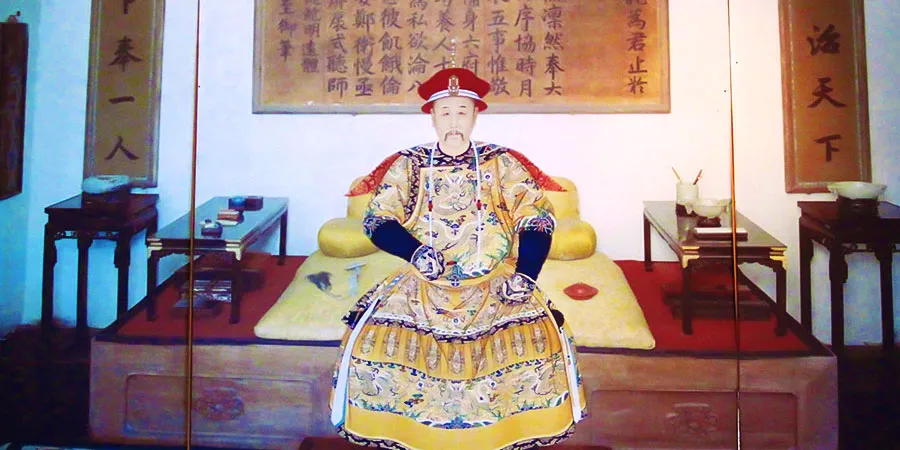 |
| Emperor Yongzheng in the Hall of Mental Cultivation |
According to Qing rituals, upon completing mourning, the successor emperor was to move to the Palace of Heavenly Purity. However, Yongzheng, feeling overly sentimental about his father's long-time residence, chose to make the Hall of Mental Cultivation his permanent palace for living and disposing of state affairs.
This remained the case until 1924, when the last emperor, Puyi (1906-1967), left the Forbidden City.
"Flipping a Sign" in the Hall: A Way to Select Concubine and Minister to AccompanyBefore dinner, a eunuch would bring a tray with small green signs inscribed with the names of the concubines to the emperor. By flipping a sign, the emperor would decide which concubine to share his bed.
For minister meetings, the emperor flipped red (especially for nobles) and green signs before breakfast. The chosen minister would discuss affairs with the emperor post-meal.
1861~1908, Late Qing Dynasty: Reigning Behind a Curtain
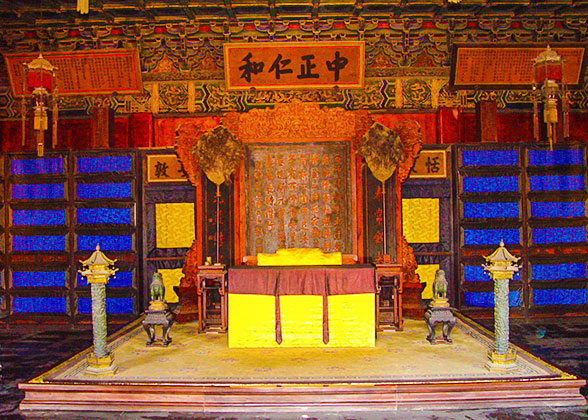 |
Inside Hall of Mental Cultivation Hall of Mental Cultivation Photos Hall of Mental Cultivation Photos |
In 1875, four-year-old Emperor Guangxu (1871~1908) succeeded him, with the Dowagers continuing their reign. When Empress Dowager Ci'an passed away in 1881, Empress Dowager Cixi assumed sole control, wielding power until her death in 1908.
Details of Reigning Behind a CurtainDuring these sessions, the young emperor sat in the front, while the Empress Dowagers sat behind a yellow gauze curtain. Ministers knelt before the emperor, addressing him but actually conversing with the Dowagers. Decisions were made by the Dowagers, who also reviewed all memorials and edicts drafted by ministers.
1908~1924, Late Qing Dynasty to Republic of China: The Last Emperor Puyi's Household
In 1908, three-year-old Puyi ascended the throne. He resided in the Hall of Mental Cultivation, assisted by Empress Dowager Longyu (1868~1963) and elder princes in governance.
 |
| Screen Gate of the Hall of Mental Cultivation |
On February 12, 1912, Longyu, with Puyi, issued the abdication edict in the Hall, bringing an end to a 2,132-year-old monarchy that had seen 492 emperors in China’s history. Despite his abdication, Puyi continued to enjoy privileges and resided in the Hall of Mental Cultivation.
However, on November 5, 1924, a coup forced people in the Forbidden City to evacuate within three hours. Alarmed, Puyi sent people to negotiate while hastily packing his belongings. The bed was left in disarray, marking the final moments of the Qing emperors in the Hall of Mental Cultivation.
Layout
|
|

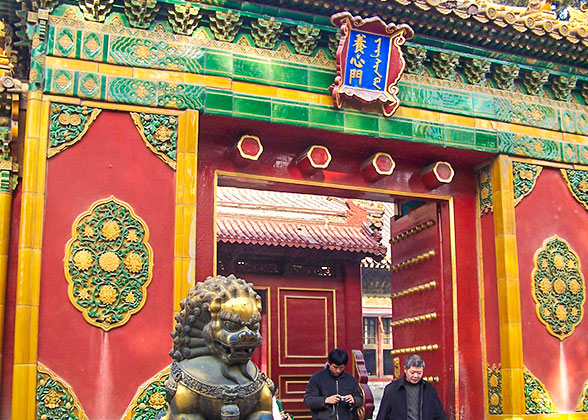
The Hall of Mental Cultivation, an enclosed courtyard covering 5,000 square meters (53,820 square feet), stretches 63 meters (207 feet) north to south and 80 meters (262 feet) east to west, housing over ten buildings and 160 rooms. It's divided into three sections: the outer, front, and backyard.
The outer courtyard, nestled inside the Gate of Following Morality (Zunyimen) and south of the Gate of Mental Cultivation (Yangxinmen), is a narrow, elongated space of about 14 meters (46 feet).
Upon entering the Gate, visitors will find themselves in the front courtyard, dominated by the Hall of Mental Cultivation itself.
The backyard mainly features the rear sleeping chambers and six rooms each on the east and west sides.
Flowers & Snow Sculptures in the Courtyard
 |
| Front Yard, Hall of Mental Cultivation |
Apricot trees, peach trees, plum blossoms, and other flora used to adorn the courtyard. From Puyi’s old photos during 1922~1924, we can glimpse the front courtyard of the Hall of Mental Cultivation, where various flowers flourished, resembling a flower garden.
During heavy snowfall, intricate snow sculptures like lions and elephants were made in the courtyard. In 1818, a snow recumbent horse also adorned the space, bringing the home office to life in the treeless season.
Architectural Highlights
Hall of Three Treasures: Emperor's Treasure Chest
 |
| Royal Wall Vases |
On the western side of the Hall lies a small, exquisite compartment, well-lit and warm in winter, used as the emperor's reading room. Once called the "Greenhouse", it was renamed "Three Treasures" in 1746 after storing three rare calligraphy treasures.
Despite its modest 8 square meters (86 square feet), it boasts 110 precious relics. For example, the walls are adorned with wall vases shaped like half a vase, filled with flowers crafted from jewels. A single wall vase is now valued at around CNY 3 million.
Hall of Diligent Governance & the Most Diligent Emperor Yongzheng
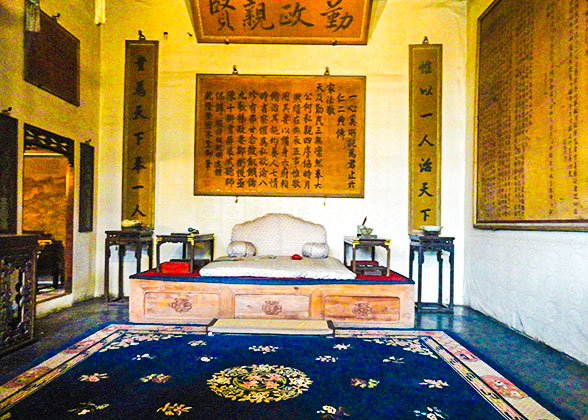 |
| Hall of Diligent Governance |
Yongzheng, renowned as the most diligent emperor in the Qing Dynasty, dealt with over 192,000 official documents, averaging 40 per day. In the Hall of Mental Cultivation's western warm chamber, he often worked late into the night, sleeping for less than 4 hours a day, and only rested on his birthday.
To remind himself of diligence, he wrote "Diligent Governance and Affinity with the Virtuous" on a plaque in 1678, earning the chamber the nickname "Hall of Diligent Governance" and leaving behind the hall's earliest preserved calligraphy.
Eastern Warm Chamber: Ruling behind a Curtain & Writing with the First Beam of Spring Sunlight
The Hall's Eastern Warm Chamber retains the original setting of Empress Dowager Cixi's reign behind a curtain. Visitors can witness the emperor's dragon throne, the sofa bed where the empress dowager conducted state affairs, and the yellow curtain separating them.
|
|


In the southwest corner of the chamber, there's a cozy compartment where the emperor would spend his winters. As Chinese Spring Festival approached, he would sit at his desk, sip wine, light a candle, dip his brush in vermilion ink, and write phrases and numbers on a silk banner. The content he wrote was considered auspicious, believed to bring peace and prosperity to the coming year.
Next: Here tourists have three choices: Far opposite to the Gate of Mental Cultivation, there is Office of Military Strategy, an assistant institution to deal with essential military affairs. Go east back to the courtyard beween the Gate of Heavenly Purity (Qianqingmen) and the Palace of Heavenly Purity (Qianqinggong), and continue the tour along the central axis. Go north to the Six Western Palaces (Xiliugong). Go west to the Palace of Compassion and Tranquility (Cininggong). Further Reading: How to visit the Forbidden City
- Last updated on Dec. 25, 2025 by Jally Zhang -