Gate of Heavenly Purity (Qianqingmen)
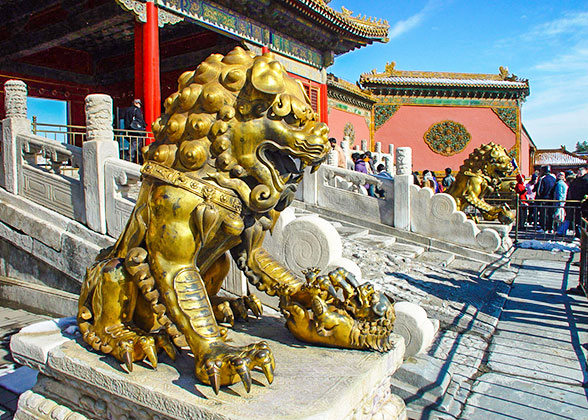 |
| Lion Statues in front of Gate of Heavenly Purity  Photos Photos |
The Gate of Heavenly Purity was established in 1420 and rebuilt in 1655. Five bays wide, three bays deep and sixteen meters high, it is a structure with single-eaved roof, resting on the 1.5-meter-high white marble base of Buddhist-style building surrounded by carved stone balustrades.
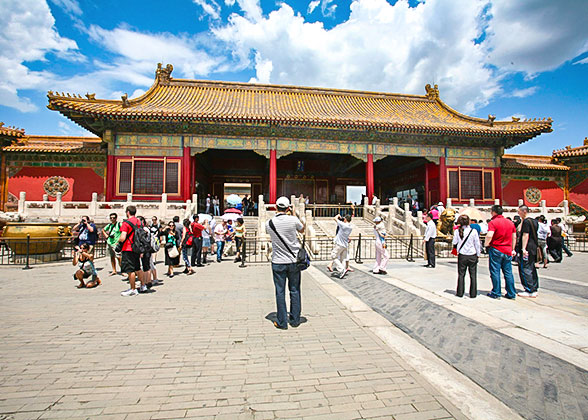 |
| Gate of Heavenly Purity |
Outside the gate there are four huge gleaming, gilded bronze vats. Although they are decorative, their prime function was to hold vast amount of water to fight the outbreak of fire. Each of these vats weighs four tons and would contain over two hundred gallons of water. Three hundred and eight vats spread around the Forbidden City, twenty-two of which are of the same design as those seen here.
In year 1644, the first emperor of the Qing Dynasty, Emperor Shunzhi (1644-1661), issued the Bill of Oblivion at this gate. During the following period of the Qing Dynasty, some emperors held court here. Ministers and officials would gather here at dawn waiting for the emperor to come. A temporary throne was set and the emperor would sit here to listen to memorandums presented to him by the kneeling ministers in the order of those in charge of the boards of Revenue, Rites, War, Works and Civil Office. Decisions would be made by the emperor. As the most diligent of the Qing emperors, Emperor Kangxi ruled for 61 years from 1662 to 1722 and made many important decisions here. However, after the reign of Xianfeng (1851-1861), no more courts were held here.
 Next:
Next:
Go further north to see the three grand halls of the Inner Court: Palace of Heavenly Purity (Qianqinggong)Hall of Celestrial and Terrestial Union (Jiaotaidian)Palace of Earthly Tranquility (Kunninggong)
One can also see the Palace of Abstinence (Zhaigong) on the east, and the Hall of Mental Cultivation (Yangxindian) on the west.
If time permits, before entering the Gate of Heavenly Purity, one can turn east to see the Hall for Ancestry Worship (Fengxiandian), or turn west to explore the Palace of Compassion and Tranquility (Cininggong). Further Reading:
How to visit the Forbidden City
Ancient Alarm System in the Forbidden City
Interesting Animal Statues in the Forbidden City
 Reply
Reply 3
3 1
1