Hall of Celestial and Terrestrial Union (Jiaotaidian)
 |
 Hall of Celestial and Terrestrial Union Video Hall of Celestial and Terrestrial Union Video Photos Photos |
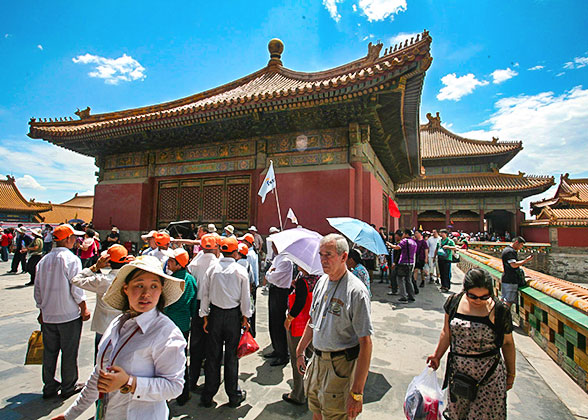
Also named the Hall of Union and Peace, the Hall of Celestial and Terrestrial Union is one of the three main palaces in the Inner Court of the Forbidden City. It is between the other two main palaces, the Palace of Heavenly Purity (qianqinggong) and the Palace of Earthly Tranquility (Kunninggong). It was established in the reign of Jiajing (1522-1566) of the Ming Dynasty (1368-1644), and was restored twice in 1655 and in 1669. In 1797, it was damaged by a fire and thus rebuilt the next year.
It is a single-roof structure with a gilded bronze spherical pinnacle. Square in shape, it is three bays wide and three bays deep, smaller than the Hall of Central Harmony (zhonghedian) which is a similar architectural style. The name was adopted from the Book of Changes, meaning the union of heaven and earth, and peace and harmony of the whole nation in Chinese. In view of the authoritarian role of eunuchs in the Ming Dynasty, Emperor Shunzhi (1644-1661) ordered to place an iron sign forbidding the eunuchs’ interference into government affairs here.
Qianqiu Festival Celebration
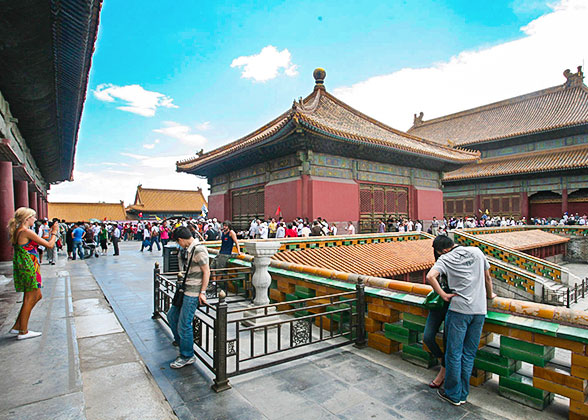 |
| Hall of Celestial and Terrestrial Union |
In the Qing Dynasty, on the Qianqiu Festival, the birthday of the empress, the empress held celebrations in the Hall of Celestial and Terrestrial Union and received worship and congratulations from high-ranked concubines, princesses and other court ladies. On the occasions of the Winter Solstice and the Spring Festival, people also came here to pay their respect for the empress.
Jade Royal Seals Storage
Big Chime Clock
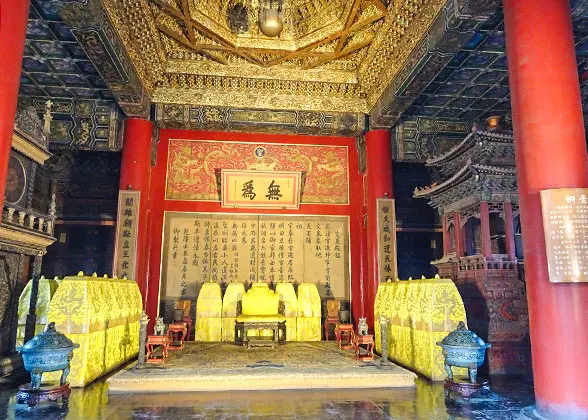 |
| Inside the Hall |
The big chime clock in the Hall of Celestial and Terrestrial Union was fabricated in 1798, the third year of the reign of Jiaqing (1796-1820). The shell is a wooden tank imitating the style of a Chinese pavilion. With a total height of 5.80 meters, the clock has three tiers. At the back of the clock there is a stair, step on which people can wind the clock. The chime clock has run for more than two centuries, yet its chime is as clear and stentorian as ever. What superior craftsmanship!
Bronze Clepsydra
 Next:
Next:
Go north to visit the Palace of Earthly Tranquility (Kunninggong). Further Reading: How to visit the Forbidden City