Hall of Preserved Harmony (Baohedian)
 |
Hall of Preserved Harmony  Photos Photos |
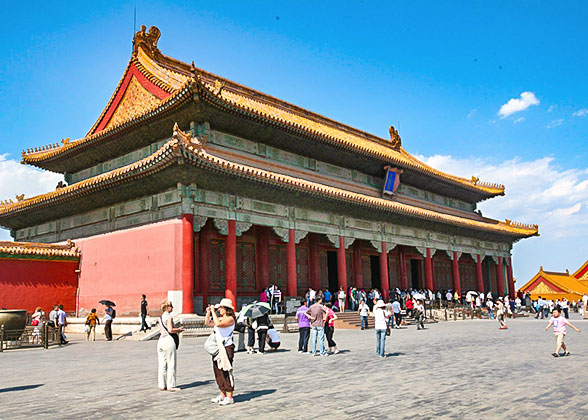
To reach the Hall of Preserved Harmony, visitors can enter through the Meridian Gate at the southern tip of the Forbidden City and proceed north along the central axis, passing by the Hall of Supreme Harmony and the Hall of Central Harmony in succession.
When Built – History of the Hall of Preserved Harmony
 |
| Hall of Preserved Harmony |
Consequently, the main structure of the Hall of Preserved Harmony today retains the form of Ming Dynasty in 1420, while its decorations reflect the Qing Dynasty style from 17th to 18th century.
What were the functions of the Hall of Preserved Harmony?
Ming Dynasty: Emperor's Temporary Dressing Room
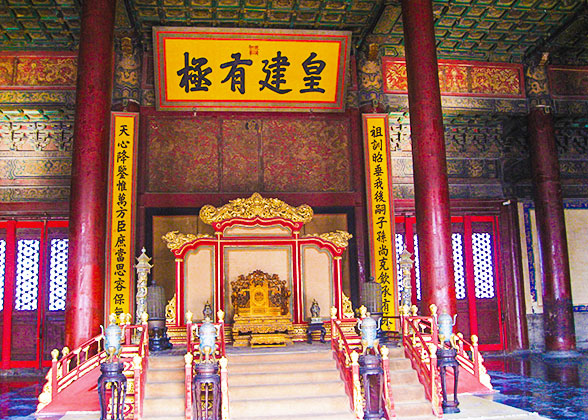
The Ming Emperors would usually change into their ritual garments here prior to the ceremonial installation of an empress or crown prince.
 |
| Inside the Hall of Preserved Harmony |
Qing Dynasty: First for Banquets, and then for National Examination
While during the Qing dynasty, the Hall of Preserved Harmony was usual for imperial banquets to be held here. Such banquets might be to celebrate a princess's marriage. The emperor would entertain high officials, the bridegroom and his father together with their relatives who served the imperial government. Each year, on the eve of the New Year's Eve, banquets would be held to feast and honor provincial governors, Mongol princes, civil and military officials.
In 1789, the midpoint of the Qing dynasty, Emperor Qianlong decided the final stage of the Palace Examination should be transferred from the Hall of Supreme Harmony to the Hall of Preserved Harmony. This was the highest level of the nation-wide imperial examination system and the emperor would honor the top ten successful candidates by reading the papers they had submitted.
Must-See Highlights: Largest Stone Sculpture & Thousand-Dragon Drainage System
Huge Stone Carving
 |
| Huge Stone Carving |
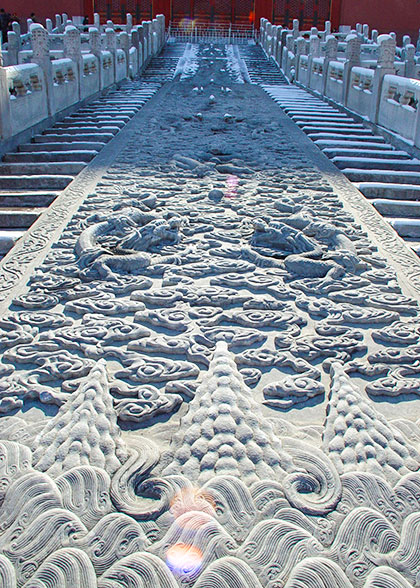
Behind the Hall of Preserved Harmony, in the center of the stairway, is a huge marble relief of nine dragons playing with pearls. It is the largest stone sculpture in the Forbidden City. Sculpted originally in the Ming dynasty, it was re-sculpted in the Qing dynasty. During these dynasties, anyone who was caught touching this holy stone would receive the death penalty!
Weighing about 250 tons, the marble slab is 16.57 meters (54.36 feet) long, 3.07 meters (10.07 feet) wide and 1.7 meters (5.58 feet) thick. The huge stone was hauled into the palace all the way from Fangshan, up to 70 kilometers (43.49 miles) from Beijing. This difficult task took about a month employing twenty thousand men and thousands of mules and horses.
It is said that a well was dug every 500 meters along the way and the well water was poured on the ground so as to form an icy road which could facilitate land boat transportation.
Dragon-Head Drainage Spout
There are 1,412 marble dragon heads below the columns of the three-tier terrace on which the three main halls stand. Chinese artisans cleverly combined the drainage system with these architectural features. On rainy days, visitors will have a chance to enjoy the spectacular sight of a thousand dragons disgorging water. Once you get a chance to actually visit the Forbidden City, please note the spouts in the dragons' mouths.
 |
| Dragon-head Water Spout |
 Next: Here tourists have three choices:
 Continue to tour along the central axis: go north across the Qianqingmen Square to see the Gate of Heavenly Purity (Qianqingmen), the entrance to the Inner Court. Go east through the Gate of Great Fortune (Jingyunmen) to see the Hall for Ancestry Worship (Fengxiandian), which houses the Gallery of Timepieces. If time permits, one can explore further east to the Palace of Tranquil Longevity (Ningshougong), a large building complex where the Treasure Gallery is located. Go west through the Gate of Great Ancestors (Longzongmen) to explore the Office of Military Strategy, Palace of Compassion and Tranquility (Cininggong), and Sculpture Gallery.
 Further Reading:
How to visit the Forbidden City