Hall of Supreme Harmony, Taihedian in Chinese, the largest and most prestigious structure within the Forbidden City, served as the venue for the Ming (1368~1644) and Qing (1644~1911) dynasties' most solemn national ceremonies, such as coronations and imperial weddings. The name “taihe” embodies the wish for the harmony between heaven and earth, symbolizing the emperor's supreme power.
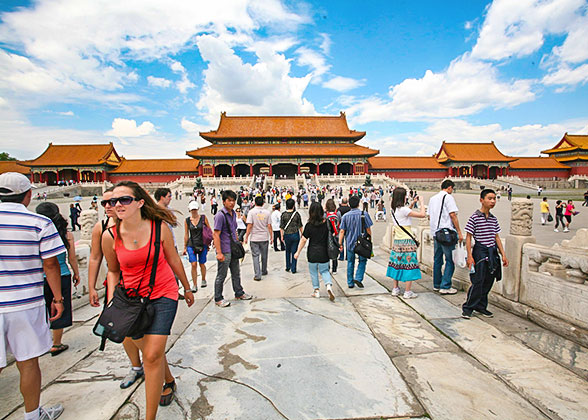
After visiting the Gate of Supreme Harmony (Taihemen), go across a spacious square that covers 30,000 square meters (32,292 square feet) and start your Hall of Supreme Harmony journey.
Functions: Imperial Power Center & Essential Ceremony Venue
As the heart of the Forbidden City, the so-called Golden Carriage Palace, used to be the place where emperors received high officials and exercised their rule over the nation.
Grand ceremonies would be held here when a new emperor ascended the throne. Celebrations also marked emperors' birthdays, wedding ceremonies and other important occasions such as the Winter Solstice, the Chinese New Year and the dispatch of generals into fields of war.
Built According to Highest Architectural Standards
Since it was the symbol of supreme imperial power, it was the highest structure in the empire during the Ming and Qin dynasties. No other building was permitted to be higher anywhere in the empire.
The heavily glazed hall is 35.02 meters (114.9 feet) high (37.44 meters/123.16 feet including the rooftop decoration). It is 63.96 meters (210 feet) in width and 37.2 meters (122.04 feet) in length respectively. There is a total of 72 pillars, in six rows, supporting the roof. The doors and windows are embossed with clouds and dragons.
Symbolic Exterior Furnishings
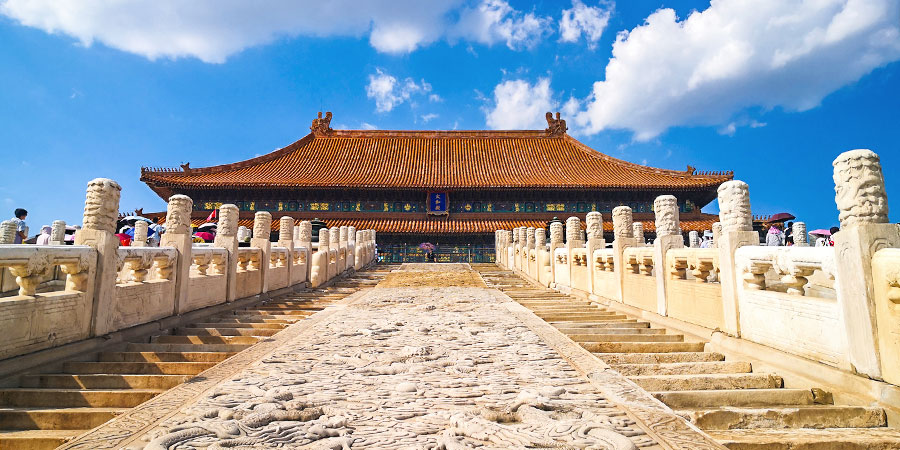
Surroundings of the Terrace
Alongside the flights of steps which ascend the three tiers of the terrace, there are eighteen bronze Dings, a kind of ancient Chinese vessel, representing the eighteen national provinces of those times.
Bronze Ding
On the luxuriously balustraded terrace, stand a bronze crane and a bronze tortoise, symbols of everlasting rule and longevity.
Bronze Turtle
Bronze Turtle
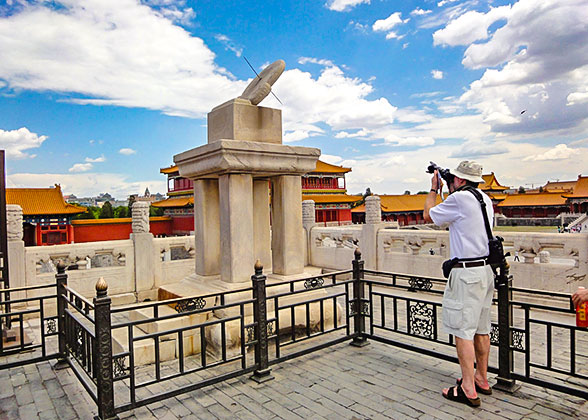
Sundial
At the east corner of the platform is a sundial made of white marble. It has a circular dial with a metal gnomon in the center, mounted on a base supported by four square pillars with three steps on the south side for viewing the shadow. It is a timekeeper working by using sunlight. Opposite to it, there is a marble sauqre pavilion named Jialiang for measuring grains in ancient times. Together, they meant the emperor brought order to both time and fairness to measurement.
Decorations of the Roof
Gaze up to the hall, and you'll be awestruck by its grand double-eaved roof – the pinnacle of ancient Chinese palace architecture. Perched at the ridge's ends are roof ornaments, each from 13 pieces of colored glaze.
Double-eaved Roof
Angle of the Eave
The real highlights are the ten glazed auspicious animals guarding the eaves corners, including dragons, phoenixes, lions, celestial horses, and a whole host of mythical creatures you've probably never heard of before. They're symbols of good fortune, protection from evil, and the triumph of justice over adversity.
Auspicious Animals on the Roof
Spectacular Inner Decorations
Imperial Throne: Where Emperors Reign & Dragons Roam
As a symbol of imperial power, the throne, standing on a two-meter (6.6 feet) high platform, is located in the center and surrounded by six thick gold-lacquered pillars decorated with dragons. Dragons are carved all over the golden throne.
Dragon Throne
Around the throne stand two bronze cranes, an elephant-shaped incense burner and tripods in the shape of mythical beasts. It is heavily decorated with dragons, giving an aura of solemnity and mystery.
Is the throne really made of pure gold?
Well, it may shine like gold, but it's not solid gold inside. Artisans used a technique to make gold finely ground and mixed with special glue, then carefully brushed onto a sandalwood dragon throne. After the glue dries, a layer of transparent lacquer is added to give it that dazzling golden glow.
Dragon & Pearl Ceiling: The Legitimate Emperor Detector
In the middle of the ceiling is the design of two dragons playing with glass balls painted with mercury. The central ball, known as the Xuanyuan Mirror, was said to be able to detect a usurper of the imperial power. If anyone who was not the descendant of the legitimate emperor usurped the throne, the pearl would drop down and strike them dead.
In 1912, Yuan Shikai forced the last emperor Puyi of Qing Dynasty to abdicate and then ruled China for 83 days. While ascending the throne in the Hall of Supreme Harmony, he was so terrified of the Xuanyuan Mirror dropping on him that he ordered the throne to be moved back three meters (9.8 feet). He later replaced it with a stylish Western high-back chair.
Fortunately, the original throne was found in storerooms, and positioned three meters back from its original spot.
When was it built – History of Hall of Supreme Harmony
Front Square of Hall of Supreme Harmony
It was first constructed in 1406 and completed in 1420, undergoing many later repairs and reconstruction. Today, what you see is a version rebuilt in 1695, during the reign of Emperor Kangxi in the Qing Dynasty.
Renaming History of the Hall of Supreme Harmony
Hall of Heavenly Mandate (1420)
Emperor Yongle (1360~1424) named the palace the Hall of Heavenly Mandate, echoing the name of the main hall in Nanjing’s Forbidden City, to emphasize his divine right to rule.
Hall of Imperial Supremacy (1562)
Later, Emperor Jiajing (1507~1567), once a local vassal king, renamed the palace the Hall of Imperial Supremacy. Chosen to rule when the previous emperor left no heir, Jiajing picked this name to show that his reign was legitimate, steeped in tradition, and free from any doubts.
Hall of Supreme Harmony
Hall of Supreme Harmony (1645)
When the Qing Dynasty came to power, they renamed the palace the Hall of Supreme Harmony, meant to show their dedication to peace and unity. By doing so, they hoped to win the hearts of the diverse people they governed.
Hall of Divine Inheritance (1915)
In 1915, Emperor Yuanshikai renamed the palace Divine Inheritance, paying homage to the Hall of Heavenly Mandate concept in 1420.
 Is the throne really made of pure gold?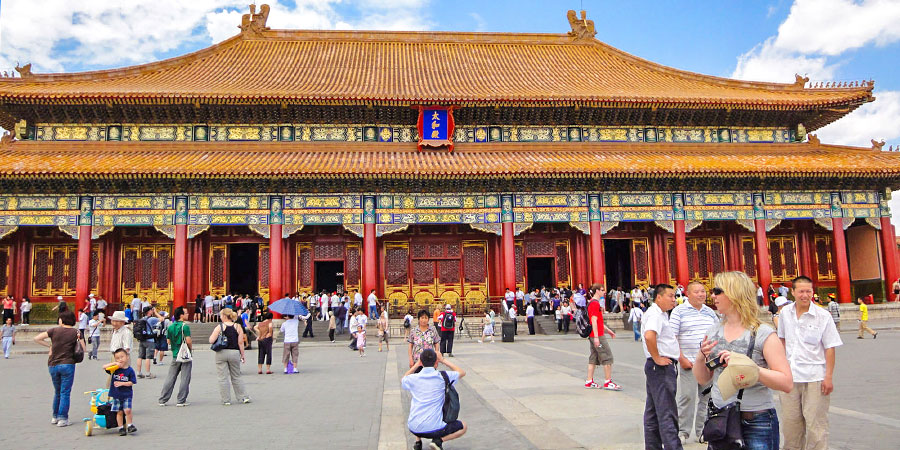





 Further Reading: