Wulong Karst National Geology Park
 Wulong Karst National Geology Park, an important part of South China Karst, is situated at the lower reaches of the Wujiang River in southeast Chongqing. It was named as a world natural heritage by UNESCO in 2007. Wulong Karst features spectacular karst landscapes, including the three main parts of Furong Cave, Three Natural Bridges, Houping Giant Doline (Houping Tiankeng) and other scenic spots.
Wulong Karst is a valuable treasure that nature created. It is a cluster of several karst landscapes, consisting of gorges, natural bridges, caves, eroded dolines, shafts and underground streams. These karst landforms developed in the carbonate rocks, vividly recording the development and evolution of karst terrain in the Three Gorges area since Pleistocene Era. Furong Cave, Three Natural Bridges and Houping Giant Doline are the three representative karst landforms, developing under the condition of intermittent uplifting movement of the earth.
Each of the three karst systems standing alone forms a spectacular landscape. Furong Cave, literally Lotus Cave, abounds with various karren sediments forming many splendid natural wonders. The limestone sediments are also of great significance in scientific study. The three natural bridges constitute the largest natural bridge cluster in Asia, and the natural karst bridges are quite high and grand, a sight rarely seen anywhere in the world. Houping Giant Doline is the prime example and the largest tiankeng cluster formed by erosion in the world, and the longest underground cavern system in Asia.
Compared with Stone Forest Karst in Yunnan and Libo Karst in Guizhou, Wulong Karst National Geology Park is located in a relatively remote area away from the impact of human activities. Therefore, Wulong Karst retains the original features of karst landforms that have been despoiled elsewhere, hence its outstanding universal value.
Three Natural Bridges
 Three Natural Bridges in Wulong Karst National Geology Park is located 12 miles (20 kilometers) southeast of Chongqing City. It is a rare geological wonder and an eco-tourist's delight. It features three natural karst bridges: Tianlong Bridge, Qinglong Bridge and Heilong Bridge. The three natural karst stone arch bridges, with an average height of over 656 feet (200 meters), and an average span of over 656 feet (200 meters), constitute the largest natural bridge cluster in Asia.
The three natural bridges of Wulong Karst National Geology Park are situated in a 0.7 mile (1.2 km) long gorge. They evolved due to tectonic uplift and the erosion by underground water. Some parts uplifted forming the bridges, and others collapsed to form karst pits. Therefore, the unique landscape of 'Three Natural Bridges enclosed with Two Pits' is solely nature's creation.
Tianlong Bridge is about 656 feet (200 meters) in height, 328 feet (100 meters) in width. It spans 1,476 feet (450 meters), and has two arches from south to north. The south arch was also called Mihun Cave. The northern arch is a passage. Qinglong Bridge is about 1,148 feet (350 meters) high, 492 feet (150 meters) wide, and spans over 1,312 feet (400 meters). After the rains, a waterfall pours over the bridge and forms a mist. When the sunset reflects on the mist, a colorful rainbow emerges like a dragon ascending to the heaven. Heilong Bridge has a deep and long arch passage, like a black dragon winding its way out from the passage. Heilong Bridge is also renowned for its four springs with tortuous trickles of stream. The Three Natural Bridges is a karst stone arch bridge cluster unrivalled elsewhere of Asia in terms of height and the thickness of the bridge surface. It is magnificent.
The Three Natural Bridge Scenic Area provided some of the settings for the 2014 Hollywood blockbuster Transformers 4: Age of Extinction. A model of Optimus can be seen at the entrance..
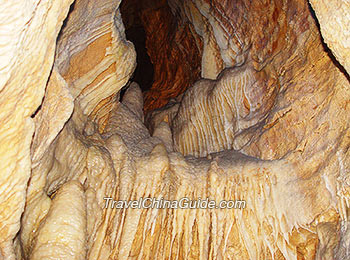
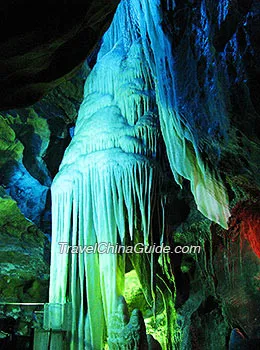 Furong Cave, located on the bank of the Furong River in Jiangkou Town, Wulong County, is the only cave in China that was listed in 'World Natural Heritage List'. Together with Mammoth Cave in the US, and Graemes Cave in France, it was named one of 'The Three Greatest Caves in the World'.
It is a large limestone cave, formed in the carbonate rocks of Cambrian-Ordovician Period. Furong Cave is abundant with various speleothems, which shape the dazzling karst landscapes.
Furong Cave of Wulong Karst National Geology Park is about 2,700 meters (8,858 feet) long, enclosing an area of 37,000 sq meters (44,251 sq yards). There are 100 species of sediment varying from carbonate to sulphur and over 300 scenic spots in the cave. The Glory Hall, covering an area of 11,000 sq meters (13,156 sq yards), is the most spectacular. The magnificent stelae, stalagmites and stalactites are splendid and astonishing to the eye. The huge stone waterfall and curtain are 15 meters (49 feet) in width and 21 meters (69 feet) in height, which are quite grand. The palm-shaped stalagmites are as smooth as jade. The texture of the stalagmites is delicate and pure, which is rare elsewhere. The red coral and calcite are very precious.
The accumulation and breakage of stalagmites records the evolution of the limestone in the cave. Numerous and varied speleothems demonstrate the amazing force of nature. The beautiful scene is a wonder that nature created. Professor Zhu Xuewen, the chairman of the China Cave Association, sings high praise to Furong Cave. He sees it as 'a bright-colored and splendid underground arts palace'.
In 1993, Furong Cave was discovered by local farmers, and was opened to the public in June 1994. It was appraised as 'one of the best caves open to tourists in the world' by Mr. Andy, the Vice Chairman of World Cave Association.
Houping Giant Doline
Houping Giant Doline (Houping Tiankeng) in Wulong Karst National Geology Park is situated at Houping Town, 88 kilometers (55 miles) from Wulong County. It is the first tiankeng cluster type of erosion discovered in the world.
A tiankeng refers to a karst doline or sinkhole, measuring at least 100 meters (328 feet) in depth and in diameter. Based on the cause of formation, tiankengs can be divided into two types: collapsed tiankengs and eroded tiankengs. Collapsed tiankengs are common, while eroded tiankengs are quite rare. The Houping Tiankeng cluster is the finest example of an eroded tiankeng.
The Houping Giant Doline developed in the soluble limestone of Ordovician Period. It is an integrated karst ecosystem, consisting of gorges, dolines, shafts and underground caves, which demonstrate the various stages of the evolution of karst terrain.
Covering a total area of 150,000 sq meters (179,398 sq yards), the Giant Doline is mainly composed of five smaller tiankengs. Located in a primitive forest, the five tiankengs well preserve the features of karst landforms. The cylindrical tiankengs are huge, measuring about 300 meters (984 feet) both in diameter and depth. At the bottom of tiankengs, there are spacious underground caves, in which larger tiankengs hide. Among the five tiankengs, Qingkou Tiankeng is the most typical one. It has integrated morphologic features, providing strong evidence of geological evolution. The pithead takes an oblong shape, and has a depth of about 300 meters (984 feet). From an overview from the pithead, the tiankeng seems to be boundless and beyond measurement. From a view from the bottom of the tiankeng, the steep walls extend to the vault of heaven. The floating white clouds and azure sky make visitors they have escaped from earthly triviality.
The Giant Doline cluster, endowed with so many wonders by nature, is not only a tourist draw, but also an ideal place for scientific study of the geological evolution. Explorers from both at home and abroad have been drawn here.
Other Attractions
Longshuixia Fissure Gorge, Fairy Mountain (known as Xiannü Mountain in Chinese) and Two Giant Dolines are the other three important scenic spots in Wulong Karst National Geology Park. The 4-kilometer-long (2.5 miles) Longshuixia Fissure Gorge is a typical Karst landscape, which came into being in the orogeny tens of millions years ago. The Fairy Mountain, located in the north bank of Wujiang River, owns a peak like a fairy, hence the name of the mountain. The mountain park occupies an area of 5,070 hectares (12,530 acres), and the average elevation is 1,850m (2,020 yards). It mostly consists of limestone, which is advantageous for formation of Karst landscape. In the scenic area of Two Giant Dolines, visitors can experience the local Tujia life and enjoy the folklore performances.
How to Get to Wulong Karst National Geology Park from Chongqing
Train
Long-distance Bus
2. Take a bus from West Nanchuan Bus Station, West Daxuecheng Bus Station, or Yubei Shuangfengqiao Bus Station to Wulong Bus Station. Upon arrival, take a taxi to Xiannü Town Tourist Center.
 From Xiannü Town Tourist Center, visitors can take special tourist bus line to Three Natural Bridges & Longshuixia Fissure Gorge. It costs CNY 9 and takes 40 minutes. To Furong Cave, visitors need to catch a bus from Wulong Bus Station to Jiangkou Town. Then, transfer to another tourist bus to the cave.
| Entrance Fee | Mar. - Oct. | Nov. - Feb. |
|---|---|---|
| Fairy Mountain | CNY 50 | CNY 50 |
| Furong Cave | CNY 80 | CNY 65 |
| Three Natural Bridges | CNY 70 | CNY 40 |
| Longshuixia Fissure Gorge | CNY 115 | CNY 115 |
| Two Giant Dolines | CNY 120 | CNY 115 |
| Opening Hours | 8:30 - 16:30 | 9:00 - 16:00 |
Top 10 Things to Do in Chongqing
 Reply
Reply 0
0 0ReplyReply
Thank you for your answer.
00Reply00ReplyReply00Reply00ReplyI'm afraid of getting lost after getting off the train...
Thank you
00Reply00Reply00Reply00Reply00ReplyReply00ReplyReply00Reply00Reply