Dazu Rock Carvings
Basic Facts
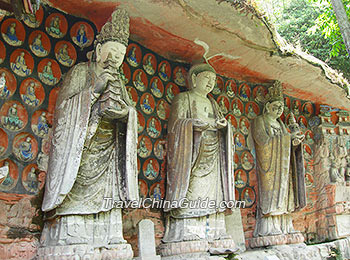
Dazu Rock Carvings contains all the cliffside carvings in Dazu County. The collection is composed of the rock carvings in Beishan, Baodingshan, Nanshan, Shimenshan as well as Shizhuanshan, all of which are of the highest artistic attainment and demonstrate the most exquisite skills.
|
|
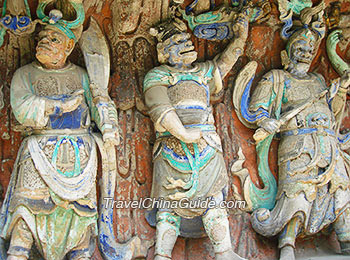
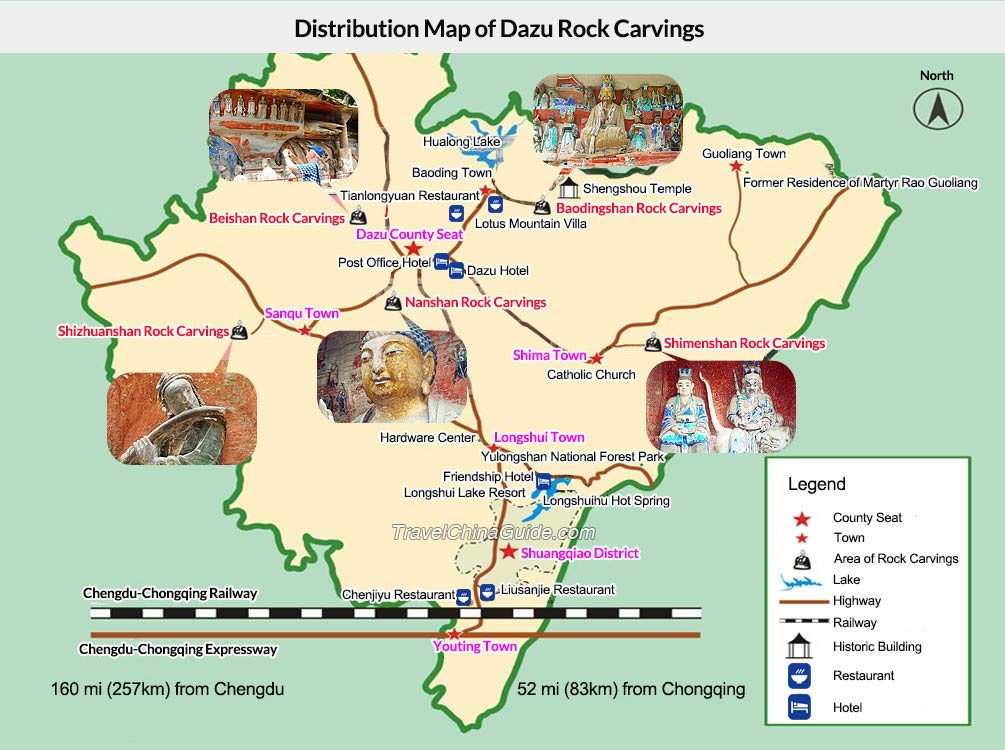
Dazu Rock Carvings was built from 650 in the Tang Dynasty and continued to the Ming Dynasty (1368-1644) and the Qing Dynasty (1616-1911). It is as famous as the Mogao Caves in Dunhuang, Gansu Province. The rock carvings in these places are very distinguished both at home and abroad. Among the rock carvings, there are more than 50,000 statues and over 100,000 Chinese characters of inscriptions and epigraphs. The Buddhist statues dominate in this rock carving group, and the Taoist and the Confucian stone figures can also be seen.
Beishan Rock Carving
It is 1.2 miles (about 2 kilometers ) away from the northwest of Dazu County. Figures in this part are something like 'an Assembly of Oriental Beauties', since it enjoys good preservation and elaborate craftsmanship. Tourists can see the graceful statue of Samantabhadra Bodhisattva, crowned as 'the Oriental Venus'. Rock carvings in this part reveal the common Buddhist faith. Standing here for a while, one may feel that it is really a Buddhist palace.
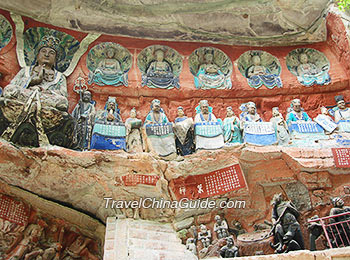 |
| Beishan Rock Carvings |
Baodingshan Rock Carving
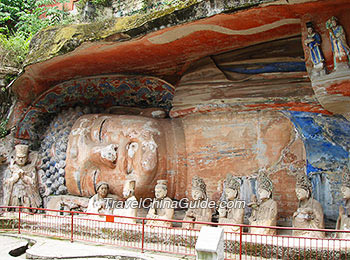
It is 9 miles (about 15 kilometers) from the northeast of Dazu County. It is made up of 13 groups of stone carving figures, totaling nearly 10 thousand cliffside figures. In this part, magnificent rock figures in different shapes compose a story. One will see some original and ethnic Buddhist rock features.
|
|
Nanshan Rock Carving
Standing at the southeast of Dazu County, the Taoism doctrine is the main theme in this part. Taoist gods' figures are carved vividly. The cave of Sanqing demonstrates the Taoist gods' ranking in the Song Dynasty (960-1279). Therefore, tourists will be impressed by these colorful clay creations.
Shizhuanshan Rock Carving
This section is 16 miles (about 25 kilometers) far from the southwest of Dazu County. The niche of Confucius and that of Lao Tzu can be seen here. Buddhist, Taoist and Confucius statues are integrated in this part which is quite rare in Chinese grotto art.
Shimenshan Rock Carving
Apart 12 miles (about 20 kilometers) from the eastern part of Dazu County, Shimenshan Rock Carving combines Buddhist and Taoist statues, but the later one predominates. In addition to these stone figures, there are also some inscriptions and remarks beside the figures. Representaion of some gods' figures are lifelike and vivid. For example, outside the niche of the Great Jade Emperor stands the statuary of Shun Feng Er, a favorable god having clairaudience. It looks as if he is looking into the distance. Besides, there is a figure of Qian Li Yan, a god that can see things happening in a thousand miles' distance. It looks as if he is listening attentively.
Many statues show the Buddhist and the Confucius doctrines, particularly the filial piety. In 1999, Dazu Rock Carvings were ranked as a World Cultural Heritage Site. Every year many thousands of tourists from home and abroad pay a visit to Dazu to appreciate the rock carvings.
How to get to Dazu Rock Carvings from Chongqing
Visitors may take a bus from Chongqing Bus Station, Longtousi South Bus Station, Longtousi North Bus Station, or Chenjiaping Bus Station to Dazu County Bus Station in around two hours. After arrival, take bus 205 to Baodingshan Rock Carving Scenic Area. After the visit, take a taxi to Beishan. Please note that Chongqing Bus Station is different from Chongqing Long Distance Bus Station. Also known as Caiyuanba Bus Station, it's the one located at No. 6, Caiyuan Road, Yuzhong District.
Click to see Long Distance Bus Stations in Chongqing
| Admission Fee | ||
| CNY 115 for Baodingshan (including Shengshou Temple) CNY 70 for Beishan CNY 5 for Nanshan | ||
| Combo Ticket | CNY 140 for Baodingshan, Beishan and Shengshou Temple | |
| Opening Hours | 08:30 to 18:00 (Ticket sale stops at 16:30) | |
| Recommended Time for a Visit | 3 to 6 hours | |
Note: Children below 3.9 feet (1.2 meters) can enter for free.Related Reading
 Maiji Caves in Tianshui, Gansu Yungang Grottoes in Datong, Shanxi Longmen Grottoes in Luoyang, Henan Top 10 Things to Do in Chongqing