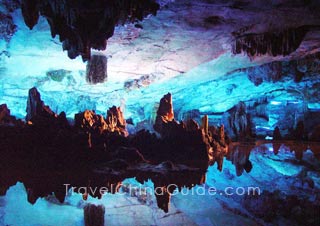
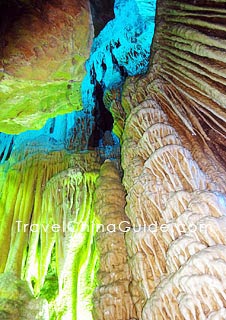
Karst is a unique landform that occurs in areas where lime stones and other soft rocks intermingles with harder stone. Over time, the soft rock dissolves leaving the remaining harder stone in unusual formations. Famed for its rich and diversified landforms, South China Karst signifies the finest examples of that topography in China and the world. It represents the unrivalled features of the tropical and subtropical terrain. Covering a total area of 176,228 hectares, South china karst is composed of seven heritage sites scattered throughout four provinces and municipalities, including Shilin (Stone Forest), Libo, Wulong, Guilin, Jinfoshan, Shibing and Huanjiang sites. The first three were inscribed in the World Natural Heritage List by UNESCO in June 2007 and the rest in June 2014.
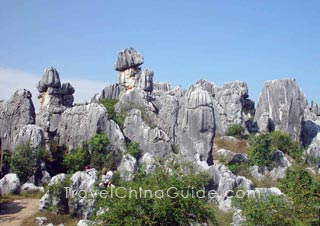 | | Stone Forest, Kunming | | |
It features numerous odd-shaped stone formations, and known as the Stone Forest. The Stone Forest is also the world's only karst landscape in the subtropical plateau area, and enjoys the fame of 'the First Wonder of the World'. The representative scenic area in Shilin is the Nagu Stone Forest, characterized by karst terrain evolved from dolomite rocks.
Libo Karst
It is renowned for its cone and tower-shaped land formations that populate many of the scenic areas. The
Libo Zhangjiang Scenic Area boasts boundless mountains, crystal creeks, cascading waterfalls, various plants and animals. Its Mandarin Duck Lake is the only aquatic forest in Karst landscape at that latitude in the world, where grow over 10 kinds of precious trees. The
Maolan Karst Forest Natural Conservation is a splendid karst ecosystem featuring much biodiversity. In the conservation area, the primeval subtropical karst forest is well preserved. The favorable natural environment makes this scenic area an ideal habitat for thousands of rare and endangered animals.
Wulong site is characterized by its special cave system, grand natural stone arch bridges and the eroded tiankeng (giant limestone sinkhole) and deep fissures. It is composed of three scenic areas: Furong Cave, Three Natural Bridges and Houping Tiankeng (Houping Giant Doline).
Guilin Karst
Covering an area of 98 square miles, the one in Guilin is the best known area with hill forest and hill clusters. It covers two sections, the
Li River section and the Putao section. On the both sides of the Lijiang River, many stone columns are lined up in a seemingly orderly formation and covered with verdant bush.
Jinfoshan Karst
Located in Chongqing municipality, Jinfoshan landscape is famous for five marvelous wonders. The tableland is noted for its enclosing edge; giant caves lie under the ground indicating the hydrogeology of Jinfoshan area. The karst site is endowed with various landforms such as depressions, a stone forest, waterfalls, valleys, rare and endangered plant and animal species.
Shibing Karst
Located in Shibing County, in easern Guizhou Province, it is the most well-known and mature dolomite karst site in world's tropic and subtropical zone. Steep cliffs, abrupt valleys and abundant flora form the unique eco system of Shibing site.
Huanjiang Karst
Situated in the northwest of Guangxi
Zhuang Autonomous Region, Huangjiang site extends from a high plateau to a lower hilly area. Here dense cluster pyramid-shaped peaks tower over visitors. The scene from a bird's-eye view is especially splendid. The site has unique scientific and aesthetic value.
Geologically, South China Karst developed due to the tectonic uplift of the Qinghai-Tibet Plateau. It has evolved into an integrated tropical and subtropical karst ecosystem. It is of significance in studying geological evolution.
- Last updated on Aug. 01, 2022 -