Situated at the foot of Wulaofeng (Mountain of Five Old Men) and facing the sea, South Putuo Temple is deemed to be one of the must-go tourist places in Xiamen, Fujian Province. Even if you are not interested in Buddhism, you will find the place a scenic area providing you with a refreshing experience.
This Buddhist temple was once called Puzhao Temple (Universal Grace Temple). It was first built during the Tang Dynasty (618-907) and was later destroyed in the warfare during the Ming Dynasty (1368-1644). During the reign of Qing Emperor Kangxi (1662-1722), a naval general ordered it to be rebuilt into a Buddhist Temple and named it Nanputuo Temple.
South Putuo Temple covers 30,000 square meters (36,000 square yards) with four main buildings on the north-south axis. The buildings include Devajara Hall (the Hall of Heavenly Kings), Mahavira Hall (Daxiongbaodian), Dabei Hall (the Hall of Great Compassion) and a Pavilion built in 1936 in which Buddhist scriptures, Buddha images from Burma, ivory sculptures and other works of art are stored. The many rooms flanking the main buildings include dormitories, libraries and study rooms for monks.
Devajara Hall
Also called the Hall of Heavenly Kings (Tian Wang Dian), Devajara Hall is the location of the statues of four ferocious Heavenly Kings. In the center of the hall stands a fat Buddha, Maitreya or Milefo. With a broad smile, bare chest and exposed paunch, Maitreya represents the Buddha of the future, also known as the Laughing Buddha.
Mahavira Hall
Mahavira Hall in South Putuo Temple is built in 1921 and features the statues of the Trinity of the Three Ages (Sakyamuni, the Buddha of the Present; Kasyapa, the Buddha of the Past; and Maitreya, the Buddha of the Future), Avalokitesvara (Guanyin Bodhisattva, the Goddess of Mercy) and Avalokitesvara's disciples. most of the attractive murals on the wall depict Buddhist stories and figures from India.
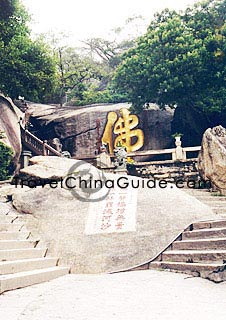 | | South Putuo Temple, Xiamen | | 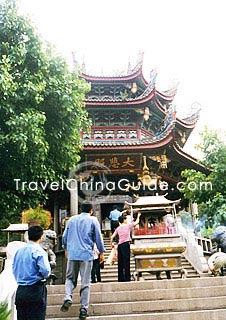 | | Dabei Hall | | 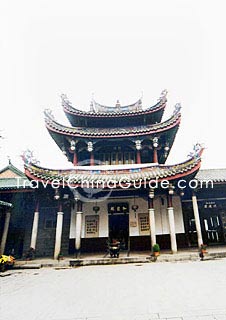 | | Jialan Hall | |
Dabei Hall
The Dabei Hall is an octagonal tower which was rebuilt in 1928. Inside, four Statues of Avalokitesvara are enshrined on a lotus-flower base. The Bodhisattva with his arms crossed in front of his chest has 48 hands stretching out. Each hand features a miniature scared eye. Two banyans are planted on each side of the hall.
Sutra-Keeping Pavilion
The Sutra-Keeping Pavilion of South Putuo Temple was built in 1936 and houses thousands of Buddhist scriptures, Buddha images from Burma, ivory Sculptures, wood sculptures, bronze bells, incense burner and other works of art. One particular porcelain Avalokitesvara in the Pavilion is said to be very precious.
The many rooms flanking the main buildings include dormitories, libraries and study rooms for monks. Vegetarian food is also served in South Putuo Temple. The dishes' unique colors, fresh tastes and poetic names make them popular with the tourists.
How to get to South Putuo Temple
1. Take Bus 1, 21, 45, 751, 841 or B1 to Xiada, and you will see the temple.
2. Take Bus 2, 20, 22, 29, 47, 48, 71, 87, 92, 96, 122, 135, 324, 659, 751, 857 or B3 to Xida Xicun, and then walk northeast for 5 minutes to the temple.
| Entrance Fee | Free |
| Opening Hours | Outer Mountain Gate: 3:00 - 20:00
Inner Mountain Gate: 3:00 - 18:00 |
| Recommended Time for a Visit | 1h |
 Top 10 Things to Do in Xiamen
- Last updated on Aug. 05, 2025 by Demi Li -
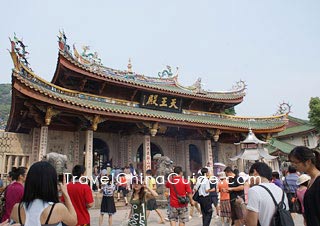
 South Putuo Temple Pictures