 |
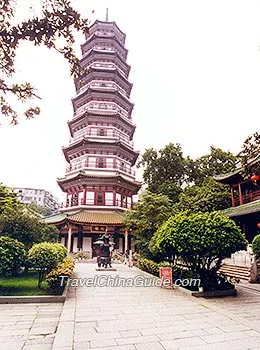
| Hua (Flower) Pagoda |
Having a long history of about 1,400 years, the Temple of the Six Banyan Trees is one of the four best Buddhist temples in
Yuexiu District, Guangzhou and located on the Liurong Road (meaning the Six Banyan Trees Road). It has a rich collection of cultural-relics and is renowned both at home and abroad.
History of Temple of the Six Banyan Trees
Originally built in 537, it has been rebuilt several times, and the name has also been changed several times from Changshou Temple (meaning Longevity Temple) to Jinghui Temple and finally the current name. It is a name given by the great litterateur Su Dongpo in the Song Dynasty (960 - 1279). It is said that he visited there while returning to the north. During the visit, he found six banyan trees there particularly striking. The vitality of the trees put him in a good mood and cheered him up. When the abbot of the monastery invited him to suggest a name, Su Dongpo wrote down its present name. Finally, its former name (Jinghui Temple) was changed to the present one, Temple of the Six Banyan Trees. A pagoda inside is known variously as Six Banyan Pagoda or Flowery Pagoda.
Tianwang Hall
After entering by the mountain gate, the Tianwang Hall is the first hall you will see in Temple of the Six Banyan Trees. The Laughing Buddha is there with smile all over his face to welcome visitors. Behind it is the Weituo Hall. According to legend, Weituo was a general who recaptured the Buddhist relics which had been stolen. He keeps a straight face, looking very serious and frightful, in distinct contrast with the Laughing Buddha.
Six Banyan Pagoda
The architecture in Temple of the Six Banyan Trees that catches the visitors' eyes most is the Six Banyan Pagoda. It is a pagoda where Buddhist relics are placed. Its roofs curve upwards and look like dark red flower petals. The tip of the pagoda is like stamens, while the whole construction looks like a huge stigma high in the air. Therefore, people like to call it the Flowery Pagoda. The pagoda not only has a nice appearance, but also provides visitors a good place to overlook enchanting scenery around.
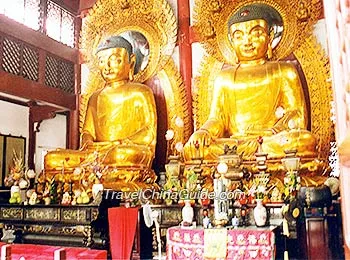 | | Golden Buddha in the Hall of Mahavira | | 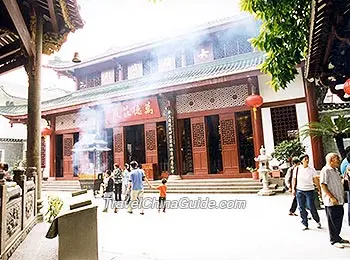 | | In front of the Hall of Mahavira | |
Daxiong Baodian Hall
To the west of the Six Banyan Pagoda is Daxiong Baodian Hall - the main hall of the Temple of the Six Banyan Trees. The three biggest copper Buddhist statues placed there are among the biggest and most ancient Buddhist statues in Guangdong. The middle one is Sakyamuni, to the left, the Amitabha and to the right, the Apothecary Buddha. They stand for present, past and future.
Burning Joss Sticks
Burning joss sticks is a big event when visiting the Temple of the Six Banyan Trees. Thus every year on the Chinese traditional
New Year and
Lantern Festival, this place becomes a busy area. Numerous people queue to burn the first joss stick in order to be blessed by gods in the coming year.
How to get to Temple of the Six Banyan Trees
1. Take
metro Line 1 or
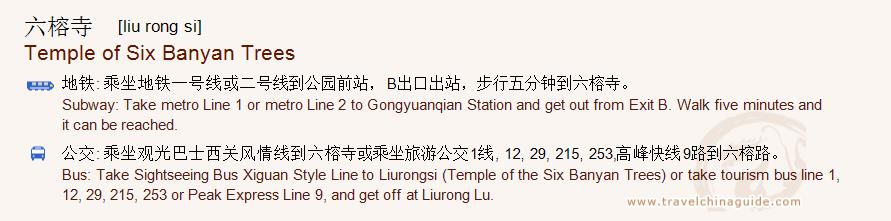
metro Line 2 to Gongyuanqian Station and get out from Exit B. Walk five minutes and it can be reached.
3. Take tourism bus line 29, 215, 253, Guang 12 or Tourist Line 1 and get off at Liurong Road.
- Last updated on Jul. 23, 2026 by Sherry Xia -