Historic Centre of Macau was formed in the middle of 16th century when the Portuguese began to settle and trade in the southwest area of the Macau peninsula. Macau subsequently developed into a main port in China open to the outside world before the 19th century. It was also an important international port in Asia.
With its prosperity in international trading, Macau attracted more people to settle there from countries around the world. These people brought their different cultures, their social customs, and their religions to this area and built houses, churches, streets, fort and even a cemetery. This area is the core part of what is now called the Historic Centre of Macau.
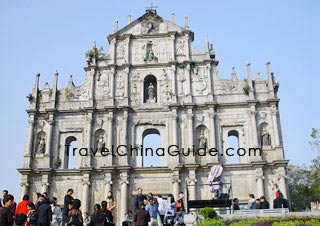 | | Ruins of St Paul's Church | | 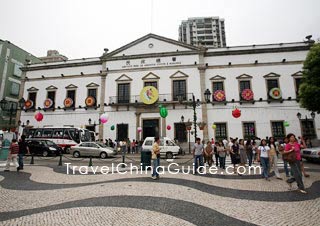 | | Macau Municipal Council, Senaso Square | |
At the same time, these settlers introduced to their own countries, the cultures, religions and social customs of the Chinese people. Macau was a window by which foreign countries got to know about China. Macau became the land where China meets the cultures of the western world.
Throughout these 400 years, Macau has been the hub where cultures of the West and the East exchange. In Historic Centre of Macau, one can find the oldest and the best-preserved western-style buildings in China, in different architectural styles emerging after the Renaissance from Baroque to neo-classical. One can also find that the numerous western religious buildings exhibit various features of different religions. The architects of these western-style buildings absorbed the cultures of India and China and added these characteristics into their buildings, even the murals in the Guia Chapel were painted in Chinese style. The Chinese temples and residential buildings make the architectural style of this Historic Centre of Macau very diverse. Until today, people in this area have held their national beliefs and habits. They hold various celebrations to continue their different traditions and the combination of Chinese and Western cultures and elements.
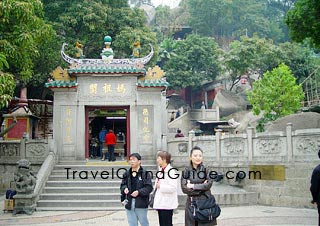 | | A-Ma Temple | | 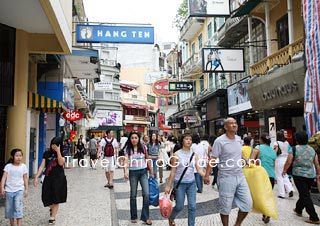 | | Historical Area of Macau | |
The Historic Centre of Macau mainly has Portuguese unreligious architectures, some churches, some Chinese residential and religious buildings and some streets and squares connecting them. There are the Moorish Barracks, the Dom Pdro V Theatre, Sir Robert Ho Tung Library, the Leal Senado Building, the Holy House of Mercy, the Section of the Old City Walls, the Mount Fortress, the Guia Fortress, the Guia Lighthouse and Lilau Square. One can also find St. Laurence's Church, St. Joseph's Seminary Building and Church, St. Augustine's Church,
Cathedral Church,
St. Dominic's Church,
St. Paul's Ruins, St. Anthony's Church, the Protestant Cemetery and the Guia Chapel; the
A-Ma Temple,
Lou Kau Mansion, the Mandarin's House, Sam Kai Vui Kun Temple and N Tcha Temple.
The Historic Centre of Macau has the quintessence of the Chinese and the Western cultural exchange of more than 400 years, and provides a particular proof of the exchange of cultural, architectural and religious influences between the East and the West. Its unique value has made it to be included in the list of the World's Cultural and Natural Heritage in 2005.
How to get to Historic Centre of Macau
1. Take bus 3, 3X, 4, 6A, 8A, 18A, 19, 26A, or N1A to Avenida de Almeida Ribeiro.
2. Take bus 2, 2A, 9, 9A, 12, 18, 18B, 22, 25, or 25B to Victory Garden.
- Last updated on Aug. 12, 2025 by Demi Li -