Macau Travel Guide
Macau Facts
Chinese Name: 澳门 (ào mén)
Population: 696,100
Area: 32.9 square kilometers (12.7 square miles)
Location: in the south of China
Area Code: 853
Zip Code: 999078
GDP (2019): USD 53.86 billion
China’s “Las-Vegas” – Best Place to Experience Blend Culture of Chinese & Portuguese
Macau, located on the southeast coast of China, is a special administrative region of the country. Being Asia's well-known gambling Mecca, it is a place to find the traditional Chinese culture while enjoying the exotic Portuguese buildings. Most visitors who have been there conclude that it is a location suited to both tourism and living as it is a beautiful city with clean streets, gardens and picturesque hilly landscapes. Sunshine, clear air, green lands and all sorts of delicious food all contribute to its attractions.
If you visit Macau without experiencing gaming entertainment, you can’t say that you have actually been to this place which is known as China’s “Las-Vegas”. The casinos in Macau are located in some hotels on the Peninsula and Taipa with luxurious equipment, strict security and modern management.
Macao also holds various activities and festivals every year. From the middle of September to the beginning of October, Macao holds wonderful international fireworks competitions. The Grand Prix Macau in November every year calls for the most exciting racing event in Macao. Macao Food Festival is close to this event. Festivals such as Niangma’s Birthday (Nianga refers to Sea Goddess in south China) show local culture and customs.
History
The name of Macau is derived from the word Magao (A-Ma Temple), which was the shrine dedicated to Mazu, a sacred sea goddess respected by the local people. It was said that in the middle of the 16th century when the Portuguese first set foot there, one of the officers asked a fisherman the name of the land. The man misunderstanding the officer's meaning, answered 'Magao' - the name of A-Ma Temple in front them. The word became the Portuguese name for the land for nearly 400 years as the Portuguese ruled here prior to its official return to the People's Republic of China on December 20, 1999.
Macao is divided into Macao Peninsula, Taipa Island and Coloane Island. You can find old buildings that are either in European baroque or traditional Chinese style on the Macau Peninsular. Senado Square, the splendid main square with surrounding simple, elegant Portuguese and baroque-style buildings is the busiest downtown Macao.
|
|
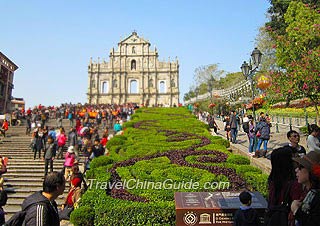
A northerly walk leads visitors to the featured attractions of Ruins of St. Paul's, a former screen wall of St. Paul's Church and the Monte Fort, one of the best-preserved forts in Macau. The Museum of Macau, to the right of the ruins, tells all stories on the city's past. Situated at the base of Penha Peninsula in the southwest part of Macau is A-Ma Temple, built in the Ming Dynasty (1368 - 1644), which is dedicated to the sacred goddess A-Ma. During the festival seasons, thousands of devout prayers come to visit the temple.
In the southern part of the Peninsular, the New Reclaimed Area and the Outer Harbor Area, compared with the more traditional central and western areas, is the newly-developed region where the modern aspect of Macao can be found. There are many luxurious hotels housing various gambling casinos and these venues are packed with people from all over the world when the night comes. Numerous museums in these two areas present the essence of the culture and history of Macau including Wine Museum, Grand Prix Museum, Museum of Art.
Taipa Island in the middle of Macao highlights the University of Macau, the world-famous food street Rua do Cunha and luxe Venetian Resort Hotel. If you want to experience the rustic charm of country life in Macao, you should visit southward to Coloane Island which features a quiet environment and fascinating see view while St. Francis's Cathedral in Baroque architectural style is the must-see scenic spot. See Also: Top 10 Things to Do in Macau
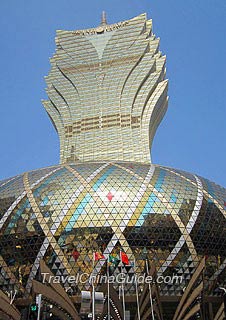 |
| Grand Lisboa |
Macau is the paradise for gourmands with a wide range of delicious cuisines from all over the world including unparalleled Macao-style Portuguese cuisine, traditional Cantonese cuisine, exotic food from Italy, France, Brazil, India, Japan, and Korea... Everyone can find his own favorite!
Moreover, the well-known Macau dim sum delicacies should never be missed. The Pastéis de Nata (a Portuguese-style egg tart) that originated on the outlying island of Coloane is the featured snacks and Margaret's Café & Nata offer the best. All kinds of dim sum ranging from almond cake, chicken cakes, cashew cookies, sesame crackers, egg and cheese rolls are served in the many Portuguese café and they are good choices for gifts of families or friends.
Entertainment
The two outlying islands of Taipa and Coloane, connected to the Macau Peninsular by two bridges feature tranquil natural and beach sceneries and are good choice for a short break away from the bustling Peninsular. The Jockey Club's horse racing attracts numerous gamblers from the nearby areas and Hac Sa Bay and Bamboo Bay are two breathtaking natural scenic areas with the best seaside bathing places.
Known as 'Oriental Las Vegas', the gambling industry in Macau is booming and has already become an important feature of the local economy. Surprisingly, visitors do not find the kind of razzmatazz in casinos as elsewhere; by contrast you can feel the expectations of gamblers from their polite manners and the peaceful atmosphere.
 You May Like: