Tomb of Princess Yongtai
The Tomb of Princess Yongtai, lying between the Tomb of Prince Yide and the Tomb of Crown Prince Zhanghuai, is a satellite tomb of the Qianling Mausoleum, the resting place of Emperor Gaozong and Empress Wu Zetian of the Tang Dynasty (618 – 907AD). It is located in Xianyang, about 88 km (55 miles) from downtown Xian. Li Xianhui - the ill-fated Princess Yongtai, the granddaughter of Empress Wu Zetian is buried here. The tomb was built to the same specifications as an empress' tomb, and adorned with thousands of relics and fine mural paintings.

Li Xianhui (684 - 701), known as Princess Yongtai, was the seventh daughter of the Tang Emperor Zhongzong and a granddaughter of Emperor Gaozong and Empress Wu Zetian. She was so beautiful that it was said even the plum blossom lost its brilliance in her presence. Adored by her imperial father for her beauty and wisdom, she was married to Wu Yanji in 700. Her newly wedded husband's father was a nephew of the Empress Wu but her family ties gave her no protection from her autocratic grandmother. Hearing that Princess Yongtai, her husband, and her brother Li Chongrun talked about a personal relationship with Wu Zetian, Wu put them to death in Luoyang in 701. In 705 after her father became the emperor, she was recognized posthumously as Princess Yongtai and was then reburied in Xian.
The Tomb of Princess Yongtai is enclosed by walls. The whole area measures 275 m (300 yards) from north to south and 220 m (240 yards) from west to east. On the ground there is a pair of stone lions, a pair of stone figurines, and a pair of ornamental columns facing each other. The underground tomb consists of a paved passageway, six skylights, eight small rest houses and two chambers, one behind the other. The front chamber with a round roof signifies the living room. The back chamber is decorated with sky diagrams including the sun, the moon, and the star-studded sky, implying people integrate into nature after death. Here lies the princess’ stone coffin. Engraved with two windows, a door, and two maids standing outside the door, it looks like a house.
The tomb is renowned for the high quality of many items discovered in it and the extremely fine wall paintings. Rainwater and silt flow down from the holes left by grave robbers, ruining a large number of elegant paintings, but what remains can still be regarded as masterpieces of Tang painting. These images are wonderful reflections of the glories of the Tang court in its heyday. Despite the intrigues and perils that surrounded the members of the aristocracy, the court enjoyed wealth, culture, and a degree of elegance that made it a source of wonder.
Many of the paintings depict famous buildings and towers, the rich trappings of courtly life and magnificent ceremonial parades, but what catches the attention of visitors is the painting of sixteen maids of honor on the walls of the front chamber. The maids are in fancy clothing with well-shaped bodies, holding various kinds of articles for daily use. They all have different postures and expressions. Some are whispering to each other, some are nodding their agreement, and some are looking around for a way to serve the princess. One of these elegant young women is known as the 'First Oriental Beauty'. Her round face with arched eyebrows and enticing lips and her graceful figure evokes the admiration from all who have looked upon her.
The original murals have been removed to Shaanxi History Museum for safekeeping and have been replaced with replicas. The Tomb of Princess Yongtai had been subject to robbery and many relics have been stolen. However, some 1,046 pieces have survived intact. Ceramic figures, tri-color figures and wooden figurines represent 878 of these pieces. Among them, 700 ceramic figures include heavenly kings, males, females and ethnic equestrians, animals, and musicians coming complete with their musical instruments. The tri-color figurines are of many subjects in a variety of poses. By contrast, there are thirty carved wooden figures that are all male.
Take a high speed train from Xi'an North Railway Station to Qianxian, and then take a taxi or the local bus line 1 or 2 to Qianling Mausoleum.
From the entrance of the scenic area, it takes 40 minutes to walk southeast to the Tomb of Princess Yongtai; or you can take the sightseeing car shuttling among the main mausoleum and the attendant tombs with a cost of CNY 30 per person.
 Qianling Mausoleum
Li Xianhui (684 - 701), known as Princess Yongtai, was the seventh daughter of the Tang Emperor Zhongzong and a granddaughter of Emperor Gaozong and Empress Wu Zetian. She was so beautiful that it was said even the plum blossom lost its brilliance in her presence. Adored by her imperial father for her beauty and wisdom, she was married to Wu Yanji in 700. Her newly wedded husband's father was a nephew of the Empress Wu but her family ties gave her no protection from her autocratic grandmother. Hearing that Princess Yongtai, her husband, and her brother Li Chongrun talked about a personal relationship with Wu Zetian, Wu put them to death in Luoyang in 701. In 705 after her father became the emperor, she was recognized posthumously as Princess Yongtai and was then reburied in Xian.
The Tomb of Princess Yongtai is enclosed by walls. The whole area measures 275 m (300 yards) from north to south and 220 m (240 yards) from west to east. On the ground there is a pair of stone lions, a pair of stone figurines, and a pair of ornamental columns facing each other. The underground tomb consists of a paved passageway, six skylights, eight small rest houses and two chambers, one behind the other. The front chamber with a round roof signifies the living room. The back chamber is decorated with sky diagrams including the sun, the moon, and the star-studded sky, implying people integrate into nature after death. Here lies the princess’ stone coffin. Engraved with two windows, a door, and two maids standing outside the door, it looks like a house.
|
|
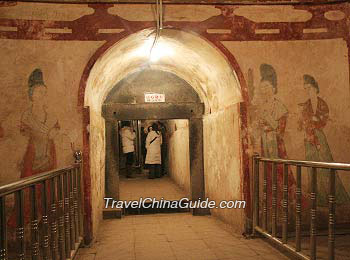
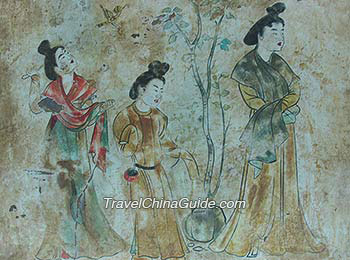
The tomb is renowned for the high quality of many items discovered in it and the extremely fine wall paintings. Rainwater and silt flow down from the holes left by grave robbers, ruining a large number of elegant paintings, but what remains can still be regarded as masterpieces of Tang painting. These images are wonderful reflections of the glories of the Tang court in its heyday. Despite the intrigues and perils that surrounded the members of the aristocracy, the court enjoyed wealth, culture, and a degree of elegance that made it a source of wonder.
|
|


Many of the paintings depict famous buildings and towers, the rich trappings of courtly life and magnificent ceremonial parades, but what catches the attention of visitors is the painting of sixteen maids of honor on the walls of the front chamber. The maids are in fancy clothing with well-shaped bodies, holding various kinds of articles for daily use. They all have different postures and expressions. Some are whispering to each other, some are nodding their agreement, and some are looking around for a way to serve the princess. One of these elegant young women is known as the 'First Oriental Beauty'. Her round face with arched eyebrows and enticing lips and her graceful figure evokes the admiration from all who have looked upon her.
The original murals have been removed to Shaanxi History Museum for safekeeping and have been replaced with replicas. The Tomb of Princess Yongtai had been subject to robbery and many relics have been stolen. However, some 1,046 pieces have survived intact. Ceramic figures, tri-color figures and wooden figurines represent 878 of these pieces. Among them, 700 ceramic figures include heavenly kings, males, females and ethnic equestrians, animals, and musicians coming complete with their musical instruments. The tri-color figurines are of many subjects in a variety of poses. By contrast, there are thirty carved wooden figures that are all male.
How to get to Tomb of Princess Yongtai
From the entrance of the scenic area, it takes 40 minutes to walk southeast to the Tomb of Princess Yongtai; or you can take the sightseeing car shuttling among the main mausoleum and the attendant tombs with a cost of CNY 30 per person.
| Entrance Fee | * It is included in the Qianling Mausoleum entrance ticket. March to November: CNY 100 December to the next February: CNY 80 Children below 1.2 meters and seniors above 65 years old can enter for free. |
|---|---|
| Opening Hours | March to November: 8:00-18:00 December to the next February: 8:30-17:30 |
| Recommended Time for a Visit | 1 to 2 hours |
Qianling Mausoleum- Tomb of Prince Yide
- Tomb of Princess Yongtai
- Tomb of Crown Prince Zhanghuai
- Last updated on Aug. 04, 2025 by Alex Jin -