Wang Family Compound is located in Jingsheng Town, Lingshi County, 35 kilometers (about 22 miles) from
Pingyao Ancient City and 140 kilometers (about 87 miles) from Taiyuan City, Shanxi Province. It is a luxurious residence built during 1762-1811 by the descendants of the Wang Family, one of the Four Families of the Qing Dynasty (1644-1911) in Shanxi Province.
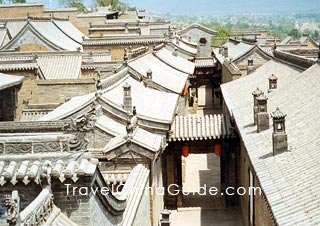
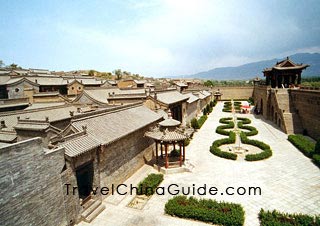
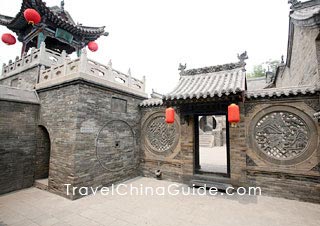
Wang Family Compound occupies a total area of 150,000 square meters (about 179,399 square yards), 45,000 square meters (about 53,820 square yards) of which has been declared as a provincial protective cultural relic. It is not only an example of residential architecture, but also a museum of architectural art. Its sculptures of stone, wood and brick can be found everywhere in the courtyard. The crafts are refined and exquisite. Today, the architectural groups open for viewing are Gaojia Ya, Hongmen Bao, Chongning Bao, etc. Altogether there are 231 courtyards and 2,078 houses.
East Courtyard
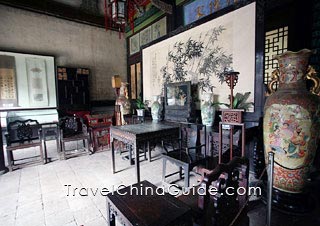
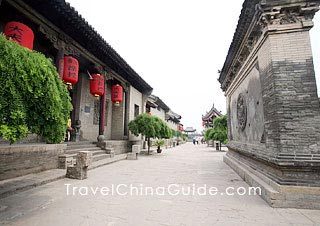
East Courtyard of Wang Family Compound, informally called Gaojia Ya, was built during the reign of Emperor Jiaqing (1796-1820) of the Qing Dynasty. It was open to the public as the Art Hall of Chinese Residences on August 18th, 1997. The complexity of the structures will make you feel like you are moving through a labyrinth. It is a cluster of courtyards, each with its own kitchen yard and private school yard. In the middle sector are two main courtyards and Beiwei Yard. In front of the main yards is a long alleyway measuring 127 meters (about 417 feet) in length and 11 meters (about 36 feet) in width. To the northeast is a small side-yard while in the southwest there is a large side-yard. At the four sides of the East Courtyard there are four gates; east gate (to the east of the long alleyway), south gate (in the middle of the alleyway), west gate (to the southwest of the large side-yard) and north gate(to the northeast of the small side-yard). You will find a large number of items belonging to the family on display in the East Courtyard.
 |  |
West Courtyard
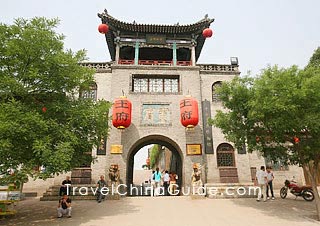
Opposite to the west gate of East Courtyard is West Courtyard in Wang Family Compound, informally called Hongmen Bao. Hongmen Bao means Red Gate Castle, taking its name from the only red gate facing the main street. The castle is 105 meters (about 344 feet) wide from west to east and 180 meters (about 591 feet) long from north to south, presenting in the shape of a regular rectangle. The main street measuring 133 meters (about 436 feet) in length and 3.6 meters (about 11.8 feet) in width divides the whole courtyard into two main areas. Three alleys of west-east direction cross with the main street, thus presenting the Chinese character 'Wang'. Hongmen Bao has 27 courtyards of different styles, splendid or delicate. The Wang Museum in the courtyard is the only example of Wang culture throughout the world.
Chongning Bao
Chongning Bao in Wang Family Compound was built cooperatively by Wang and other Family in 1725. The style is similar to that of the Ming Dynasty (1368-1644). Liqun Art Hall is located inside the castle. Liqun is a famous painter. Many of his works are displayed in this hall.
Painting and Calligraphy Hall
The Painting and Calligraphy Hall displays hundreds of excellent works while Treasure Hall contains collections of furnishings, old coins, porcelains, rare stones and jade carvings. Both displays are open to the public.
Note: August 18th of each year is the Tourism Festival of Wang Family Compound and certain activities will be held on that day. During
Chinese New Year, there are marvelous traditional performances of Shehuo in the Wang Family Compound.
How to get to Wang Family Compound from Pingyao
1. Take a bus from Pingyao Bus Station to Lingshi county. The bus departs at 8:40 and 8:50 in the morning. After arrival, take Lingshi Bus 7 to Wenchang Dong and then walk north for 10 minutes to get there.
2. Take a train from
Pingyao Railway Station to Jiexiu or Lingshi Railway Station and then catch Jiexiu bus no. 11 (fare: CNY 5), or Lingshi bus no. 1 (fare: CNY 2) to the Wang Family Compound.
| Apr. - Oct. | Nov. - Mar. |
| Ticket Fare | CNY 55 | CNY 35 |
| Opening Hours | 08:30 - 18:00 | 08:30 - 17:00 |
- Last updated on Aug. 14, 2025 by Demi Li -
 Wang Family Compound Pictures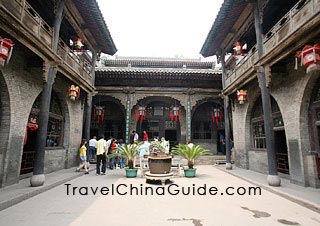
 Recommended tour with the visit to Wang Family Compound: