Ningwu Pass (Ningwuguan)
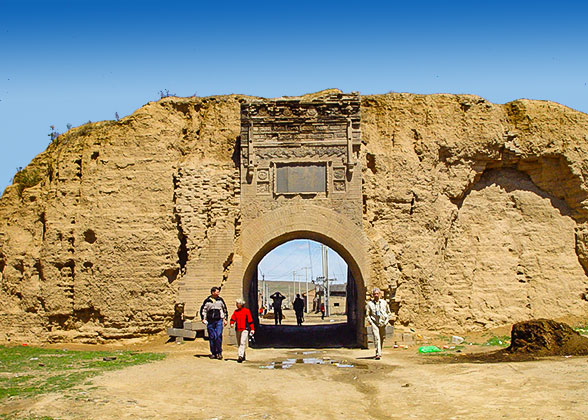 |
| Ningwu Pass in Shanxi |
Concerned about the ever-present threats of the northern Mongolian tribes, the emperors of the Ming Dynasty (1368-1644) determined to strengthen the northern borders by extending the Great Wall. In central Shanxi Province, which used to be the northern border in the Ming Dynasty, you can find three important passes known as the Three Outer Passes of the Great Wall. The grand Yanmenguan Pass stands in the east, and the Pianguan Pass lies in the west. Sitting in the central area and acting as the garrison headquarters is the Ningwuguan Pass. It is sandwiched by the Huagai Mountain in the north and the Phoenix Mountain and the rippling Huihe River in the south.
History of Ningwu Pass
 It was first constructed in 1450 during the Ming Dynasty, and was renovated and enlarged many times. In a rectangular shape, it originally had three gates in total: the East Gate, the South Gate, and the West Gate.
 In 1479, the North Gate was opened. Many emplacements and watch towers were also built along the wall of the pass.
After the enlargement in 1498, the pass had a girth of 2.2 miles (3.5 kilometers) and its wall was about 38 feet (11.5 meters) high.
In 1606, the rammed earth wall was wrapped by bricks, making it more solid and sound. The East Gate Tower and West Gate Tower were also constructed. At the top of the Huagai Mountain was erected a magnificent three-storey Fire Tower. Additionally, the 12 miles (20 kilometers) long Great Wall was built to the north of the pass.
In 1644, a fierce battle took place at Ningwu Pass. The peasant rebels led by Li Zicheng fought against the guarding soldiers led by General Zhou Yuji. The fight lasted seven days and the General Zhou Yuji was defeated and killed. The rebels marched to Beijing, the capital city. Then, they overthrew the Emperor, putting an end to the Ming Dynasty. Nowadays, you can see the Tomb of General Zhouyuji stands quietly to the east of the Huihe River.
As time passed, the Ningwuguan Pass has fallen into disrepair. Today, you can see some relics of the rammed earth wall. Fortunately, the Drum Tower, the representative building, is well-preserved.
 |
| Ningwu Great Wall |
Drum Tower- Landmark at Ningwuguan
Yangfangkou Fort- Largest Fort at Ningwuguan
The Yangfangkou Fort served as an important spot for transportation in the ancient times. Today, it is a transport hub between Taiyuan and Datong. The gate of the fort still remains. Also, you can see the dilapidated Great Wall and three well-preserved watchtowers there.
Apart from these wonders of human construction, you can enjoy the intoxicating natural landscapes near the pass. The Guanceng Mountain, the main peak of the Luya Mountain, is home to the only virgin forest along the Great Wall of China. You can also see many beautiful lakes there.