Guguan Great Wall
 |
Guguan Great Wall in Shanxi  Photos Photos |
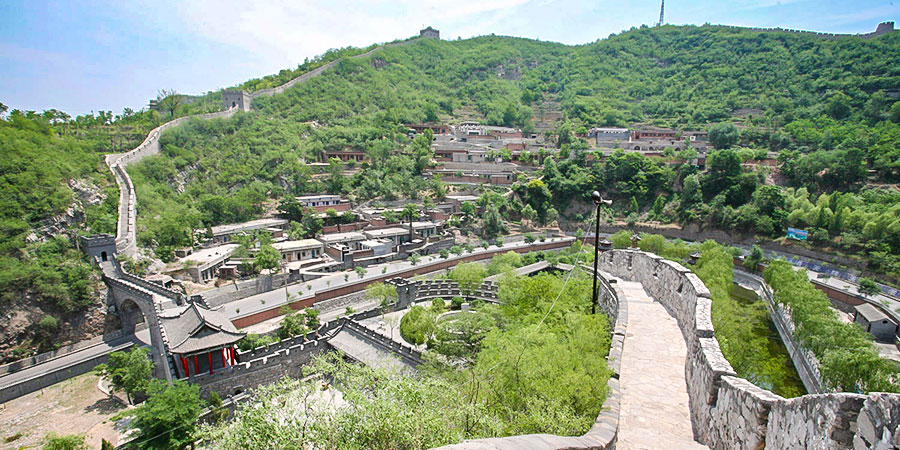
The Guguan Great Wall was first constructed in 369BC by Zhongshan State during the Eastern Zhou Dynasty (770-256BC), 155 years earlier than the Great Wall built by Emperor Qin Shi Huang. However, what you see today are mainly relics from Ming Dynasty (1368-1644). From 1998 to 2003, Guguan Pass was repaired by the villagers living at its foot. They are said to be the descendents of the soldiers who once guarded the pass. They could not bear to see the heritage built by their forefathers remain dilapidated, so they decided to raise funds to reconstruct it. Finally, most parts were restored to the original state and opened to visitors in 2003.
Pass City
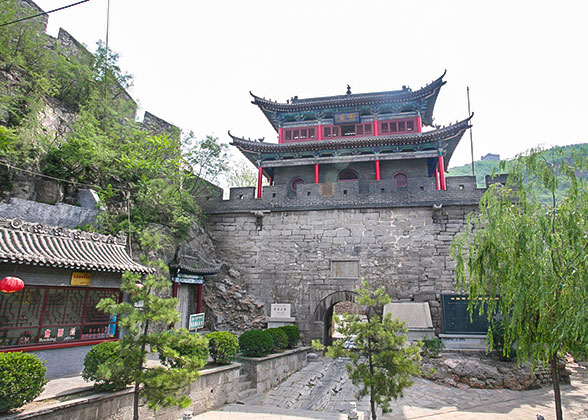
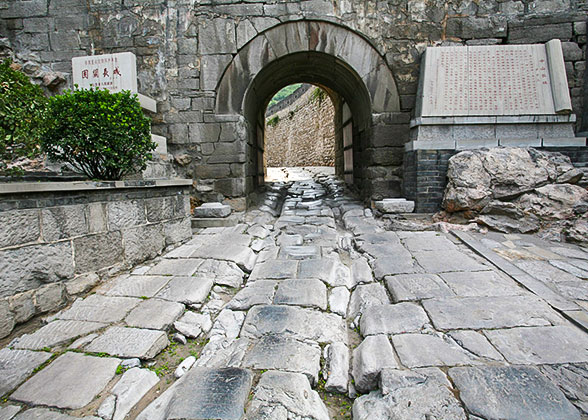
The pass has two gates: the West Gate and East Gate. As enemies mainly came from the west, the West Gate is firmer than the East Gate. Over the West Gate is a two-storey gate tower. There is also a barbican outside the West Gate. Entering the barbican, you can see the ancient post road paved with smooth stone slabs. You can find deep and narrow ruts along the road because carriages passed by year after year in the ancient times. Seeing them, you will have a strong sense of the passage of time. In contrast, the East Gate is not as splendid as the West Gate.
|
|
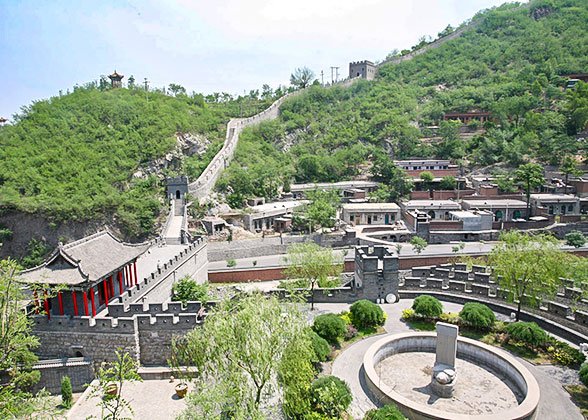
Inside the pass, you can find three administrative offices (called Yamen in ancient China): Big Yamen, Medium Yamen, and Small Yamen. To the east of the pass is the Stele Corridor, near which you can see the Statue of Han Xin (a brilliant general during the Western Han Dynasty), and the exhibition hall of the Guguan Great Wall. To the south of the pass was a cavalry drill ground, which used to be composed of Platform for Appointing Commanders, arrow rest, raceway and archery pavilion.
It is noteworthy that there are many temples in and around the pass: the Temple of the Dragon King near the West Gate, the Laoye Temple near the Big Yamen, the Sanguan Temple by the Medium Yamen, the Temple of the God of Literature near the East Gate, etc. The most impressive ones are the Temple of Guan Yu (a loyal and righteous general during the Eastern Han Dynasty), the Temple of Laomu (Mother of Emperor Shun), and the Temple of Xuanwu (a constellation god) on the Xifeng Mountain to the west of the pass.
|
|
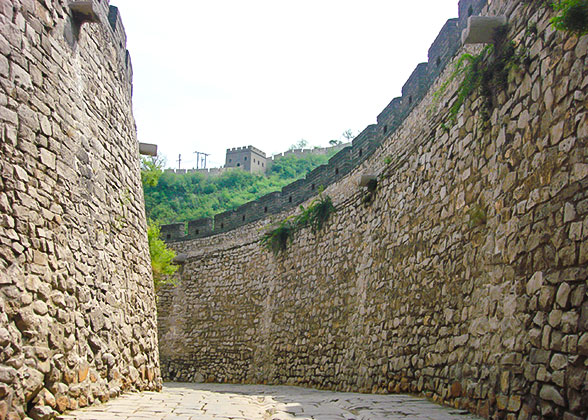
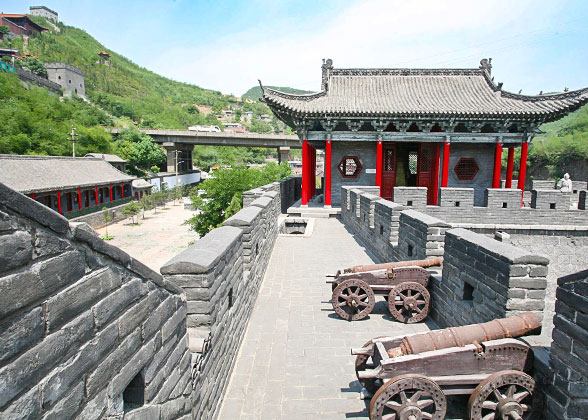
Guguan Great Wall
The beacon towers, emplacements and sentry posts were built at significant points on the wall. At present, there are eleven emplacements and mounds, three enemy towers, two beacon towers, one sentry post, and one ammunition tower in existence.
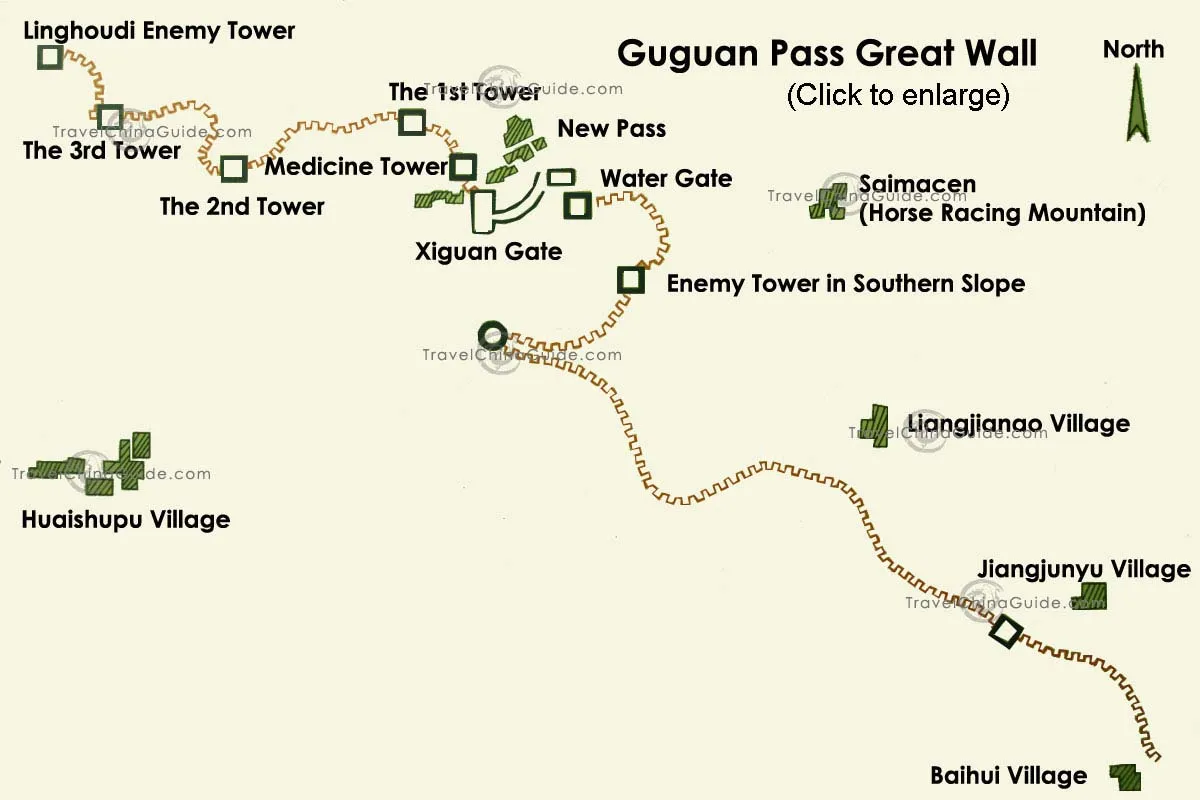 |
| Map of the Guguan Pass |
How to Tour Guguan Great Wall
 Enter the pass from the West Gate, and start your visit. You can enjoy the grand gate tower, have a walk on the ancient post road, and see the temples, Stele Corridor and Exhibition Hall close by.
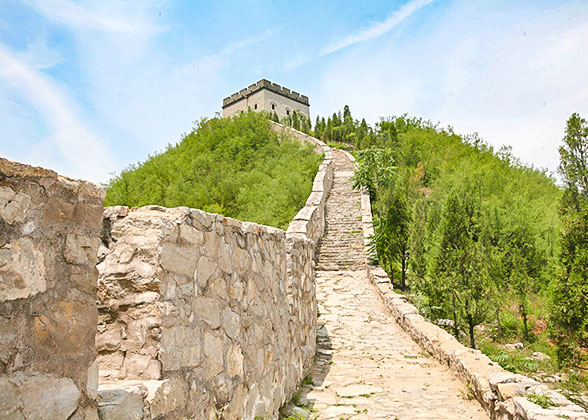
 Afterwards, you may ascend the Great Wall Bridge from the gate tower and go north, and you will reach the Northern Section of the Great Wall. This section was laid with unpolished stones. The adhesive between the stones was the mixture of glutinous rice congee and lime. Go straight for about 550 yards (500 meters), you will come across an enemy tower. Keep going north and pass another enemy tower, turn west, and you will see the wild wall. The first several hundred meters of the wall were badly collapsed. Five to six hundred meters further, the wall is recognizable. The northern side of the wall is almost as tall as a man, and the southern side uses the mountain slope as the natural barrier.
The Southern Section of the wall is basically same as the northern section except there is a restored beacon tower laid by the original stones.
The stone wall is uneven and precipitous. You need to be careful and mind your steps.
|
|
How to Get to Guguan Great Wall
 By Bus:
You may take a bus to Yangquan from Taiyuan Jiannan Bus Station. The buses are available from 6:00 to 19:30 at an interval of about 10 minutes. The trip takes about 2 hours.
Or, you may take a bus to Yangquan from Datong Long-distance Bus Station at No. 3, Weidu Avenue. The bus departs at 8:30, and the trip takes about 5 hours.
Upon arrival, walk west along East Desheng Road for about 400 yards to Yangquan Railway Station. Take bus line 203 to Dongguan Station. Then, transfer to a minibus to the site.
 By Train:
Take a high speed train to Yangquan North Railway Station from Taiyuan, Shijiazhuang, or Beijing. Then, take bus line 901 to Yangquan Railway Station, and then change to bus line 203 to Dongguan Station. Afterwards, transfer to a minibus to the site.
Click to check detailed China Train Schedule
 Note: After your visit, you can charter a car to the nearby Niangzi Pass. It costs around CNY 40 for a round trip, and CNY 25 for a single trip.
| Admission Fee | CNY 30 |
|---|---|
| Opening Hours | 8:00- 19:00 |