Zijingguan Great Wall
The Zijingguan Great Wall lies at the foot of Wanren Mountain in the east and Rhino Mountain (Xiniu Mountain) in the west, with the Horse Blocking River flowing swiftly to the north. More than 140 battles took place here owing to its strategic location. Along the 7.5 miles (12 kilometers) long wall lie three city gates, three water gates and two watchtowers. Some sections are renovated, while others retain their old characters.
|
|

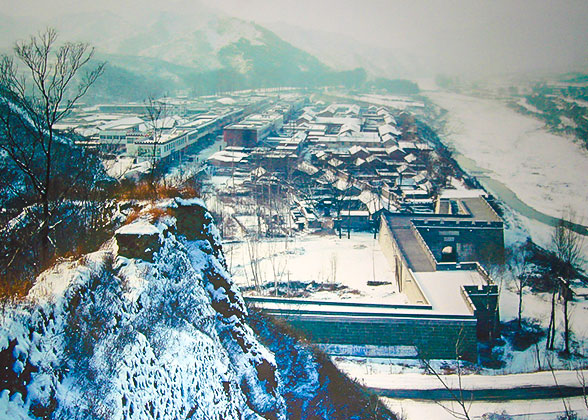
Generally, the restored section is quite flat and there are wide horse tracks beside the Wall. It is thus easy to climb. However, the original unrestored section is quite narrow and precipitous. The bricks are so severely weathered that they have collapsed into piles of debris. The top of the wall is bare because the battlements and crenels have long since gone. What's worse, the watchtowers lean haphazardly and in danger of collapsing. Some have already disappeared, leaving behind their broken foundation. Visitors need to be careful while hiking.
Zijingguan Pass (Zijing Pass)
The pass had four gates originally. The North Gate is well-preserved with two inscriptions on it. The first reads “Everlasting Country”, while the second reads “Zijingguan Pass”. Although the words are quite vague but are still legible. The East Gate still stands with the inscription “Solid Stronghold”. Unfortunately, the South Gate (Nantian Gate) and West Gate (Yanghe Gate) were ruined and only some relics are left.
Flower-shaped Structure
It resembles a flower with five petals with an aerial view. The Great Wall overlaps and intersects with one another, making it quite confusing for those unfamiliar with its structures, although leaving a long impression after the visit.
 |
| Zijingguan Great Wall |
How to Get There from Baoding
You may take a coach to Zijingguan from Baoding Passenger Transport Center at no. 1085, East Yuhua Road. The coaches are scheduled at 7:00, 9:50, 11:45, 12:20, 12:45, and 14:00. The trip takes about 2 hours. The fare is CNY 35-45.