Jingmen Travel Guide
Jingmen Facts
Chinese Name: 荆门 (jīng mén)
Population: 3,000,000
Area: 12,400 square kilometers (4,788 square miles)
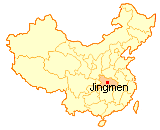
Location: in the central region of Hubei Province, central China
Administrative Division: 4 districts (Dongbao, Duodao, Zhanghe New District, Qujialing Management Zone); 2 counties (Shayang, Jingshan); 1 county-level city (Zhongxiang)
Area Code: 0724
Zip Code: 448000
GDP (2018): CNY 184.789 billion (USD 27.97 billion)
A Transport Hub of Hubei
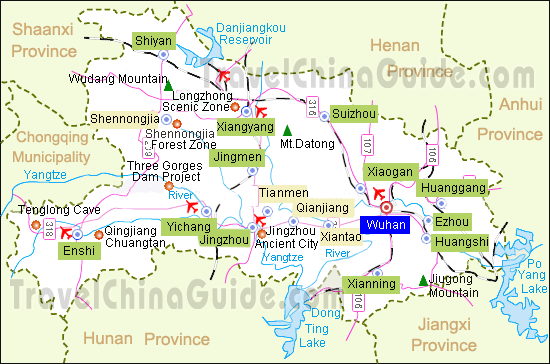
Located in the heart of Hubei Province, Jingmen is the transport hub inside the province. It is 217 kilometers (315 miles) west of the provincial capital, Wuhan, 120 kilometers (75 miles) east of Yichang, and bounded on its south and north are Jingzhou and Xiangfan. Jingmen literally means the gate to Jingzhou. Now, it is the largest special aircraft design, production and flight test base in China, and has the whole industrial chain of new energy vehicles. It also acts as an important freight logistics hub and the largest natural gas distribution center in central China. Also, visitors can find many historical sites such as the largest single imperial mausoleum in China, Xianling Tomb of the Ming Dynasty (1368 - 1644) and the ancient tomb group of Kingdoms of Chu and Han. The natural scenery of Jingmen is composed of karst landscapes, secret caves, canyons and waterfalls.
Jingmen Attractions - Things to Do
Xianling Tomb of the Ming Dynasty
Strictly following traditional Chinese Fengshui theory, Xianling Mausoleum combines the surrounding mountains and rivers as its necessary parts. The mausoleum is composed of over 30 large building complexes. It is divided into the inner and outer parts connected by a 1,422-yard sacred way. On both sides of the sacred way, there is an orderly display of stone statues; pairs of animal carvings such as lions, camels, kylins, horses and elephants, and two stone figures including civil officials and generals. Inside the Red Gate, there are Xiama Bei (a stele erected to remind people to dismount to show respect in the past), Imperial Tablet Pavilion, Ming Tower, Heavenly Gate, Imperial River, White Marble Stone Bridge and other attached buildings, all of which are supremely exquisite, reflecting the high level of ancient Chinese constructional craft.
Due to its abundant underground cultural relics, unique environment, ingenious layout and important historical value, Xianling Mausoleum has been added to the China World Cultural and Natural Heritage List in 2000.
Huangxian Cave
It is a long and winding cave measuring over 2,187 yards long. The mouth of the cave faces northwest and measures 328 feet and 77 yards wide. Through the extremely long period of geological change and development, the abundant limestone inside the cave has formed into the typical karst landscape like a heavenly world. Walking into the cave, you can find all sorts of wonderful rock formations everywhere. Nature has been carving the stalagmites and stalactites into stone columns, stone curtains, stone waterfalls, stone spears and stone needles. And nature doesn't forget to dress them in different gorgeous colors – red, white, yellow and green. The most attractive sight is the more than two hectares of karst basins called "Yun Pen". In rainy seasons, these basins are filled up with water.
People have given many of stone sculptures vivid names, such as Dongkou Xiongfeng (The Imposing Manner in the Cave Mouth), Murong Yingke (Banyan Welcomes Guest), Jigong Yangtian (Jigong Looks Up to the Sky), Die Xi Xiongmao (Butterfly Makes Fun of Panda), Dapeng Zhanchi (Roc Spread Its Wings), Shuangxiang Xishui (Two Elephants Splash in the Water), and Wanxia Mantian (A Sky full of Sunset Glow).
Through the ages, Huangxian Cave has attracted countless men of letters and monks who have left many cliffside inscriptions and frescos. Due to its marvelous landscape, rich cultural relics and high value geological research, it is worth being regarded as a rare karst treasure in China.
| Entrance Fee: | CNY 50 |
How to Get to Wuhan & Yichang from Jingmen
Weather
Enjoying a subtropical monsoon climate, Jingmen has a relatively temperate weather, rich in rainfall and sunshine. With clear four seasons, it has an annual average temperature of 16 C (61F).
 When to Go: Spring and autumn are the most favorable seasons to Jingmen.
Jingmen Travel Tips
History: Although Jingmen was inhabited as early as the Neolithic Age, it was established as an administrative unit in late Shang Dynasty (16th - 11th century BC). The name of Jingmen began in the Tang Dynasty (618-907) when the government established county to administrate this area.
Geographical Features: Lying between the Jingshan Mountain and the Jianghan Plain, Jingmen has lower mountains and hills in its northwest and central part. Plains and lakes are mainly distributed in southern Jingmen.
Shopping: Zhongtian Street and Changning Avenue can be the busiest areas of Jingmen City, gathering many shopping malls and supermarkets. They are good locations to find all kinds of authentic Jingmen specialities.
Special Local Products: wild kudzu root powder, artemisia selengensis (li hao)
 Reply
ReplyWhat is the traveling time? Thank you.
 3
3 1Reply
The train schedules are 11:02, 14:30 and 16:02. The duration is no more than an hour.
Reply22ReplyReply12ReplyHere is the E-mail : travelchinaguide.com|booking
Good luck!