Zhangjiajie Travel Guide
 |
 More Zhangjiajie Maps See also Fenghuang Maps More Zhangjiajie Maps See also Fenghuang Maps |
Zhangjiajie Facts
Chinese Name: 张家界 (zhāng jiā jiè)
Population: 1,709,100
Area: 9,653 square kilometers (3,727 square miles)
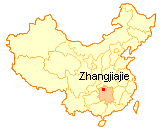
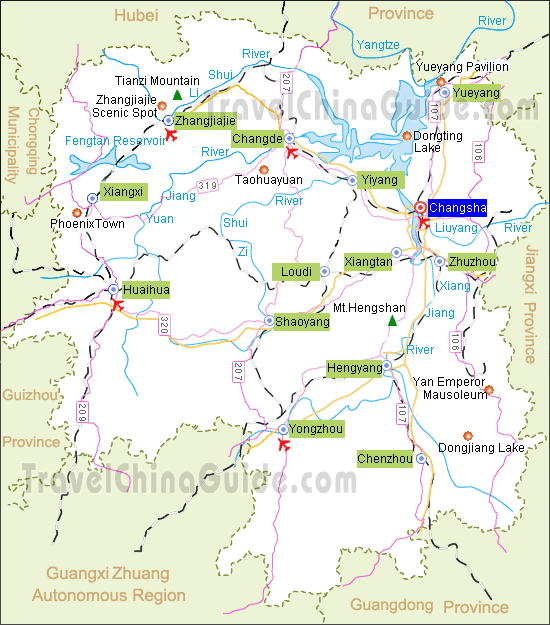
Location: in the northeast of Hunan Province, south-central China
Administrative Division: 2 districts: (Yongding, Wulingyuan); 2 counties (Cili, Sangzhi)
Area Code: 0744
Zip Code: 427000
GDP (2018): CNY 57.892 billion (USD 8.75 billion)
Nationalities: Han, Tujia, Bai, Miao
Famous for Quartzite-Sandstone Formations with Thousands of Spires
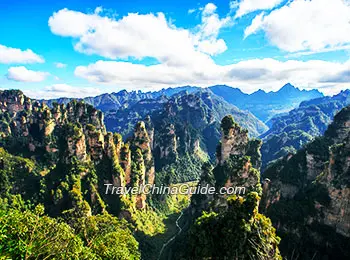
Located in the northwest of Hunan Province, Zhangjiajie with world-renowned natural scenery is a city that is born and thriving for tourism. Nearly 3,000 stone peaks erect and 800 streams wind in Wulingyuan Scenic Area. People who visit Zhangjiajie are all fascinated by Wulingyuan's unique sandstone peak forest landform and magnificent karst landscape. After Avatar which was once shot in Zhangjiajie came out, more people knew this beautiful place. One of the top things to do in Zhangjiajie is walking on the world’s tallest and longest glass bridge located in Zhangjiajie Grand Canyon. Visitors can also experience ethnic traditional customs including Tujia, Bai and Miao through visiting ethnic style scenic spots such as Tujia Ethnic Garden. Pictures of Zhangjiajie Videos of Zhangjiajie
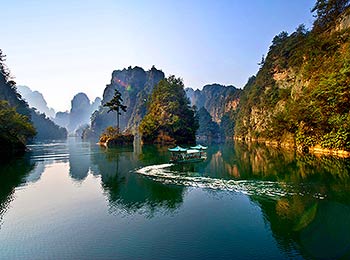
The city features a variety of different terrains including: mountainous regions, upland areas, plains, and Karst rock areas. Among these, the mountains cover 76 percent of the total area. The world-famous natural heritage site 'Wulingyuan Scenic Area' is located on the base of these great mountains. Areas worth visiting include Zhangjiajie National Forest Park (known as China's first national forest park), Suoxiyu Nature Reserve, and Tianzi Mountain Nature Reserve. The scenic area hosts many natural features including: mountains, forests, caves, lakes and waterfalls and perhaps there are more than three thousand rock ridges and eight hundred ghylls. They enjoy the reputation of 'Original Picture on Mountain and River of China'. This wonderland is covered with dense forests and is considered Mother Nature's Oxygen Bar.
One of the most interesting things to do here is the experience of drifting on the Maoyan River. The Maoyan River is the upper reach of the Li River in Yongding District. The length for drifting is 25 kilometers (about 16 miles) and the zigzags in the river offer an exhilarating ride. There are four wonders on the Maoyan River: Bangtou Spring, Jianxie (intermittent) Spring, Yan (salt) Spring and Pen Wu (spout mist) Cave. These scenic spots cover the river with a mysterious color. The most renowned scenic spot is the Shui Dongzi (water hollow) Waterfall. On the bank opposite the waterfall there are several huge rocks which provide a perfect natural observation platform. This is an ideal place for visitors to take photos.
Top 9 Things to Do in Zhangjiajie
|
|
 4 Days Zhangjiajie In-depth Tour from $589 2 Days Private Zhangjiajie Tour from $309
Transportation here is very convenient. Zhangjiajie Hehua International Airport has flights to destinations such as Beijing, Shanghai, Guangzhou, Xi'an, Nanjing, Nanning and Yinchuan, as well as Taipei and Busan. Train routes extend to Guangzhou, Beijing, Zhanjiang, Changsha and Wuxi. The highways extend in all directions, and it is worthwhile to mention that a superhighway connects Changsha and the city. New roads connect the city center to a number of scenic areas, making travel by car very convenient.
See also about
How to get to Zhangjiajie National Forest Park
How to Travel from Guilin to Zhangjiajie
How to Travel from Zhangjiajie to Guilin
How to Travel between Zhangjiajie and Fenghuang
Best Way to Travel between Changsha and Zhangjiajie
Chengdu to Zhangjiajie: 2 Ways to Travel
Shanghai to Zhangjiajie: 3 Ways to Travel
Guangzhou to Zhangjiajie: 4 Ways to Travel
Best Time to Visit Zhangjiajie
The history of Zhangjiajie can be traced back to the Neolithic Age. There are three main ethnic minority groups Tujia, Bai, Miao and other 29 minority groups living harmoniously with the Han Nationality. Many different folk cultures converge here and the visitor can experience the various folk-customs, clothing, decorations, dance and music. In 2006, Folk Songs of Sangzhi County, Hands-waving Dance of Tujia Ethnic Group, Maogusi Dance, and The Crafts of Tujia Brocade were all listed in the Protection Catalog of Chinese Intangible Cultural Heritage. The people here are all very hospitable and visitors immediately feel at home. And local snacks may become travelers' favorite.
|
|
|
You May Like
10 Places to Visit in China for a Trip of a Lifetime
10 Best Places to Visit in China for Return Visitors
10 Most Beautiful Cities in China Reply
ReplyI am planning 3 days in Xi'an then 3 days in Zhang Jia Jie. Wonder if here is tour for 6 days tour for 2 places?
Thank you
 0
0 0Reply
As for the tour, you can contact TravelChinaGuide and they can help you with a tailor-made tour.
Reply1. Last bus to Wulingyuan Scenic area.
I will arrive at Zhangjiajie West railway station on 3rd October
 16:40.
 I read in some pages that bus from Zhangjiajie Central bus terminal to Wulingyuan Scenic area
operate until 17:30 and at some places mentioned that bus until 20:00. Which one is correct?
If bus operate until 20:00, I prefer to take bus directly to Wulingyuan rather than stay 1 night in
Zhangjiajie city. So next morning I can start gong to Forest Park etc.
2. I also plan to go to Grand Canyon & Glass bridge.
Is it better to stay in Wulingyuan and take a bus to Grand Canyon in early morning
and back to Wulingyuan in evening for 1 day trip?. Or better take hotel at Grand Canyon area?
Seems like Wulingyuan is more convenient place to stay (many hotels, restaurants etc)
3. Share Bicycle
In Wulingyuan Scenic Area, is it have a share bicycle (Meituan, Apple, Hello etc) in ?
Thank you.
00Reply2. It will be ok for you to stay at Wulingyuan after touring around Grand Canyon.
3. I remember that there is no share bicycle inside the scenic area.
00ReplyReply00ReplyReply00ReplyReply00Reply