 |
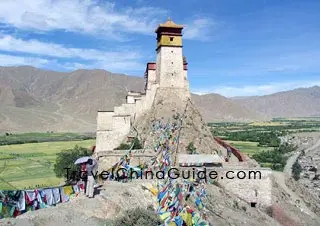
| Yumbu Lakang, Tibet |
Deciding what is ancient history and what is mysterious legend is not always an easy task. Tibet is no exception. Legend tells us that history of this high land starts with a monkey and a Raksasi, a female ogre, when the monkey was sent by Avalokiteshvara (Chenrezi) for the religious training on this high plateau. The Raksasi persuade the monkey to marry her by threatening to kill thousands of people. Having the permission of Avalokiteshvara, they married and had five offspring who are believed to be the ancestors of the local people. This legend is well known and depicted in ancient books and murals. Even the name of Tsedang, the capital city of
Shannan Region, means 'the place where the monkey plays'.
However, archeological and geological discoveries lead ethnologists to believe that people living on this land are descendants of aboriginal and nomadic Qiang tribes. According to archeology, history of this land can be traced back 4,000 years. At that time, life was simple, with stone implements being used. Historical records show that not until the 7th century could the livings here be recognized as a race of people. The rising Yarlung Dynasty (Tubo Kingdom) unified this land and became an aggressive power. The first palace in Tibet,
Yumbu Lakang was built for its first king, Nyatri Tsenpo. His offspring,
Songtsen Gampo,
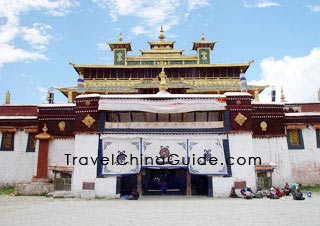 |
| Samye Monastery |
the most powerful and intelligent king of Tubo, conquered other tribes and founded the first dynasty of this land, Yarlung Dynasty (Tubo Kindom). Songtsen Gampo also made great contributions to the region's culture, economy, technology, religion, etc. by communicating with the outside world. The outstanding king of the Tubo Kingdom married two princesses of Nepal and of the Tang (618-907). The Princesses brought with them advanced technology, exotic culture, tea, silk and most important of all, peace and Buddhism.
Songtsen Gampo embraced the religion and the first transmission of Buddhism came to the snowy land. The king and the princesses built
Jokhang Temple and
Ramoche Temple to enshrine the holy statues of Sakyamuni. They also ordered the construction of the grand
Potala Palace. The king's successors followed the religion too and in 779 King Trisong Detsen set up
Samye Monastery, the first Buddhist temple on this land. The great religious teacher, Padmasambhava was invited there and Buddhism was recognized as the state religion. The Buddhist influence spread as the expansion of the Tibetan empire continued. The indigenous
Bon were not satisfied with the popularity that Buddhism held with the royal family. In 836, King Ralpachen was assassinated and Lang Darma , who believed in Bon and objected to Buddhism, was installed as King. Severe persecution against Buddhists ended the first Buddhism transmission. Lang Darma, in 842, was assassinated by a Buddhist and the collapse of the Yarlong Dynasty followed causing the decentralization of the region and a struggle for power for the next 400 years.
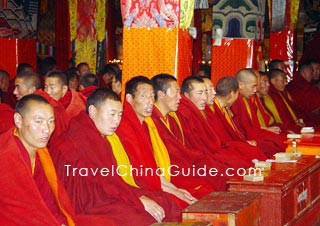 | | Gandan Monastery, Gelugpa Sect | | 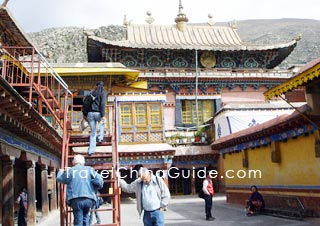 | | Drepung Monastery, Gelugpa Sect | |
In 1042, Atisa was invited to the land to launch the second Buddhism transmission and Buddhism gradually revived. Gradually,
Tibetan Buddhism divided itself into many sects and sub-sects, which rigorously debated with each other, vying for dominance by seeking patrons among the warring principalities. In the twelfth century, the Mongol Empire rose to power and expanded aggressively. Sakyapa, or the Stripe sect, was quite powerful among all the sects at that time. The Mongol Emperor negotiated with the abbot of Sakyapa and assisted him to become the ruler of the land. From then on, the region became an appendage of
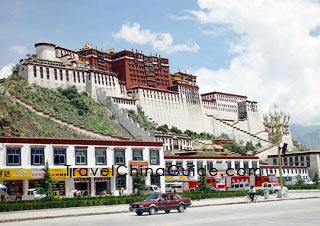 |
| Potala Palace |
the Mongol Empire. Later, the Mongol Empire conquered the Song Dynasty (960-1279) and founded the Yuan Dynasty (1271-1368). In 1254, Kublai Khan granted supreme authority over the snowy land to the leader of Sakyapa. Sakya Pandit was appointed to become the imperial preceptor and a high official in his court. The area was thus incorporated as one of the 13 provinces of China. At the end of the Yuan Dynasty, Sakyapa declined and was replaced by the Kagyu order, whose patron offered tribute to the imperial court and was conferred with titles and administrative authority. After the Ming Dynasty (1368-1644) was established, high lamas there were summoned to the imperial court to receive titles and appointments.
In 1644, Qing Dynasty replaced Ming Dynasty. In 1652, the Fifth Dalai Lama was summoned to Beijing, and in 1653 he was conferred with the title Dalai Lama and made religious leader of local Buddhism by Emperor Shunzhi (1643 - 1661). In 1727, the central government of the Qing Dynasty sent ministers there as a representative to supervise local administration. The boundary of Tibet and Sichuan, Yunnan, and Qinghai was then official set. The Qing government promulgated
Imperially Approved Ordinance for the More Efficient Governing of Tibet concerning many issues such as the duty of representative ministers, boundary military defense, finance, tax and the management of the temples etc in 1793. Since then, the major principles of the ordinance worked as the regulation for local regime and legislation for more than a century.
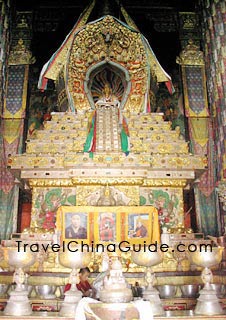 |
Stupa-tomb of the Tenth
Panchen Lama, Tashilhunpo |
In 1911, the Qing Dynasty collapsed and the Republic of China was founded. The government of Republic of China practiced the sovereignty of the area just as the Yuan, Ming and Qing Dynasties did. The central government set Mongolia and Tibet affair office and commission to execute the administration of Tibet nationality, Mongolia nationality as well as other minorities. In 1949, the People's Republic of China was founded. The PRC government adopted the policy of peace liberation and signed with local government
the Seventeenth Point Treaty. Later in 1959, Chinese government carried out a democratic reform of abolishing feudal serf system so that hundreds of thousands of serfs and slaves were free and no longer forced to labor.
With a steady development of the next several years, the Tibet Autonomous Region was officially set up in September, 1965. Up to now, this splendid pure land has received numerous visitors from all over the world ever since it is opened to the outside world.
Related Link: Songtsen Gampo
- Last updated on Aug. 15, 2025 by Demi Li -