As a country that pays great attention to courtesy, the food culture is deep rooted in China's history. As a visitor or guest in either a Chinese home or restaurant you will find that table manners are essential and the distinctive courtesies displayed will invariably add to the enjoyment of your meals and keep you in high spirits!
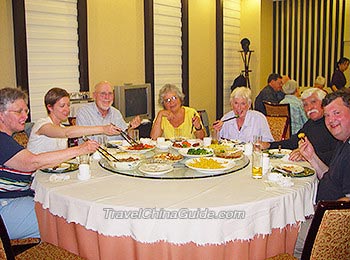 |
| Have a dinner on a round table in China |
Respect First
It is really an admirable custom to respect others at the table, including the aged, teachers and guests while taking good care of children.
Chinese people stress filial piety all the time. The practice of presenting the best or fine food first to the senior members of the family has been observed for countless generations. In ancient times the common people led a needy life but they still tried their best to support the elder mother or father who took it for granted.
Although the hosts in China are all friendly and hospitable, you should also show them respect. Before starting to eat dinner, the host may offer some words of greeting. Guests should not start to eat until the host says, 'Please enjoy yourself' or something like that, otherwise it suggests disrespect and causes displeasure.
When hosts place dishes on the table, they will arrange the main courses at the center with the supporting dishes evenly placed around them. When the main dishes are prepared in a decorative form either by cut or other means they will be placed facing the major guests and elder people at the table. This also embodies virtue.
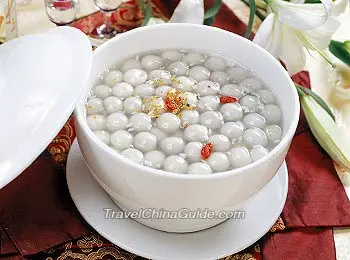 | | Yuanxiao on Lantern Festival | | 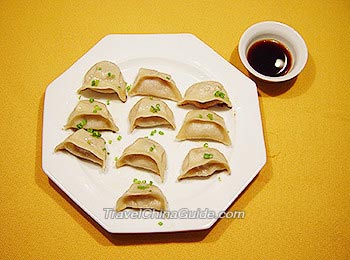 | | Jiaozi on Spring Festival | |
On Chopsticks
China is the hometown of chopsticks. The culture of chopsticks has a long history in China. The tradition of using chopsticks as tableware was introduced to many other countries in the world such as Vietnam, North Korea and South Korea.
The invention of chopsticks reflects the wisdom of Chinese ancient people. A pair of chopsticks, though they look simple, can nip, pick, rip and stir food. Nowadays, chopsticks are considered to be lucky gifts for marriage and other important ceremonies.
For more details, please click Chopsticks.
At Important Moments
To celebrate the birthday is important moment in one's life. When one is young, usually he will eat noodles before his birthday, because the long noodles indicate the longevity in China, and birthday cake on the actual day. After middle age, his birthday will grander. In addition to the above, peaches in many forms will be added symbolizing the longevity and immortality, as well as delightful couplets and candles.
On the wedding day, it is also customary to serve dates, peanuts, longan and chestnuts together as wish that the couple will soon have a baby in accord with the Chinese proclamation.
To most Chinese people, returning home after long absence or departure from home are both significant and there are dining customs associated with this. The return home is greeted with noodles and off home while a farewell is offered with dumplings. This is especially popular in northeast China.
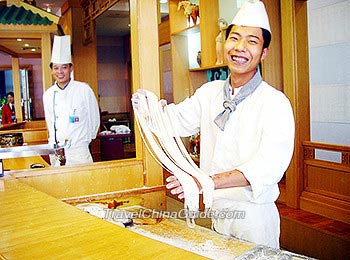 | Long noodles mean longevity in China,
so people eat noodles on birthday. | | 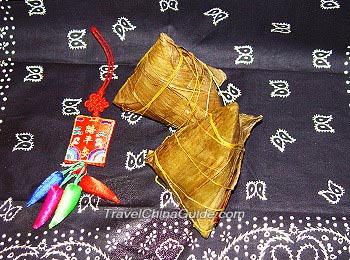 | Zongzi
on Dragon Boat Festival | |
During the Dragon Boat Festival, though many people cannot reach the riverside to watch the boat race, almost all of them eat zongzi, a pyramid-shaped dumpling made of glutinous rice wrapped in bamboo or reed leaves. The festival on that day is to venerate the patriotic poet Qu Yuan and the people fearing his body would be eaten by the fishes, threw Zongzi into the river to feed the fishes so that they wouldn't bite Qu Yuan's body. Now Zongzi is made in various shapes and sorts.
On the eighth day of the last month in the Chinese lunar calendar, people will enjoy a nourishing porridge called 'La Ba Zhou'. In ancient times, monks would kindly share all sorts of grains with people and made them flavorful porridge on this particular day. People still keep this convention.
In Central China, when a baby is born, the happy father will send red boiled eggs to announce the news. Eggs with a black pointed end and dots in an even number such as six or eight, indicates a boy's birth; those without a black point and in an odd number like a five or seven will say the baby is a girl.
In addition to these, fish has always been used to suggest the accumulation of prosperity and wealth with meals on New Year's Eve.
 You May Like:
15 Interesting Chinese Food Facts
Features of Chinese Food
Chinese Food History
- Last updated on Aug. 08, 2025 by Gabby Li -