Qin & Han Money - Ban Liang Qian & Wu Zhu Qian
Ban Liang Qian of Qin and Early Western Han Dynasty
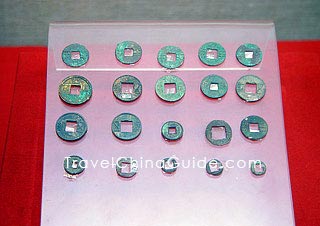 |
| Wu Zhu Coins and Ban Liang Coins |
Ban Liang coin can be said to have reached the foremost ideal of symmetry and balance. The round coin with a square hole in the center reflected the concept the round sky covering the square earth held by our ancestors. Round and square are representative of flexibility and strength respectively as well as mobility and stability. The round symbolizes heavenly commandment while the square symbolizes the authority of the emperor. Wherever the Ban Liang coins went, the prowess of the emperor would go.
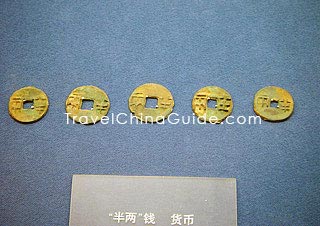 |
| Ban Liang Coins of Qin State |
The Chinese characters Ban Liang were written by Minister Li Si, the originator of zhuan shu (seal character), a font of Chinese calligraphy.
The value of Ban Liang was high compared to the low price for other goods. An interesting anecdote may help us to understand this. When Liu Bang stationed his army in Xianyang, most of officials gave him 3 Ban Liang coins while Xiao He, a well known general, gave him 5 coins. One year later, when Liu Bang became Emperor Gao Zu of Han Dynasty (206BC - 220AD), he regarded Xiao He's exploit as the most brilliant and endowed him most generously. Some people hold that besides Xiao He's achievement, these two extra coins were also a decisive factor.
In summery, the unification of currency promoted the exchange of commodities and economic development.
Two monetary records are notable during the Han Dynasty.
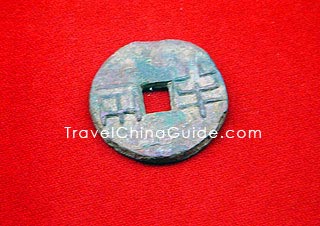 |
| Ban Liang Coin, Han Dynasty |
Wu Zhu Qian
- Last updated on Jun. 20, 2023 -
Questions & Answers on Qin & Han Money
Asked by bella from AUSTRALIA | Jun. 20, 2023 21:40 Reply
Reply
Replywas Qin a good king or a bad king?
Answers (1)
Answered by Dennis | Jun. 20, 2023 22:49 0
0 0Reply
00ReplyHe was cruel and did many bad things. But he was capable: he unified China and carried out many policies good to the country.
Asked by olivia from AUSTRALIA | May. 18, 2023 00:37Reply
ReplyWhy did Qin Shi Huang create currency?
Answers (2)
Answered by Joseph | May. 18, 2023 01:2800Reply
00ReplyIt was an important means for Qin Shihuang to establish and consolidate centralization and national unity through a unified currency system.
It helps to strengthen the financial power of the central government, facilitate the collection of national taxes, and prevents the residual forces of the original six countries from using their original money to destroy economic development and social stability.
At the same time, monetary unification has created favorable conditions for the exchange among various ethnic groups and promoted national unity and integration. That is, it consolidated the centralized rule and maintained the national unity.
It helps to strengthen the financial power of the central government, facilitate the collection of national taxes, and prevents the residual forces of the original six countries from using their original money to destroy economic development and social stability.
At the same time, monetary unification has created favorable conditions for the exchange among various ethnic groups and promoted national unity and integration. That is, it consolidated the centralized rule and maintained the national unity.
Answered by olivia | May. 18, 2023 01:3200Reply
00ReplyThank you so much im doing this for a test and im very stressed about it so you made my day and grade. Don't worry i wont copy paste.
Asked by Gayfeather from USA | Mar. 12, 2023 13:42Reply
ReplyHow much money was one coin worth in today's money(US Dollars prefferably)
Answers (1)
Answered by Paul | Mar. 14, 2023 19:0600Reply
00ReplyThere are many different types of ancient coins. Usually, the older the coin, the higher its value. The most expensive one was once sold out at CNY 41,975,000, about USD609,9471. The most common ones usually worth a dozen hundred to thousand CNY.
Asked by Doris from SINGAPORE | Apr. 12, 2016 08:17Reply
ReplyWhy did qin shi huang standardized the currency used?
Answers (2)
Answered by Dolly from UNITED KINGDOM | Apr. 12, 2016 21:50100Reply
100ReplyBefore the unification of the whole nation, there were numerous states around the country with various currencies, making the trades between different regions hard to achieve.
In addition, it restricted the economic development. The standardized currency solved this problem. It was also an important move to solidify the unity. :)
In addition, it restricted the economic development. The standardized currency solved this problem. It was also an important move to solidify the unity. :)
Answered by james | May. 07, 2023 17:0000Reply
00Replythank you dolly really helpful on my exam