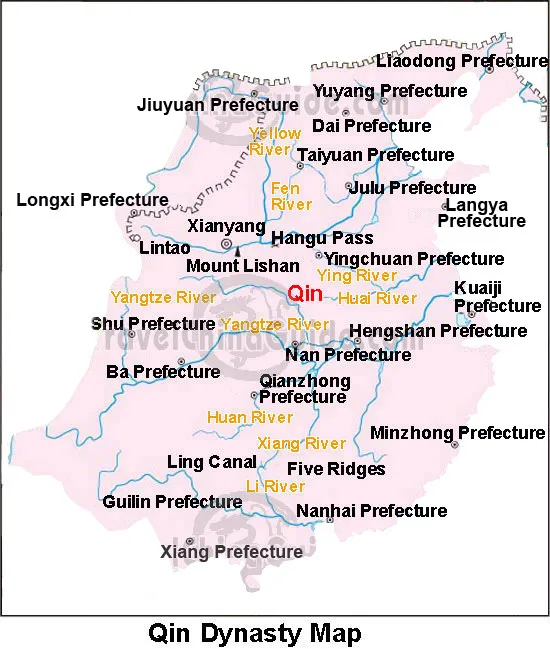
Qin Dynasty was the first unified, multi-national and power-centralized state in the Chinese history. It lasted from 221 BC to 207 BC. Although surviving only 15 years, the dynasty held an important role in Chinese history and it exerted great influence on the following dynasties. Only two emperors, Yingzheng -
Emperor Qin Shi Huang, the first emperor in the Chinese history, and his son Hu Hai ever ruled the state, which was finally overthrown by the people's uprising.
Political History
During the late Warring States Period (476 BC - 221 BC), the state of Qin was in its full development. When Yingzheng was in his reign, he defeated the other six states (Han, Zhao, Wei, Yan, Chu and Qi), from 230 BC to 221 BC. So ending the chaos caused by wars among vassals that had lasted over 500 years. He established a unified and centralized country and declared Xianyang, in Shaanxi Province, the capital city of the Qin.
A series of effective measures has been taken during the reign of Yingzheng. He contributed much to the development of his country. However, during the late period of his reign, he was cruel and oppressive to his people, and caused dissatisfaction. After he died, Hu Hai succeeded him. However, he was so fatuous that caused the uprising led by peasants, Chen Sheng and Wu Guang. Later the insurgency was led by Xiang Yu and Liu Bang. In 207 BC, Xiang Yu's army defeated the Army of Qin and Liu Bang swept into the capital which finally ended the Qin Dynasty.
At the end of the Qin Dynasty in 207 BC, war broke out between Liu bang and Xiang Yu. It was known as the Chu-Han war, and it lasted for four years, ending with the victory of Liu Bang, who later established the Western Han Dynasty.
Measures Taken by Emperor Qin
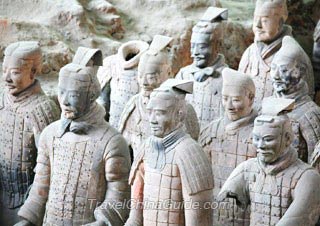 |
| Terra Cotta Army |
To strengthen the unity of the nation to perpetuate the Qin Dynasty, Emperor Qin carried out many reforms in politics, economy, military affairs, and culture.
In politics, he declared himself the Emperor of the state. All major powers including politics, economy, military affairs were in his hand. Executive organizations both in the central and local places were systematically reorganized and local counties were restructured.
In his economy, he standardized weights and measures and he stipulated that the round coin with square hole (
Ban Liang Coin) should be the coin used in the country.
In Addition, he standardized the written character, making the Qinzhuan the standard font. He also placed great importance on infrastructure: irrigation works and road building projects. The miracle of the world, the
Great Wall of China, was built under his order. All that he achieved had promoted the development of Qin's economy.
Emperor Qin Shi Huang was a tyrant despite his contributions to the country. To prevent his people to think freely, he burnt many books which he feared would affect people's thinking. Worse, in his second year, after he learnt some scholars' discussions about his arrogance, he buried 460 of them alive. In history, these two events are called 'To Burn the Books and Bury the Scholars Alive'. And yet, at the same time, he ordered to build luxurious palaces, the Great Wall, the famous
Terra-Cotta Warriors and Horses, together with his own
mausoleum, by imposing on the masses, through hard labor, heavy taxes, and rigorous law and military service, giving the community a difficult and arduous existence.
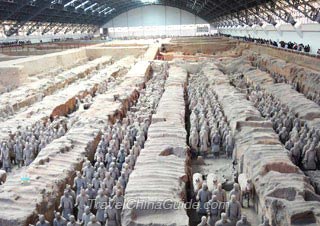 | | Pit 1 of Terracotta Army | | 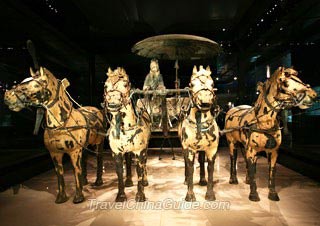 | | Bronze Chariot and Horses | |
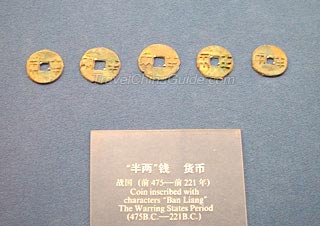 | | Banliang Coins of Qin Dynasty | | 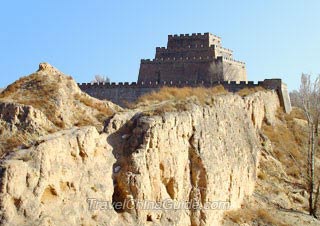 | | Zhenbeitai, Yulin, Shaanxi | |
- Last updated on Jun. 03, 2026 by Sherry Xia -