The Terracotta Army, also known as the Terracotta Warriors and Horses, consists of thousands of life-sized terracotta figures, each with a unique expression. Over 2,200 years ago, China's first emperor, Qin Shi Huang, ordered this underground army to be built as his guardians in the afterlife. Notably, the terracotta warriors accurately recreate a Qin army, with various military branches. Originally, these figures were painted in bright, vibrant colors, but after excavation, the pigments quickly cracked and peeled, leaving the earthy gray tones seen today. Known for its monumental size, lifelike craftsmanship, and deep historical significance, the Terracotta Army is celebrated as the "Eighth Wonder of the World" and stands as one of the two remaining greatest wonders. Additionally, it was inscribed on the UNESCO World Heritage List.
Today, you can find them at the Emperor Qin Shi Huang's Mausoleum Site Museum in Lintong District, Xi'an, about a one-hour drive from the city center. Walking into the museum and seeing these lifelike warriors lined up in battle formation up close is a memorable experience. It feels like stepping back in time and encountering soldiers from the Qin Empire thousands of years ago.
As China's first emperor, Qin Shi Huang took the throne at 13 and gradually unified the country by conquering six rival states. During his reign, he introduced reforms that shaped China for centuries: standardizing writing, currency, and measurements, and connecting and rebuilding the Great Wall. It was this ambitious ruler who ordered the construction of the legendary mausoleum, the Qin Shi Huang Mausoleum.
Qin Shi Huang's Mausoleum
This vast mausoleum was built as his empire for the afterlife, with construction starting early in his reign. Historical records say it took nearly four decades, at times employing hundreds of thousands of craftsmen and laborers. The central underground palace remains unexcavated, but surveys suggest a large space beneath the burial mound, possibly with mercury flowing to imitate rivers and seas. The entire mausoleum covers 56 square kilometers (22 square miles), an area equivalent to 78 Forbidden Cities. Within this vast area, over 600 burial pits have been found, and the grand Terracotta Army is just a small part of them.
It's believed that the purpose of these clay soldiers was clear: to guard the emperor in the next world and to ensure his continued rule over all realms. That's why each warrior looks so lifelike, because they weren't just symbolic funerary objects, but soldiers meant to accompany their sovereign into another battlefield.
In March 1974, a farmer named Yang Zhifa and his fellows stumbled upon some fragments of terracotta figures while digging a well in Lintong District, Xi'an. This accidental finding brought the Terracotta Army, buried for over two thousand years, back into view. By July of that year, an archaeological team had launched large-scale excavations. On October 1, 1979, the Terracotta Warriors and Horses Museum was established at the original site of Pit 1 and officially opened to the public. Later, additional pits and exhibition halls were unveiled, giving visitors the chance to see this incredible underground army up close.
Pit 1 is the largest, earliest excavated, and best-preserved among all the Terracotta Army pits. It holds over 6,000 terracotta figures across 14,260 square meters (about 3.5 acres), roughly the size of two football fields. Inside, rows of terracotta warriors and horses stand in perfect formations, each crafted to life-size proportions. Walking into the vast hall and seeing thousands of soldiers lined up as if ready for battle is a powerful, solemn, and, for most visitors, the most unforgettable part of their visit to the Terracotta Army.
Tip: Enter through the east gate, and you'll find an observation platform with a perfect panoramic view of Pit 1, also the best spot for photos.
Pit 2 shows a more complex military setup, featuring cavalry, charioteers, archers, and infantry all together. It represents a combined-arms force where different units operate in coordination, showcasing the multi-faceted combat capabilities of the Qin army.
Currently, excavation work continues here, offering visitors the opportunity to watch archaeologists at work in real time. Additionally, five display cases within the pit showcase different figures, including a kneeling archer, a standing archer, a cavalry figure, a middle-ranking officer, and a high-ranking officer. This allows visitors to appreciate intricate details up close, like their different headgears, decorative armor patterns, and even stitching on shoe soles.
Pit 3, spanning approximately 520 square meters (5,600 square feet), contains 68 warriors and a chariot drawn by four horses. Although the smallest among the three pits, its more discreet and defensive location suggests it was the command center for the entire underground army. Notably, this pit escaped damage by fire, leaving its terracotta figures remarkably well-preserved.
To commemorate the 50th anniversary of archaeological excavations at the Terracotta Army site, the museum opened a permanent exhibition on the second floor of the hall near Pit 2. It features 230 carefully selected cultural relics, many shown publicly for the first time, including colored warrior heads, a figure with purple sleeves, and stone armor and helmet.
Additionally, visitors can view some surviving weapons: bronze swords, crossbow, spears, and dagger-axes, which remain remarkably sharp despite more than two millennia underground. For those who have already explored the pits, this exhibition fills in the bigger picture of the entire mausoleum, with many cultural relics not visible in the pits themselves.
Beyond Terracotta Army Pits: More Interesting Experiences
Make Your Own Terracotta Warrior
At the Terracotta Warrior DIY experience hall near the museum, you can try to shape a small terracotta figure from clay and carve your name upon it, and experience the creative process that ancient craftsmen underwent two thousand years ago. After finishing, you can either take it home directly or have it fired and mailed to you later, as a truly unique souvenir.
You can also visit Yang Zhifa, the discoverer of the warriors, who lives just a short distance from the museum. He will tell you the story of that day in 1974 when his hoe first struck fragments of terracotta figures while digging a well. Remarkably, you might even see the exact hoe that unearthed the first piece of this ancient wonder.
The Terracotta Army is famous for its "a thousand warriors with a thousand different faces"; each figure has unique characteristics in height, face shape, hairstyle, headwear, clothing, mustache style, and even eyelid formation.
♦Types: Terracotta figures mainly include infantry, cavalry, chariot warriors, civil officials, and acrobatic figures. The horses come in two types: those for riding and those for pulling chariots.
Civil Official Figure
Strong Acrobatic Figure
♦Height: Most warriors stand approximately 1.8 meters (5.9 feet), with the shortest about 1.65 meters (5.41 feet) and the tallest exceeding 2 meters (6.6 feet).
♦Faces Shapes: About eight distinct types have been identified, with Chinese character "国"-shaped faces being the most common.
♦Hairstyles and Headgears: Two main hairstyles and five types of headgears help distinguish rank and status among warriors.
Hairstyle of Kneeling Archers
Headgear and Armor of High-ranking Officer
♦Clothing: Warriors typically wear knee-length gowns with long or short pants, armor, and either shallow shoes or boots.
♦Eyelids: Notably, every terracotta warrior discovered so far features single eyelids.
♦Mustaches: Seven main styles give each figure its unique character: some appear kind and gentle, while others look stern and serious.
♦Route: Pit 1 → Pit 3 → Pit 2 → Exhibition Hall of Cultural Relics ♦Duration: 2.5 - 3 hours Pit 1: 1 - 1.5 hours Pit 3, Pit 2, and Exhibition Hall: approximately 30 minutes each
Upon entering the museum, you can either take a ten-minute walk to the exhibition area or take the sightseeing bus. Then, go to explore the three pits and the exhibition hall.
Entrance of the Terracotta Warriors and Horses Museum
Tourists visiting the Terracotta Warriors
Route 2: The In-depth Tour
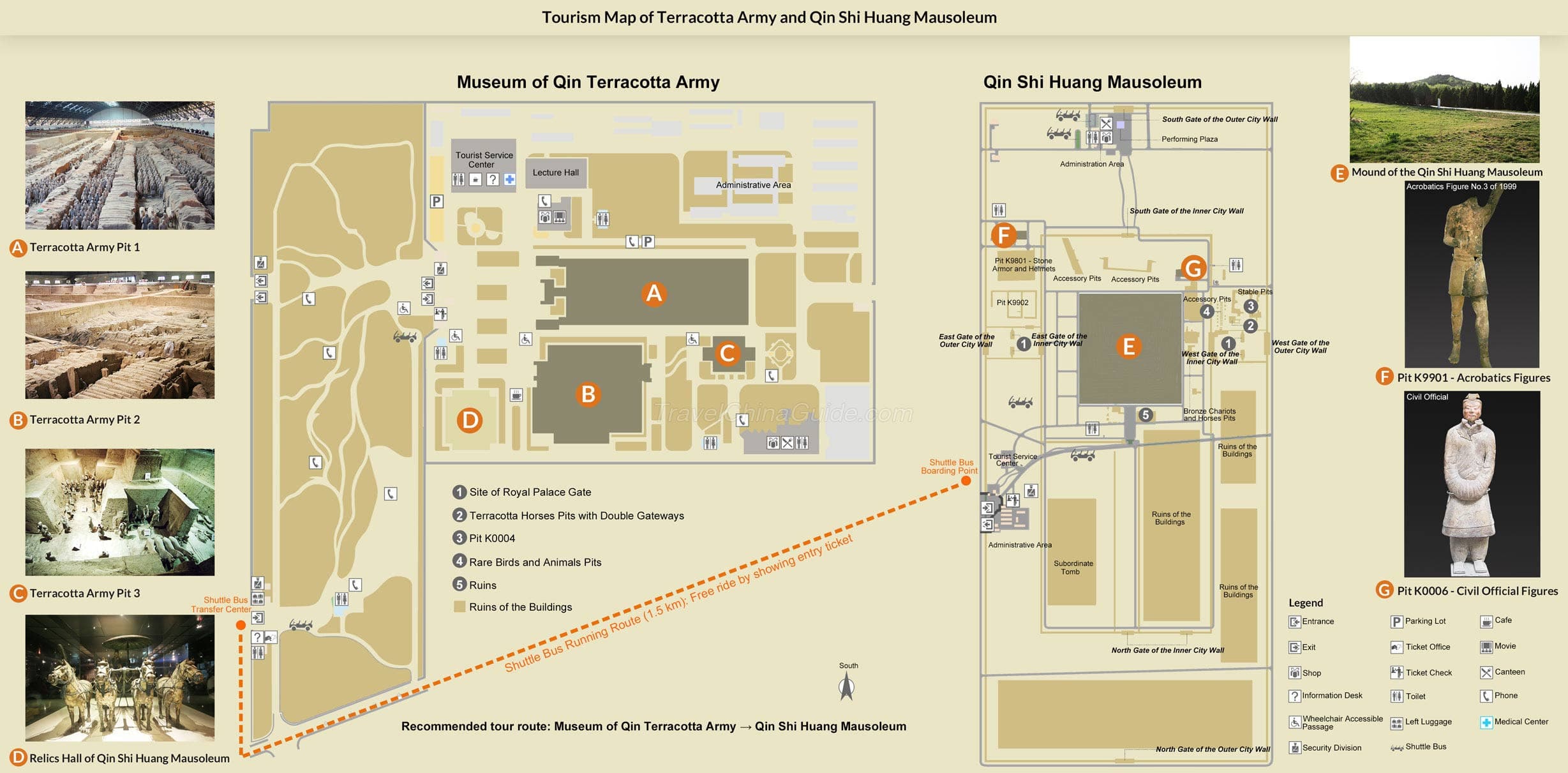
The museum complex includes two main areas: the Terracotta Army pits and Qin Shi Huang's Mausoleum. The ticket gets you into both. At the emperor's mausoleum, don't miss the two bronze chariots and horses, often called the "Crown of Bronze", along with various other terracotta figure types.
♦Duration: 6 hours 3 hours at the Terracotta Army + 1 hour for rest and lunch + 2 hours at Lishan Garden
After visiting the Terracotta Army pits, take a break for a meal and recuperate. Then, board the free shuttle bus to Qin Shi Huang's Mausoleum. Upon arrival, the sightseeing bus can be utilized to visit Pit K9901, the Museum of Bronze Chariots and Horses, and Pit K0006 in sequence, a process that typically takes around 2 hours. Finally, shuttle back to the Terracotta Army exhibition area.
Shuttle Bus Station to Lishan Garden
Sightseeing Bus, Lishan Garden
Tip: To avoid crowds, try visiting Qin Shi Huang's Mausoleum first upon arrival, then come back to the main three pits, thus ensuring a much more relaxed experience.
Yes, a professional guide makes a real difference. The true wonder of the Terracotta Army lies largely in its history. Without context, you might only see clay soldiers in big pits. Generally, it's advisable to book through a qualified agency beforehand rather than finding a guide casually at the gate.
Guests Enjoying Our Pickup Service
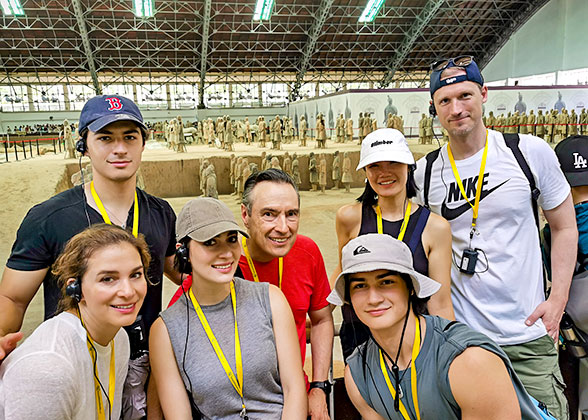
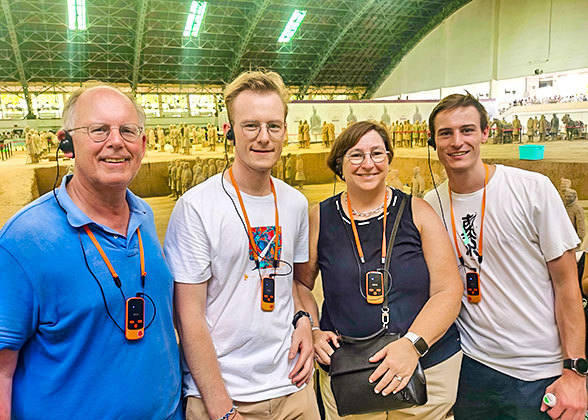
Our Guests in Terracotta Army Museum
Unlicensed guides around the site may take you to fake attractions or push you into various tourist traps, diminishing your experience. A reliable guided tour gives you a knowledgeable English-speaking guide as well as organized transportation and ticketing, allowing you to simply enjoy your Terracotta Army Experience.
1.Please bring your passport carefully, you'll need it for several security checks.
2.It's recommended to wear comfortable shoes as the site is large with plenty of stairs.
3.If possible, try to avoid visiting during major Chinese holidays, especially the summer vacations from July to August, the Spring Festival from late January to early February, the May Day holiday, and National Day week in early October, as the site becomes extremely crowded.
4.Be wary of people offering tours to artificial sites like the "Underground Palace" or "Eight Wonders Museum"; these are usually attempts to redirect you to fake attractions.
Opening Hours:
- March 16 - November 15: 08:30 - 18:30, last admission at 17:00. - November 16 - March 15: 08:30 - 18:00, last admission at 16:30.
The best time to visit the Terracotta Army Museum is after 15:00 on non-holiday weekdays, as this allows visitors to evade the bulk of the crowds and enjoy a more serene visit.
Terracotta Warriors with Golden Armors
Tickets:
Entrance Fee
CNY 120, access to both the Terracotta Army Museum and Qin Shi Huang's Mausoleum.
Sightseeing Bus
Terracotta Army Museum: CNY 5 Qin Shi Huang's Mausoleum: CNY 15
Visitors need to make a reservation seven days in advance via the official website or WeChat Official Account of the Emperor Qin Shi Huang's Mausoleum Site Museum. Since the ticket purchase page is not available in English, you can purchase it through a reliable third-party travel agency. Demand for Terracotta Army tickets is high. To ensure your visit proceeds smoothly, advance purchase is strongly recommended.
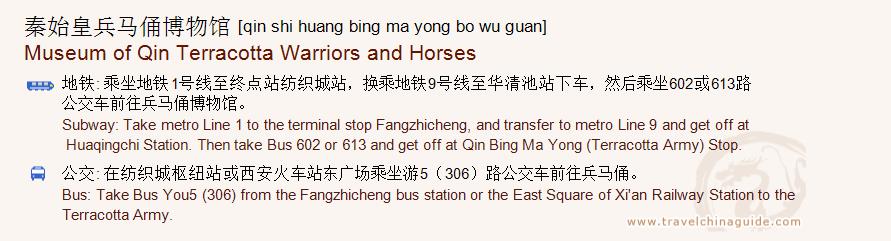
Take Metro Line 1 to Fangzhicheng Station, then transfer to Metro Line 9 to Huaqingchi Station. Exit from Exit C and board Bus No. 602 or No. 613, which will take you to the Terracotta Army within approximately 30 minutes.
Huaqingchi Station, Metro Line 9
2. By tourist bus: 1 hour, CNY 30 for a single-way
♦Boarding points:
East gate of Yisushe Grand Theater, near the Bell Tower
Aside from Xi'an, the Terracotta Warriors frequently travel abroad for exhibitions, and you may even encounter them in museums near your home. Currently, the latest international exhibition tour is on display at the Museum of Fine Arts in Budapest, Hungary, running from November 28, 2025, through May 25, 2026.
Since its excavation, the Terracotta Army has faced ongoing preservation challenges. Figuring out how to make them available for people to see while keeping them safe for the future is a tough balance to strike. It is hoped that as preservation technologies improve, these ancient treasures will receive increasingly effective protection.


 You may like:






 Tip: To avoid crowds, try visiting Qin Shi Huang's Mausoleum first upon arrival, then come back to the main three pits, thus ensuring a much more relaxed experience.