Bell Tower of Xi'an
Xi'an Bell Tower Facts
Location: at the city center of Xi’an
Height: 36 meters (118 feet)
First Built in: 1384
Number of Stories: Two
Layer of Eaves: Three
Central Landmark in Downtown Xi’an
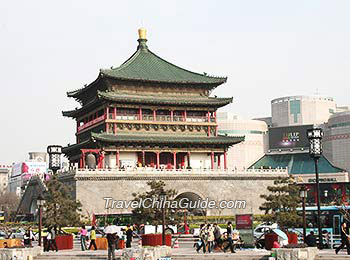
The Bell Tower, a stately traditional building, marks the geographical center of the ancient capital Xi’an. From this important landmark, extend East, South, West and North Avenues, connecting the tower to the East, South, West and North Gates of the ancient City Wall of the city.
 |
Largest and Best-preserved of Its Kind in China
It stands on a square brick base 35.5 meters (116.4 feet) long and 8.6 meters (28.2 feet) high on each side, and there is a 6-meter-high (20 feet) doorway on each side of the base. In the past, vehicles were allowed to pass through the arches, but as the city has grown the volume of traffic has become too great, so a bright, spacious pedestrian subway has been constructed under the tower. The entrance to the tower is from this subway.
It has three layers of eaves but only two stories. The three layers of eaves not only enhance beauty of the Bell Tower, but also reduce the impact of rain on it. Inside the building, a staircase spirals up. As a whole, the grey bricks of the square base, the dark green glazed tiles on the eaves, gold-plating on the roof, and gilded color painting make the tower a colorful and dramatic masterpiece of Ming-style architecture.
Sound of Bell, Flow of Time
 |
| Bell Tower and Drum Tower |
How did the Bell Tower Tell the Time in the Past?
Famous Jingyun Bell
 |
The Bell was once housed in the northwest corner of the Bell Tower but fell silent in Ming Dynasty although nothing had happened. Then it was moved to the current Stele Forest in Xi’an, and amazingly, its sound recovered later. The chime of Jingyun Bell was recorded and widely used in China nowadays, for instance, at 00:00 during Chinese New Year Gala to welcome the coming of the Chinese New Year. Currently on the Bell Tower, you can still find a one-to-one replica of the Jingyun Bell.
What Else in the Bell Tower?
|
|


Beautiful Night View of the Bell Tower

Best Places to Admire the Bell Tower
How to Get to Bell Tower:
 By Metro:
Take Metro Line 2 or Line 6 and get off at Bell Tower Station. The entrance to the Bell Tower is on the underpass and opposite Exit C.
 By Bus:
1. Take bus No. 6, 11, 26, 29, 35, 46, 203, 208, 603, 605, 608, 609, and 616 to Bell Tower South;
take 15, 32, 43, 45, 201, 215, 218, 221, 222, 251, 252, 286, 300, 604, 611, 618, and 622 to Bell Tower West;
take 4, 12, 37, 229, 235, 600, and 606 to Bell Tower North.
2. Xi'an City Sightseeing Bus
Almost all the city sightseeing buses pass by Bell Tower.
| Entrance Fee | Bell Tower only: CNY 30 Drum Tower only: CNY 30 Joint ticket of Bell and Drum Towers: CNY 50 |
|---|---|
| Opening Hours | 08:30-21:30 in peak season from April 1 to October 10, and admission stops at 21:00. 08:30-18:00 in off season from October 11 to March 31, and admission stops at 17:30. |
| Recommended Time for a Visit | One hour |
 Bell & Drum Tower Tickets Booking

 Recommended Nearby Attractions:
1. Great Mosque
2. City God Temple
3. Gao's Grand Courtyard
 Further Reading:
Top 10 Things to Do in Xian
Recommended Tours


- Last updated on Jul. 22, 2026 by Sherry Xia -