Han Yang Ling Museum - Yangling Mausoleum of Han Dynasty
Located about 20 kilometers (14 miles) to downtown Xi’an and approximately 20-minute-long drive from Xi’an Xianyang International Airport, the Yangling Mausoleum of Han Dynasty, in short Han Yangling, is a joint tomb of Liu Qi, a notable emperor of the Western Han Dynasty (202BC-8AD), and his empress Wang. The mausoleum was initially built in 153BC and the whole construction lasted for 28 years.
Covering an area of about 20 square kilometers (4,940 acres), this vast mausoleum comprises the emperor’s tomb, the empress’s tomb, accessory burial pits, and the ancestral temple site. Besides, an archaeological exhibition hall has been built in the south of the mausoleum area for displaying unearthed treasures.
Emperor Liu Qi's Tomb
(1) 亞-shaped Mausoleum - Exclusive to Emperors and Empresses
|
|

Covered and sealed by a 32-meter-high (105 feet) nearly square mound of soil, the emperor’s tomb is in the center of the whole mausoleum area. It has not been excavated yet but according to archaeologists, from an overhead perspective, the underground chamber has four passages to the south, north, east, and west, and thus the shape of the tomb assembles the traditional Chinese character “亞”. With the most passages, this type of tomb has the highest royal grade and was exclusive to emperors and empresses in ancient times.
(2) Protection Hall of Burial Pits - First and Largest Underground Museum in China
A total of 81 burial pits are radially arranged around the emperor’s tomb, and they vary in size. In the 1990s, archaeologists excavated 10 burial pits in the northeast part. In 2006, an underground museum, also the first and largest one in China, was completed right above these pits. The underground protection hall covers an area of about 7,850 square meters (2 acres) and is approximately as large as a football field. Innovatively, the walls and grounds of the underground museum are built with high-tech glass, not only allowing tourists to closely and clearly view the burial objects and even watching archaeologists excavating, as if they step into an archaeological site, but also providing a “safe” environment with stable temperature and humidity to the relics.
|
|
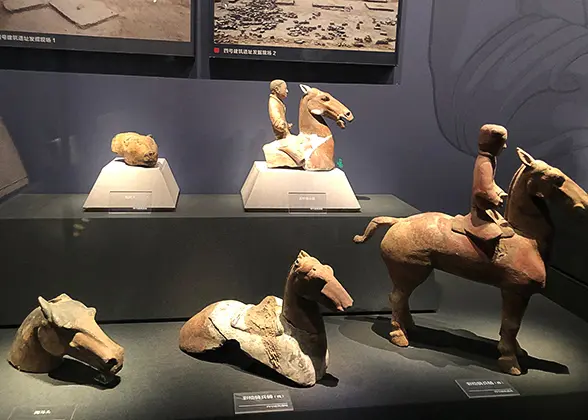
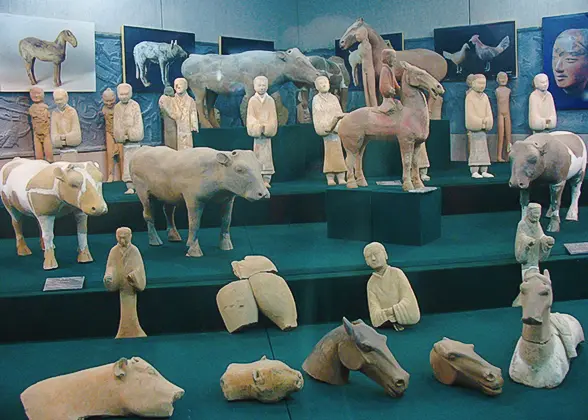
Back to the Western Han Dynasty, “Treat the dead as if he is still alive” is the common principle to build a mausoleum. Therefore, the burial pits contain rows and rows of pottery figurines, chariots and horses, weapons, articles of everyday use and a large number of pottery animals, to make sure the emperor can still enjoy a good life in his afterlife. Among them, Pit 12 is used to deal with royal family and lineage affairs, Pit 13 is a food storage facility, Pit 16 is the kitchen, and Pit 19 is the Cold Palace.
|
|

(3) South Tomb Gate Ruins Exhibition Hall
The tomb is surrounded by four rammed-earth walls, each with a gate in the middle. On the site of the south gate, only the ruins including broken enclosed walls and platforms can be seen. Nowadays, to protect the ruins, a majestic “gate” with three connected towers in Han-style has been constructed and further serves as an exhibition hall. It should be noted that in ancient times, a gate with such a structure can only be used for emperors. From this newly-built gate, a panoramic view of the emperor’s tomb can be gained.

Empress Wang's Tomb - Not Opened Yet
The Empress Wang’s tomb is about 450 meters (490 yards) to the northeast of the emperor’s tomb and is smaller in size. Similarly, the empress’s tomb is also surrounded by rammed-earth walls in four directions and the 26-meter-high (85-feet) soil mound on the tomb is also approximately square-shaped. Empress Wang was also buried in a 亞-shaped tomb with four passages extending to four cardinal directions. Protected by solid rails now, the tomb doesn’t open to the public.
Archaeological Exhibition Hall - What to See Inside
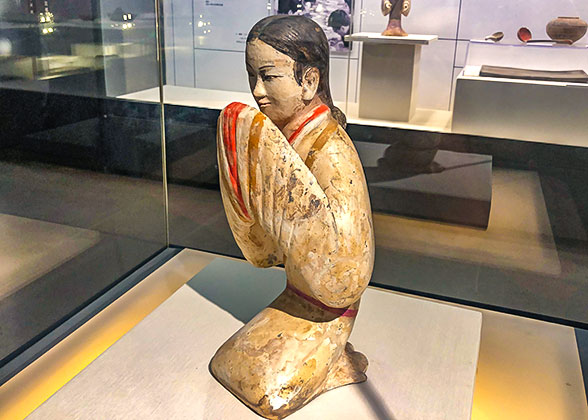
1. “China’s Initial Smile” - Mascot Shanshan: The Painted Terracotta Squatting Female Figure impresses people with her gentle smile and elegant appearance. Her hands cover the lower part of her chin, making her smile even more attractive.
 |
| Mascot Shanshan |
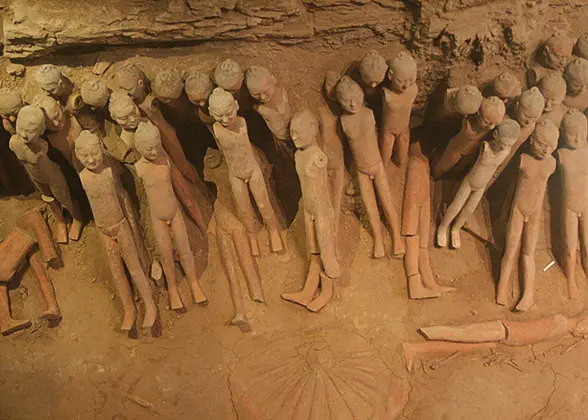
2. “Oriental Venus” - Naked and Armless Pottery Figurines: You may be curious about their missing clothes and arms. When the pottery figurines were made, they indeed had wooden arms and wore silk and fibrilia clothes. But after being buried for more than 2,000 years, the arms and clothes decayed and disappeared.
|
|


3. Earliest Tea Leaves in the World: Unearthed in Pit 15 in 1998, the specimen of tea leaves has been included in “Guinness World Records” as the world’s earliest tea leaves with a history of more than 2,000 years.
4. Earliest Chessboard in China: Although this chessboard, unearthed in the south gate site in 2005, is not a complete one, you can still find cross lines and a cross mark on it.
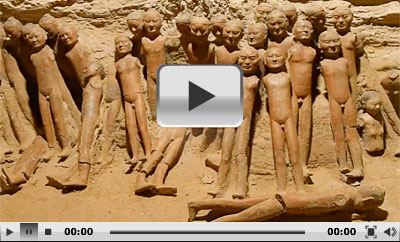
Luojing Stone on Ancestral Temple Site
To the southeast of the emperor's tomb is the Ancestral Temple Site on which archaeologists found the round Luojing Stone with a diameter of about 1.4 meters (1.5 yards) and a cross-line mark. The site, as an important and one of the largest discovered ceremonial sites of the royal cemetery in China, is surrounded by moats and is almost square, and is 260 meters (280 yards) in length. Besides, the Luojing Stone in the center of the site sits on a square pounded-earth platform. Therefore, the site is generally in the shape of “回” from an overhead perspective.
Spring Flowers and Autumn Leaves
The Han Yangling Museum also features beautiful natural views in the southern part: In April, cherry blossoms are delicate on both sides of the road; fragrant China Roses in May are in full bloom; and most importantly, from late October to November, rows of ginkgo trees are in vibrant gold and the whole ginkgo forest is an excellent photography spot.
China’s First Simulating Archaeological Base
On May 17th, 2012, China launched its first simulated archaeological base in Han Yangling Mausoleum. In the excavation simulation, visitors are allowed to use professional archaeological tools including Luoyang shovels for probing to excavate under the guidance of archaeological experts. When a "ruin" or "relic" is discovered by visitors, experts share knowledge about artifacts, including identification, dating and usage on the spot.
Han Yangling Mausoleum vs. Qin Shi Huang Mausoleum (Terracotta Army)
1. Compared with the life-size Terracotta Army of Qin Shi Huang Mausoleum, terracotta figurines unearthed in Han Yangling are just one third of real humans. They are warriors, civilians, and servants, and you can also find valiant female warriors which Qin Shi Huang Mausoleum doesn’t contain.
2. From the strong bodies and the solemn faces of terracotta soldiers, you will know how powerful the military of the Qin Empire was and the ambition of Emperor Qin Shi Huang for territory expansion and unification of China. While during the reign of Liu Qi, the country was relatively peaceful and stable, no wonder the pottery figurines in his burial pits have peaceful facial expressions.
|
|
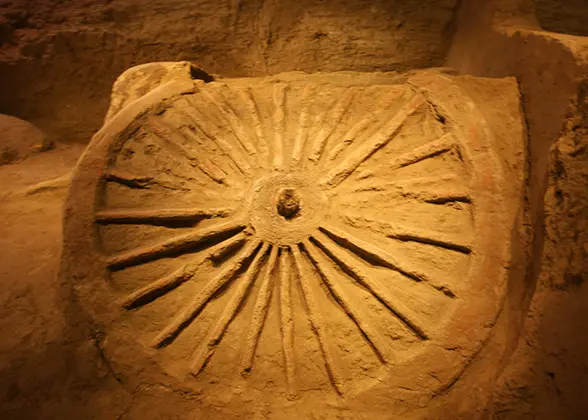
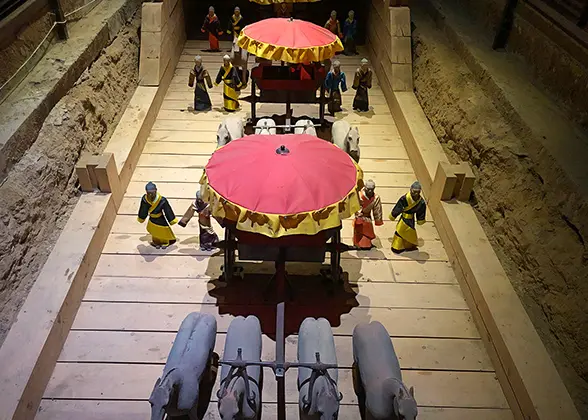
3. Also, in Han Yangling Mausoleum with a great many of pottery animals including horses, oxen, pigs, sheep, dogs, and chickens, you will know how abundant was people’s life back then. In terms of articles of daily use, those unearthed in Han Yangling Mausoleum are also of a richer variety. Eaves tiles, cooking utensils, drinking vessels, gold and silver wares, and jade articles are all witnesses of the rise and prosperity of the Han Dynasty.
|
|


4. Compared with Emperor Qinshihuang's Mausoleum Site Museum, Han Yangling Museum is not that crowded, so you can gain better travel experience.
Han Yangling Museum Travel Tips
1. The recommended route for visiting Han Yangling Museum is as follows:
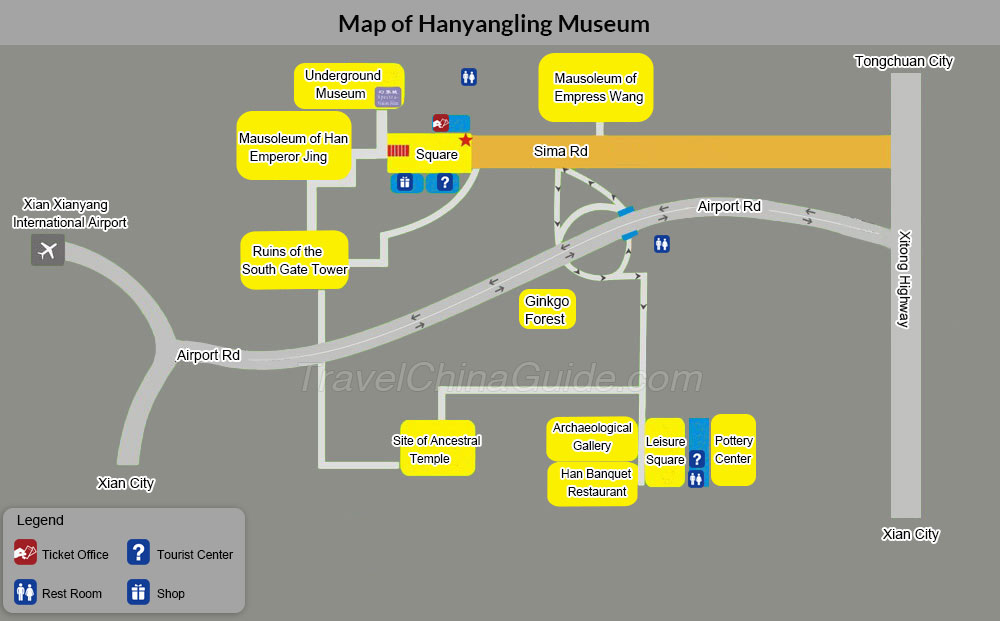
Entrance - Archaeological Exhibition Hall - walk for about 10 minutes and pass the soil mounds of the emperor’s and empress’s tombs - underground museum - walk for 5 minutes to the site of the south gate - walk for 5 minutes to the east and admire the ancestral temple site - Exit.
2. To protect the underground museum to the largest extent, during the visit, tourists need to wear shoe covers prepared by the museum staff, and please walk steadily in case of falling down on the glass ground.
3. No flash when taking photos, and in some areas, photography is banned. Around the whole mausoleum area, no drone can be used.
Take Metro Line 2 to Honghui yiyuan beiqu, North District of Honghui Hospital, Station, get out from Exit B or C, and then take a taxi to get to the museum. The taxi journey takes about CNY 20 (USD 3) and 20 minutes.
Xi'an Bus / Metro Search
How to Get to Yangling Mausoleum of Han Dynasty from Xi'an
Xi'an Bus / Metro Search
| Fee | March to November: CNY 70; |
|---|---|
| Opening Hours | March to November: 8:30-18:30, and tickets are available from 8:30 to 17:00. |

 Read More:
 Top 10 Things to Do in Xi'an 4 Sites of Terracotta Warriors besides Xi’an Terracotta Army
 Recommended Tours
- Last updated on Aug. 06, 2025 by Alex Jin -