Small Wild Goose Pagoda
Small Wild Goose Pagoda, located inside Jianfu Temple and adjacent to Xi’an Museum, is one of the most important landmarks in south Xi’an. As a UNESCO World Heritage, this Buddhist pagoda built in the Tang Dynasty (618-907) has witnessed how Buddhism was introduced to China and integrated with traditional Chinese culture. It is widely considered as the “sister building” of Giant Wild Goose Pagoda.
 |
 Small Wild Goose Pagoda Photos Small Wild Goose Pagoda Photos |
Look Like An Emerging Bamboo Shoot
 |
| Bamboo-shoot-shaped Pagoda |
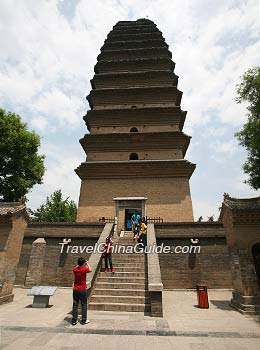
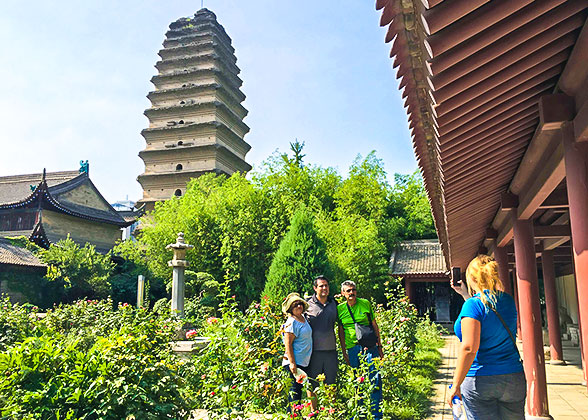
The square base is about 11 meters long each side, and the upper stories feature multiple eaves with overlapped bricks. The first story of the pagoda has two doors facing south and north respectively, and windows are arranged at the same positions on each of the upper stories. From an overall perspective, the pagoda looks like an emerging bamboo shoot with slightly curved lines on all sides.
Why called Small Wild Goose Pagoda?
When talking about the Small Wild Goose Pagoda, the famous Giant Wild Goose Pagoda is certainly unneglectable. Actually, its present name is closely related to the "Giant Wild Goose Pagoda".
The Small Wild Goose Pagoda was once called "Jianfu Temple Pagoda".
In the Yonghui Period (650-655) under the reign of Tang Emperor Gaozong, “Wild Goose Pagoda” was built in the Da Ci’en Temple to store the sutras which the eminent monk Xuan Zang had brought from India to Chang’an, today’s Xi'an. In the Jinglong Period (707-710) under the reign of Tang Emperor Zhongzong, “Jianfu Temple Pagoda” was built in order to store the Buddhist sutras that Monk Yi Jing had brought from India.
Because it looked like the “Wild Goose Pagoda” but was a little bit smaller, “Jianfu Temple Pagoda” was called the “Small Wild Goose Pagoda”, while the previous “Wild Goose Pagoda” in the Da Ci’en Temple became known as the “Giant Wild Goose Pagoda”.
Small Wild Goose Pagoda vs. Giant Wild Goose Pagoda
|
|
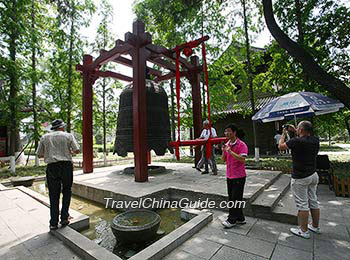
1. Giant Wild Goose Pagoda and Small Wild Goose Pagoda have similar functions and roles: they are both constructed in the Tang Dynasty for storing Buddhism sutras brought from India, and listed as the UNESCO World Heritage with unmeasurable historic value.
2. The Small Wild Goose Pagoda has gentle appearance. Standing on the surrounding areas of the Small Wild Goose Pagoda, you will find it exists harmoniously with surrounding natural scenery including ancient trees and lovely flowers like an elegant lady. As for the giant one, it features a rectangular pyramid shape with sharp lines, looking more majestic like a strong man.
3. The Giant Pagoda is indeed more popular from the early time, so it is quite commercial and crowded now, and the admission fee increases a lot. The small one with quite peaceful environment and pleasant scenery is different, and especially it also boasts a museum along with. Besides, this site is totally open for free.
Magical “Three Cracks and Three Healings” in Earthquakes
Since its completion, the Small Wild Goose Pagoda has withstood more than 70 earthquakes, with 11 of them being highly destructive and occurring right in Xi'an. Among these numerous seismic events, the pagoda has witnessed at least three instances of cracking and healing.
The first time was in 1487, when the pagoda experienced earthquakes and developed a vertical longitudinal crack from top to bottom, with a width of more than 30 centimeters (12 inches). Yet, 34 years later, in 1521, another earthquake hit Xi'an. Against all odds, the pagoda emerged unscathed from this new quake, and the crack caused by the previous one miraculously sealed shut.
The second time was in 1556, when a massive earthquake of magnitude over 8.0 struck Shaanxi. As the epicenter, Xi'an endured catastrophic damage. During this seismic disaster, the top two floors of the Small Wild Goose Pagoda were destroyed, reducing its height from fifteen floors to thirteen, and the tower body was cracked again. Then, eight years later, in 1563, in the aftershock of another earthquake, the cracks on the pagoda's body once again vanished as if they had never been there.
The third cycle occurred in 1691, when an earthquake caused the Small Wild Goose Pagoda to crack once more. And in 1721, during another earthquake, these cracks astonishingly closed up, with a thirty-year interval between cracking and healing.
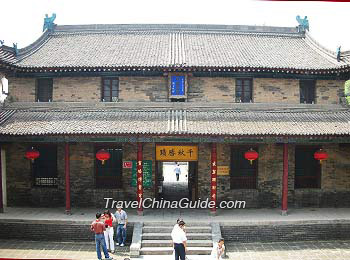 |
| Attractive Spring View of Small Wild Goose Pagoda |
How did the Pagoda survive countless earthquakes and even repair the cracks itself?
1. Ancient artisans, considering the geological features of Xi'an, ingeniously constructed the pagoda's foundation into a semi-spherical rammed-earth structure. This unique design allows the pagoda to distribute the pressure it receives during an earthquake. As a result, much like a tumbler toy, the Small Wild Goose Pagoda has remained upright after experiencing many earthquakes.
2. The square base on the ground and also slightly tapering pagoda body just keep the pagoda’s center of gravity in the lower part, making the pagoda even steadier.
3. The quality of pagoda bricks are guaranteed by brick makers, and they even stamp their handprints on the bricks to make sure they are hard and sturdy.
Small Wild Goose Pagoda Travel Tips
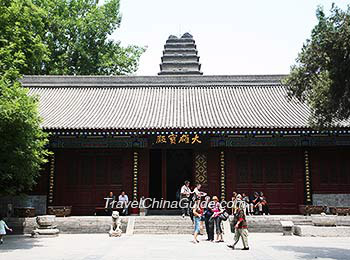 |
| Cherry Blossom around Small Wild Goose Pagoda |
2. Scenery around the Small Wild Goose Pagoda is beautiful all year round: From late March to early April, cherry blossoms are delicate in warm and breezy weather. From late May to June, pink and purple hydrangeas bloom in clusters to the northeast of the pagoda. From mid-June to mid-July, lotus flowers are the highlights. From late October to November, rows of red maples and golden ginkgo trees are impressive.
How to Get to Small Wild Goose Pagoda
 By Metro
Take Metro Line 2 or Line 5 and get off at Nanshaomen Station, get out from Exit F, walk westward for about 6 minutes, and get in through the North Gate.
 By Bus
Take Bus No. 21, 40, 46, 203, 224, 258, 521, 410, 700, or Tourist Line 7 and get off at Xiaoyanta / Small Wild Goose Pagoda Station, and get in through the North Gate.
| Admission Fee | Free, but tickets still need to be booked online or at the ticket office of the attraction at most 5 days in advance. |
| Opening Hours | 8:30-18:00, and last admissions are at 17:00. (1) From May 1 to October 31, the attraction opens every day. (2) From November 1 to April 30, the attraction is closed every Tuesday, except for China Public Holidays, and also China's New Year Eve. (3) From July to August, in consideration of the school summer holiday, the attraction may extend its opening hours, so it’s wise to check beforehand. |
 Top 10 Things to Do in Xi'an
Recommended Tours

- Last updated on Jul. 22, 2026 by Sherry Xia -