Beijing Bell and Drum Towers
As a part of the 7.8km long Beijing Central Axis, Bell and Drum Towers are visibly prominent constructions and represent the symbol of this old city, and have been inscribed on the UNESCO World Heritage List on July 27, 2024. They were built in 1272 and rebuilt twice after two fires. At one period in history they were the time-telling center of the capital city during the Yuan, Ming and Qing Dynasties (1271-1911).
 |
The bell and the drum were originally used as musical instruments in China. Afterward, however, they were used for telling time. As early as in the Han Dynasty (206 BC-220), there was 'a morning bell and a dusk drum'. Telling the time by them played an important role in helping people live and work regularly when there was no other means to keep track of the time. As a result, the towers holding the bell and the drum became public architectures, and were widely constructed in almost every city throughout the country since the Han Dynasty. In the history of their construction, they are the largest and highest. Their layout is unique, in that they were placed fore-and-aft, not as the traditional sense of standing right-and-left horizontally.
Bell Tower
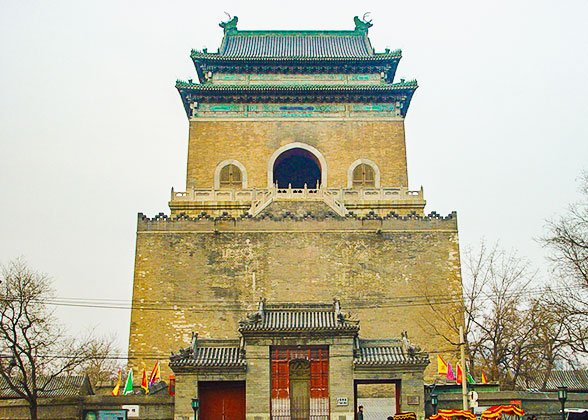
This brick and stone made building has two floors: there is an arched door on all four sides on the first floor, and you can go up to the second floor through stone stairs. The same exists on the first floor. An arched door was also built on the four sides of the second floor. Additionally, there is a stone window on each side of the four doors. Hanging on an eight-square wooden frame of the second floor, the bell in it is the largest and heaviest in China. It is 23 feet (7.02 meters) high including the pendants, with a weight of 63 tons. It was made of copper, and you can hear its round and clear sound from far away. The two 2-yard-long (2 meters) wooden logs hanging sideward are used to ring it.
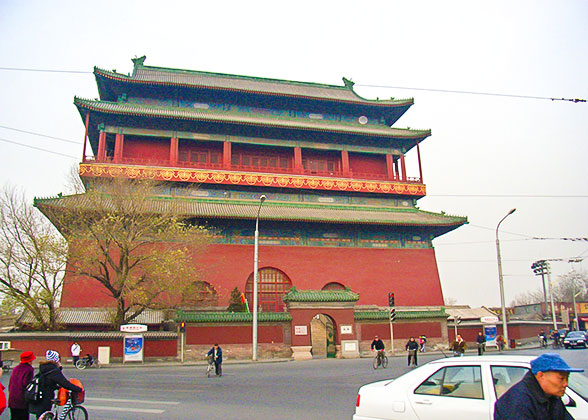
Located 110 yards (91 meters) south to the Bell Tower, it was placed on a 13-feet-high (4 meters) stone and brick base. It is 153 feet (46.7 meters) high, a little bit lower than the Bell Tower that is 157 feet (47.9 meters) high. It is also a two-storey building; the first floor contains the China Committee for the Promotion of the Minority Art. The second floor contains the exhibition area. Originally, there was one big drum and 24 smaller ones, but only the big remains. The method of beating it is to beat it quickly for 18 times and then slowly for 18 times. Altogether there are three rounds and 108 tollings. People knock the bell and the drum 108 times, because 108 times represent one year in ancient times.
 |
Telling time by them was abolished after Pu Yi, the last emperor of China, left the Forbidden City. Since the New Year's Eve of 1990, the sweet sound of the bell that had disappeared for a long time began to ring out in the city. Being drowsy for nearly a century, the drum was also beaten again on the New Year's Eve of 2001. It has been beaten four times a day, for 15 minutes at a time since January 1st in 2002. From then on, every New Year Eve, they are beaten together 108 times to send a blessing to the people.
Their location has been flourishing since the Yuan Dynasty (1271-1368), when they were just standing behind the imperial palace. It was the busy downtown district there then, full of storefronts and businesses. Thanks to the further developing of the businesses, the street in front of the Drum Tower became the busiest shopping street in the Ming (1368-1644) and Qing (1644-1911) Dynasties. During the Republican Period of China (1911-1949), many have-nots (impoverished people), along with merchants selling handcrafted items (handicraftsmen) and vendors selling snacks and local food items (snack stands) swarmed the place between them, which attracted people from all walks of life at that time.Today, when visiting, you can climb onto them to have a birds-eye view to admire the entire city, and even take part in the activity of knocking them, appreciating all kinds of folk-customs, such as the dragon and lion dance, and other folk-custom exhibitions.
How to get to Bell & Drum Towers
 By Subway:
1. Take Subway Line 8 and get off at Shichahai Station. Get out from Exit A2 and walk northwards straightly for about five minutes to the Drum Tower.
2. Take Subway Line 2 and get off at Guloudajie Station. Get out from Exit G and walk south for about 10 minutes to the Bell Tower.
 By Bus:
Take bus 82 or135 and get off at Gulou (Drum Tower) Station.
Beijing Bus / Subway Search
| Admission Fee: | Bell Tower: CNY 10; Drum Tower: CNY 20 Combo ticket: CNY 30 |
| Opening Hours: | March 26 - October 25: 09:30 - 17:30 October 26 - March 25: 09:30 - 16:30 Close on Mondays Drum Performances at the Drum Tower: 10:00, 11:00, 13:00, 14:00, 15:00, 16:00, 17:00 |
 The ticket can be bought on-site with passports.
  Further Reading:
Xian Bell Tower
Xian Drum Tower
Zhangye Bell and Drum Tower
10 Fun Things to Do in Beijing with Family
 Recommended Nearby Attractions
 Dianmen