

Ming Tombs (Thirteen Tombs of Ming Dynasty)
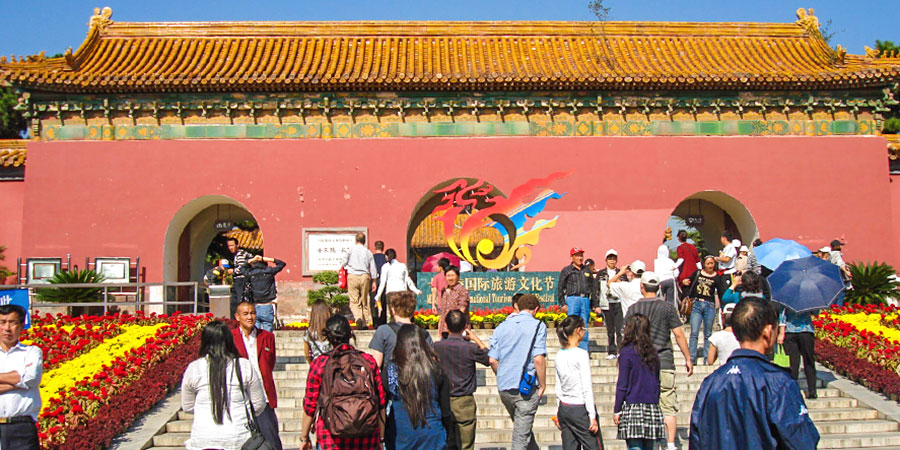
50 kilometers (31 miles) northwest from Beijing City, at the foot of Tianshou Mountain, is the Ming Tombs Scenic Area, aka Thirteen Tombs of Ming Dynasty, where lie the mausoleums of thirteen emperors of the Ming Dynasty (1368 - 1644). Since 1409 when Zhu Di, the first emperor of the Ming Dynasty, built his Changling Tomb here, the succeeding twelve emperors had their resting places built around Changling during the next 230 years, covering a total area of over 120 square kilometers (46.3 square miles). This is the best preserved mausoleum area with the most emperors buried. Every year millions of tourists come to the site to appreciate its long history and palatial architecture.
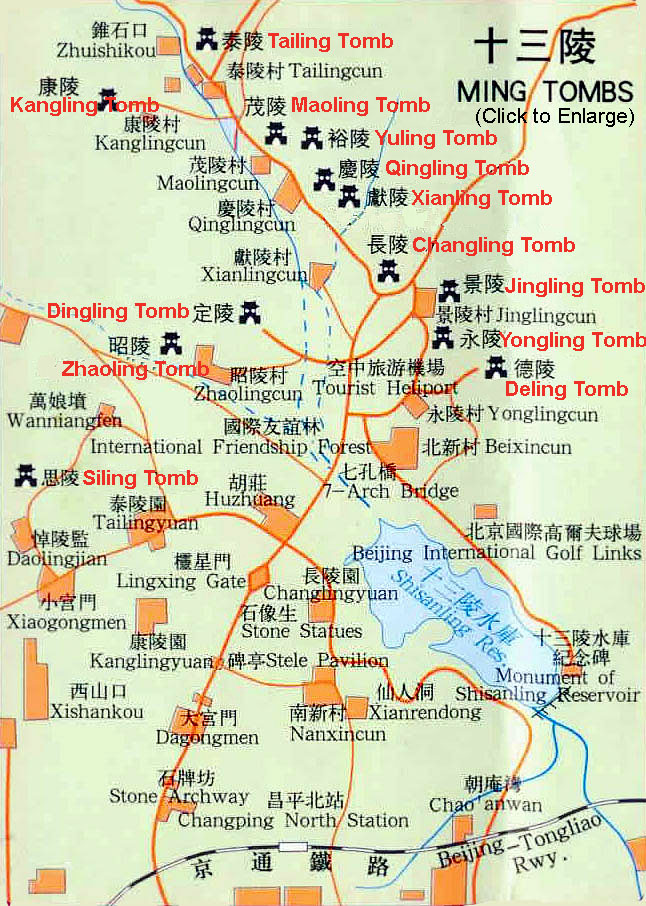
In the Ming Dynasty Tombs scenic area, each mausoleum has its own independent unit. The layout and arrangement of all the thirteen mausoleums are very similar, but they vary in size as well as in the complexity of their structures. Each was built in an area at the foot of the mountain, with distances ranging from half a kilometer (547 yards) to eight kilometers (5 miles) between them. The tombs stretch out on the two sides of Changling Tomb in a fan shape, except for the Siling Tomb, which sits separately in the southwest corner. From site selection to design, great attention was paid to the harmony and unity with nature, pursuing a perfect situation of ‘made by God’ and reflecting the philosophy ‘the unity of heaven and humanity’. As outstanding representatives of the ancient Chinese mausoleum, the Ming Tomb China demonstrate the richness of traditional Chinese culture.At present, only Changling Tomb, Dingling Tomb, Zhaoling Tomb and the Sacred Way are open to the public.
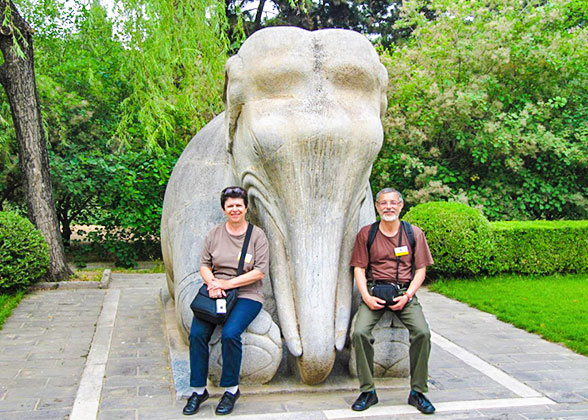
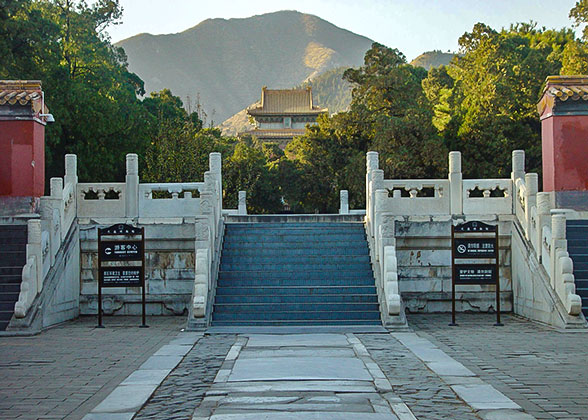
The Sacred Way in Ming Tombs, also known as Changling Sacred Way, is the approach to the Changling Tomb. Along the Way from south to north, you will see a number of sites (or sights) of interest and beauty, including the Stone Tablet Archway, Great Red Gate, Tablet Pavilion, Ornamental Columns, Stone Figures, Lingxin Gate.
Walking along the Sacred Way to the end, you can see the Changling Tomb built in 1409, where lie the third Emperor of Ming Dynasty, Emperor Zhu Di and his Empress Xu. It is the largest, original and the best preserved among the 13 Ming Tombs, and has three courtyards in the front and a Treasure City in the round rear part. The magnificent Grace and Blessing Palace (Ling'en Palace) in the second courtyard is highly recommended.
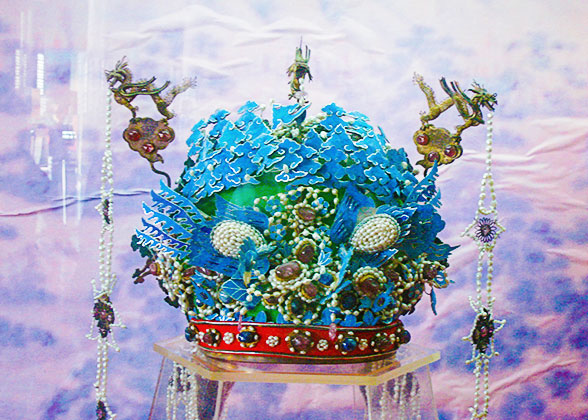
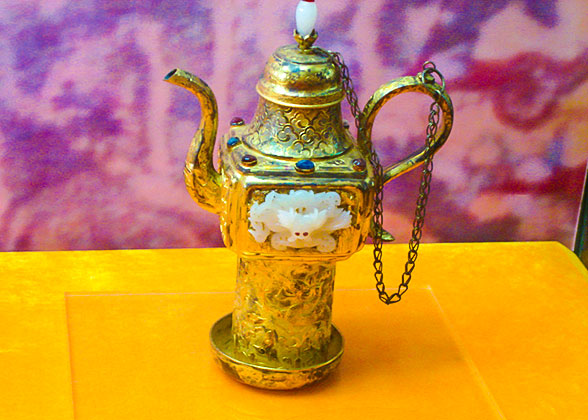
Built from 1584 to 1590, it is the mausoleum of Emperor Zhu Yijun, the thirteenth emperor of the Ming Dynasty and his two empresses. The highlight part is the stone Underground Palace, which was discovered between 1956 and 1958, and had a great deal of precious relics unearthed.
Located in eastern foot of Dayu Mountain, Zhaoling is where the 12th emperor of the Ming Dynasty, Emperor Zhu Zaihou and his three empresses were buried. It features the special Dumb Yard in a crescent shape housing the imperial coffins.
Besides the three tombs above, other ten in Ming Tombs not open to the public are as follows:
By Bus:
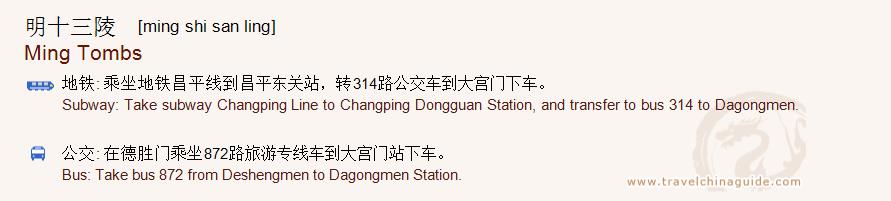
Take bus 872 from Deshengmen Bus Station to Dagongmen stop; the bus is available from 7:00 to 20:10.
By Subway:
Take subway Changping Line to Changping Dongguan Station, then walk westward for 750 meters (820 yards) to transfer to bus 314 and get offf at Dagongmen stop.
Or walk westward for 500 meters (547 yards) to take Chang 67 to Dagongmen. At Dagongmen bus stop, walk for 300 meters (328 yards) to Ming Tombs.
Notice that don't get off at Ming Tombs Subway Station, since it is still 4 kilometers (2.5 miles) from the scenic area and you can only hire a local car and may be overcharged.
In the Ming Dynasty Tombs scenic area, each mausoleum has its own independent unit. The layout and arrangement of all the thirteen mausoleums are very similar, but they vary in size as well as in the complexity of their structures. Each was built in an area at the foot of the mountain, with distances ranging from half a kilometer (547 yards) to eight kilometers (5 miles) between them. The tombs stretch out on the two sides of Changling Tomb in a fan shape, except for the Siling Tomb, which sits separately in the southwest corner. From site selection to design, great attention was paid to the harmony and unity with nature, pursuing a perfect situation of ‘made by God’ and reflecting the philosophy ‘the unity of heaven and humanity’. As outstanding representatives of the ancient Chinese mausoleum, the Ming Tomb China demonstrate the richness of traditional Chinese culture.At present, only Changling Tomb, Dingling Tomb, Zhaoling Tomb and the Sacred Way are open to the public.
The Sacred Way in Ming Tombs, also known as Changling Sacred Way, is the approach to the Changling Tomb. Along the Way from south to north, you will see a number of sites (or sights) of interest and beauty, including the Stone Tablet Archway, Great Red Gate, Tablet Pavilion, Ornamental Columns, Stone Figures, Lingxin Gate.
|
|
 |
| Ling'en Palace |
 |
| Dingling Mausoleum of Emperor Zhu Yijun |
Located in eastern foot of Dayu Mountain, Zhaoling is where the 12th emperor of the Ming Dynasty, Emperor Zhu Zaihou and his three empresses were buried. It features the special Dumb Yard in a crescent shape housing the imperial coffins.
|
|
Besides the three tombs above, other ten in Ming Tombs not open to the public are as follows:
| Tombs | Buriers |
| Yongling | the 11th emperor of the Ming Dynasty Zhu Houcong and his three empresses |
| Xianling | the 4th emperor Zhu Gaochi and Empress Zhang |
| Qingling | the 14th emperor Zhu Changluo and his three empresses |
| Maoling | the 8th emperor Zhu Jianshen and his three empresses |
| Kangling | the 10th emperor Zhu Houzhao and Empress Xia |
| Jingling | the 5th emperor Zhu Zhanji and Empress Sun |
| Tailing | the 9th emperor Zhu Youtang and Empress Zhang |
| Deling | the 15th emperor Zhu Youxiao and Empress Zhang |
| Yuling | the 6th emperor Zhu Qizhen and his two empresses |
| Siling | The 16th and last Ming emperor - Zhu Youjian and his Empress Zhou and Concubine Tian |
How to get to Ming Tomb From Beijing
Take bus 872 from Deshengmen Bus Station to Dagongmen stop; the bus is available from 7:00 to 20:10.
By Subway:
Take subway Changping Line to Changping Dongguan Station, then walk westward for 750 meters (820 yards) to transfer to bus 314 and get offf at Dagongmen stop.
Or walk westward for 500 meters (547 yards) to take Chang 67 to Dagongmen. At Dagongmen bus stop, walk for 300 meters (328 yards) to Ming Tombs.
Notice that don't get off at Ming Tombs Subway Station, since it is still 4 kilometers (2.5 miles) from the scenic area and you can only hire a local car and may be overcharged.
Ming Tombs Entrance Fee & Opening Hours
| Entrance Fee | Opening Hours | |||
|---|---|---|---|---|
| Apr. - Oct. | Nov. - Mar. | Apr. - Oct. | Nov. - Mar. | |
| Combo Ticket | CNY 130 | CNY 100 | - | - |
| Dingling | CNY 60 | CNY 40 | 08:00 - 17:30 | 08:30 - 17:00 |
| Changling | CNY 45 | CNY 30 | 08:00 - 17:00 | 08:30 - 16:30 |
| Zhaoling | CNY 30 | CNY 20 | 08:30 - 17:00 | 08:30 - 16:30 |
| Sacred Way | CNY 30 | CNY 20 | 08:00 - 17:30 | 08:30 - 17:00 |
| Note: Free for children under 1.2m (3.9 ft). | ||||
Recommended Ming Tombs Tour Routes
A popular itinerary for touring the Ming Tombs and the nearby attractions is recommended: Badaling Great Wall → Ming Emperors Wax Museum → Sacred Way → Dingling → Changling → Zhaoling
If you have only one day, you can omit some sites and go like this: Badaling Great Wall → Ming Tombs
How to Visit Ming Tombs from Badaling Great Wall?
Bus 877 can take you from Deshengmen Bus Station to Badaling Great Wall. After touring the wall, you can take Bus No. 919 to Dengzhuang stop, and transfer to Bus No.879 to Dagongmen stop to visit Ming Tombs.
 Further Reading:
Top 10 Things to Do in Beijing
Top 10 Beijing Historical Sites You Should Not Miss
12 Best Places to Visit near Beijing
- Last updated on Jul. 23, 2026 by Sherry Xia -