Sacred Way
In the front part of the imperial necropolises, there usually is a Sacred Way (or Divine Road) which means the road leading to heaven. The Emperor, known as the Son of the Heaven, who came from Heaven to his country through the Sacred Way, also deservedly would return to Heaven through this road.
The Sacred Way is often lined with stone statues which are important decorations of the mausoleum. These statues are usually 12 human figures (including the general, civil officials and meritorious officials) and 24 animals which are lion, camel, elephant, xiezhi (a mythological unicorn), qilin (one of the four "divine animals, the other three are dragon, phoenix and tortoise), and horse.There are 4 of each of these animals: two standing and two squatting with different meanings. Lion symbolizes awesome solemnity because of their ferocity. Camel and elephant are meant to suggest the vastness of the territory controlled by the court, because they are dependable transport in desert and tropics. Xiezhi was put there to keep evil spirits away, because it was believed to possess the sixth sense to tell right and wrong. If two men fight, a xiezhi would gore the wicked one. Qilin, an auspicious symbol, was placed on two sides. Horse, as the emperor's mount, is absolutely indispensable. It is said that these animals is supposed to change guard at midnight.
Among the many Sacred Ways, the one of Ming Tombs' is best preserved and complete. The Sacred Way starts with a huge stone memorial archway lying at the front of the area. Constructed in 1540, during the Ming Dynasty, this archway is the earliest and biggest stone archway existing in China today. Farther in, the Shengong Shengde Stele Pavilion can be seen. Inside it, there lies a 50-ton tortoise carrying a stone tablet. A white marble Huabiao (ornamental pillar) is positioned at each corner of the stele pavilion. At the top of each is stationed a mythical beast facing either inward or outward, expressing hope that the emperor will neither cling to the palace nor forget to return to the Palace to handle state affairs. Then come two Roof Pillars on each side of the road, whose surfaces are carved with the cloud design, and tops are shaped like a rounded cylinder. After the 18 pairs of stone statues which are all sculpted from whole stones, and larger than life size, comes the Dragon and Phoenix Gate. The Sacred Way was originally built to lead to the Changling mausoleum. Afterwards, twelve more mausoleums were built. It is a ten-minute bus ride from this place to Changling..
1. Take bus 872 from Deshengmen and get off at Nanxin Village Station.
2. Take bus 345 Express or 886 from Deshengmen West Station, get off at Changping Dongguan Station, and then take bus 314 to get off at Nanxin Village Station.
3. Take Subway Changping Line to Changping Dongguan Station, and then transfer to bus 314 to Nanxin Village Station.
Surrounding Scenic Spots: Badaling Great Wall Ming Tombs
 |
The Sacred Way is often lined with stone statues which are important decorations of the mausoleum. These statues are usually 12 human figures (including the general, civil officials and meritorious officials) and 24 animals which are lion, camel, elephant, xiezhi (a mythological unicorn), qilin (one of the four "divine animals, the other three are dragon, phoenix and tortoise), and horse.There are 4 of each of these animals: two standing and two squatting with different meanings. Lion symbolizes awesome solemnity because of their ferocity. Camel and elephant are meant to suggest the vastness of the territory controlled by the court, because they are dependable transport in desert and tropics. Xiezhi was put there to keep evil spirits away, because it was believed to possess the sixth sense to tell right and wrong. If two men fight, a xiezhi would gore the wicked one. Qilin, an auspicious symbol, was placed on two sides. Horse, as the emperor's mount, is absolutely indispensable. It is said that these animals is supposed to change guard at midnight.
|
|
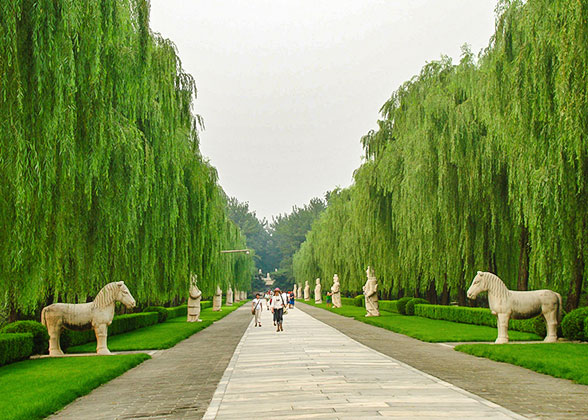


Among the many Sacred Ways, the one of Ming Tombs' is best preserved and complete. The Sacred Way starts with a huge stone memorial archway lying at the front of the area. Constructed in 1540, during the Ming Dynasty, this archway is the earliest and biggest stone archway existing in China today. Farther in, the Shengong Shengde Stele Pavilion can be seen. Inside it, there lies a 50-ton tortoise carrying a stone tablet. A white marble Huabiao (ornamental pillar) is positioned at each corner of the stele pavilion. At the top of each is stationed a mythical beast facing either inward or outward, expressing hope that the emperor will neither cling to the palace nor forget to return to the Palace to handle state affairs. Then come two Roof Pillars on each side of the road, whose surfaces are carved with the cloud design, and tops are shaped like a rounded cylinder. After the 18 pairs of stone statues which are all sculpted from whole stones, and larger than life size, comes the Dragon and Phoenix Gate. The Sacred Way was originally built to lead to the Changling mausoleum. Afterwards, twelve more mausoleums were built. It is a ten-minute bus ride from this place to Changling..
How to get to Sacred Way of Ming Tombs in Beijing
2. Take bus 345 Express or 886 from Deshengmen West Station, get off at Changping Dongguan Station, and then take bus 314 to get off at Nanxin Village Station.
3. Take Subway Changping Line to Changping Dongguan Station, and then transfer to bus 314 to Nanxin Village Station.
|
|
| Entrance Fee | April to October: CNY 30 November to March: CNY 20 Note: Free for children under 1.2 meters (3.9 feet). |
|---|---|
| Opening Hours | April to October: 08:00 - 17:30 November to March: 08:30 - 17:00 |
Surrounding Scenic Spots: Badaling Great Wall Ming Tombs
- Last updated on Jul. 23, 2026 by Sherry Xia -