Beijing Zoo
 To celebrate Beijing Zoo's 120th anniversary, the new Giant Panda House opens on July 16, 2026, featuring star panda residents like Meng Lan. You can visit it with either a combined ticket or a separate panda house ticket priced at CNY 5.
Situated in the Xicheng District, Beijing Zoo was the first of its kind in China. It contains a diverse collection of animals, a number of exhibition halls and some sites of historical interest.
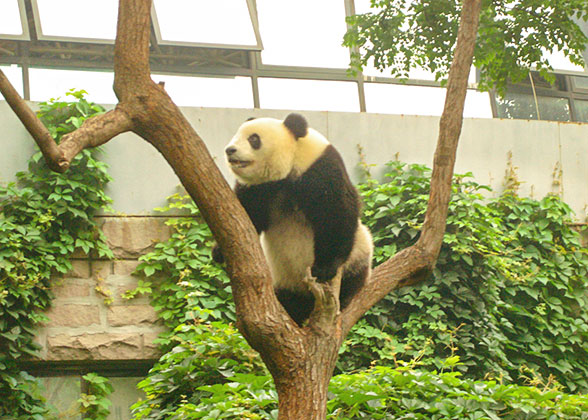
Beijing Zoo is home to around 450 different species and has a population of some 5,000 animals. Some of the most popular attractions among visitors are the wild rare animals of China itself, such as the giant pandas, golden monkeys, milu deer and northeast tigers. However, the collection is far from restricted to those species found only in China; the polar bears, American bison, zebras, kangaroos, giraffes and elephants also draw large crowds.
|
|
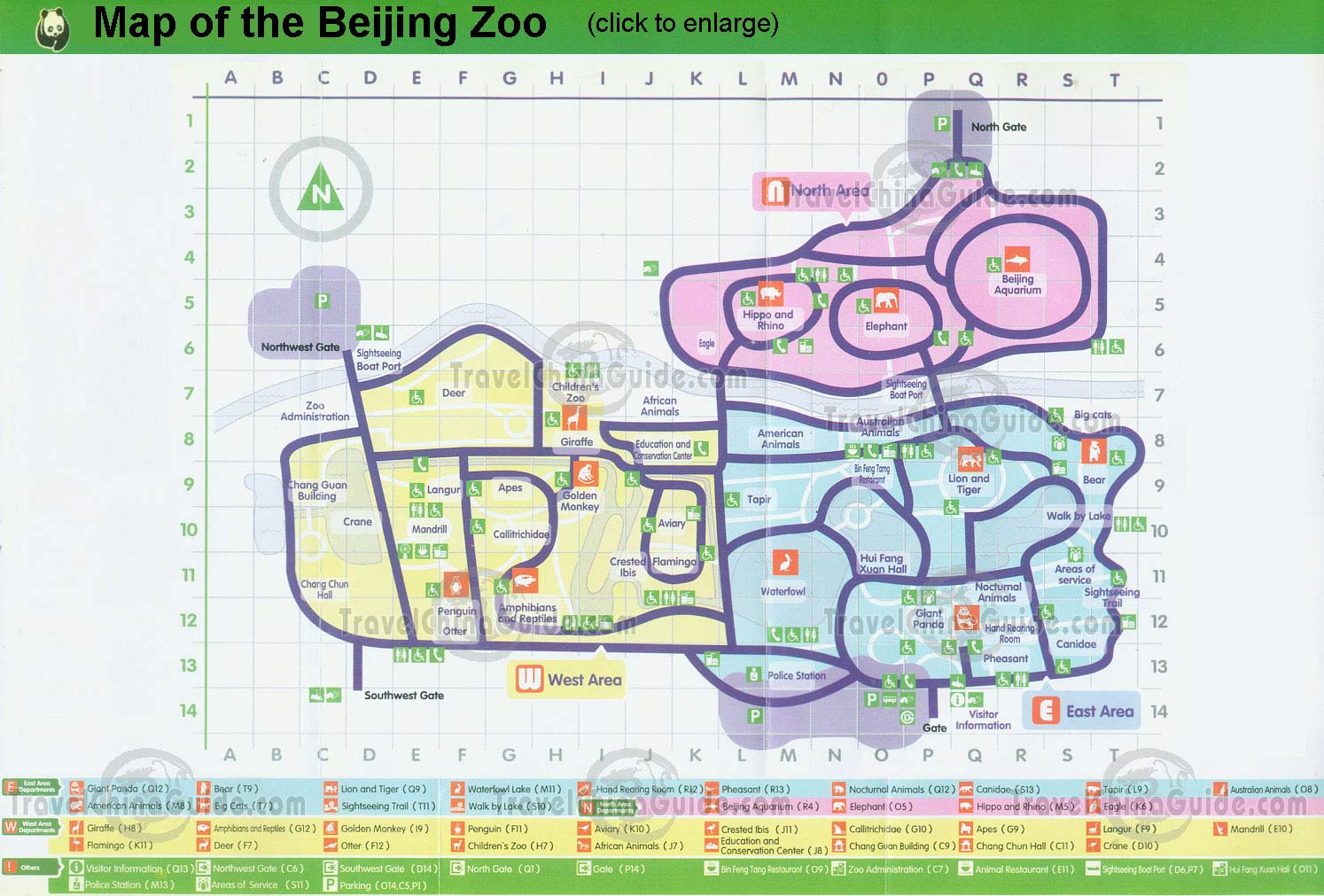
Beijing Zoo is comprised of 16 different exhibition areas and halls. The most popular is the Panda Hall. Built in 1989 and covering an area of around 2.5 acres (10,000 square meters), it delivers an impressive aesthetic scene while also managing to account for the practical considerations of housing such large and physical animals. The inside of the hall replicates the style of traditional Chinese gardens and is shaped in the pattern of a Tai Chi diagram.
Another famous hall, the Gorilla Hall, was constructed two years earlier in 1987. The building houses a series of artificial hillocks and wooden apparatus for the animals which sit against a backdrop of attractive gorilla murals. Facilities introduced for the gorillas include a medical room, a mating room and a specialist feeding room. The hall itself is decorated by a series of rockeries and pools.
All halls and exhibition areas are finely constructed so as to ensure that the animals enjoy a both comfortable and healthy living environment.
 |
 More China Panda Pictures More China Panda Pictures |
While at here, visitors also have the chance to sample some the nearby historical relics: Lemarck Hall was built to commemorate the life of Lemarck (1744-1829), a famous French natural historian, and has also been used as the Chinese Botanical Science Research Base.
Also on the site is the Song Jiaoren Memorial Tower. Song (1882-1913) was one of the early leaders of the Kuomintang, but was assassinated soon after he was elected as China's premier in 1913.
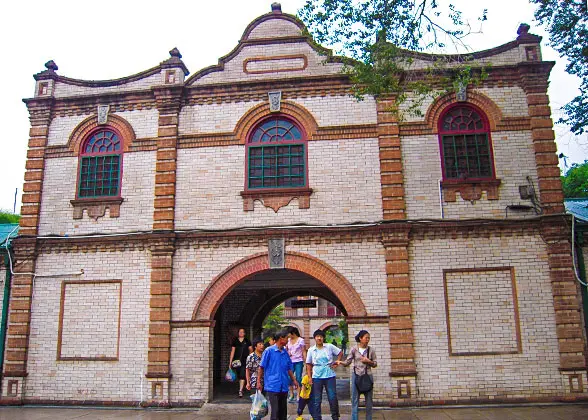
Another site of historical interest is the Changguan Tower: a two storied baroque-style building constructed by brick and wood. In the late 19th century it was occupied by the Empress Dowager Cixi (1835-1908), ruler of the Qing court between 1861 and 1908. Sun Yat-sen (1866-1925), the founder of the Kuomintang, is also said to have lived in the hall.
With the support of the Chinese government and having undergone continual development throughout its 90-year history, Beijing Zoo has become one of the largest in China. It provides thousands with the opportunity to witness strange and exotic species at firsthand, and also allows visitors to learn more about the lives of the animals that inhabit the world alongside us.
How to get to Beijing Zoo
 By Subway:
Take Subway Line 4 and get off at Dongwuyuan (Beijing Zoo) Station. Get out from Exit B and you can see the south gate of the zoo.
 By Bus:
Take bus 87, 105, 107, 111, 305 or 604 and get off at Dongwuyuan Station, then walk eastward to find the gate.
 By Boat:
There are boats cruising between Beijing Summer Palace and Beijing Zoo via Ziyuwan Wharf, known as Imperial Waterway Cruise or Empress Dowager Cixi Watercourse. The total length is about 9km (5.6 miles) and the duration is about one hour. After visiting the zoo, one can embark and continue to take ferry to visit the Purple Bamboo Garden and Summer Palace.
Where to buy ticket:
Summer Palace Stop: South Ruyi Wharf near South Ruyi Gate of Summer Palace
Ziyuwan Stop: Ziyuwan Wharf beside the north gate of Purple Bamboo Garden
Beijing Zoo Stop: near the ticket office of Beijing Aquarium
| Schedule | From Beijing Zoo: 10:30, 11:30, 12:30, 13:30, 14:30, 15:30 From Ziyuwan Wharf: 10:00, 11:00, 12:00, 13:00, 14:00, 15:00 |
| Cruise duration | One hour |
| Ticket Fare | From Beijing Zoo and Summer Palace: CNY120 From Ziyuwan Wharf: CNY100 Half of the fare for children under 3.9 feet (1.2 meters). |
Beijing Zoo Ticket Price
| Type | Apr. to Oct. | Nov. to next Mar. |
|---|---|---|
| Zoo Entrance Fee | CNY 15 | CNY 10 |
| Combo Ticket (Zoo + Panda Hall) | CNY 19 | CNY 14 |
| Beijing Aquarium | CNY 175 for adult; CNY87 for children | |
Note:1. Children under 1.2 meters (3.9 feet) enjoy free entry of Beijing Zoo.
2. Visitors to the aquarium need to buy Beijing Zoo tickets as well.
 Beijing Zoo Tickets Booking
Beijing Zoo Opening Hours
| Place | Apr. to Oct. | Nov. to next Mar. |
|---|---|---|
| Zoo | 07:30 - 19:00 | 07:30 - 18:00 |
| Aquarium | 09:00 - 17:30 | 10:00 - 17:00 |
Top 10 Places to Visit in Beijing 10 Fun Things to Do in Beijing with Family Travel to Beijing with Kids - 11 Things to Do
Neighboring Attractions: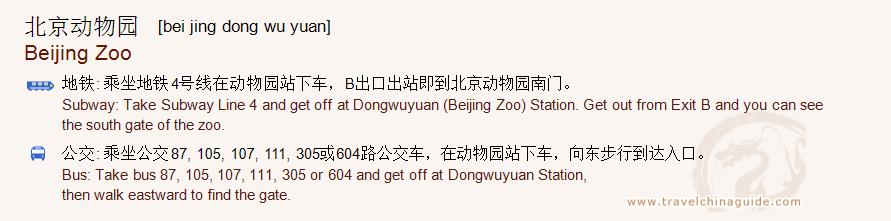
 Beijing Planetarium Paleozoological Museum of China