


Beihai Park
 Jul.-Aug. Extended Opening
From July 4th to August 31st, 2026, Beihai Park's historic Yong'an Temple will be open to the public every day.
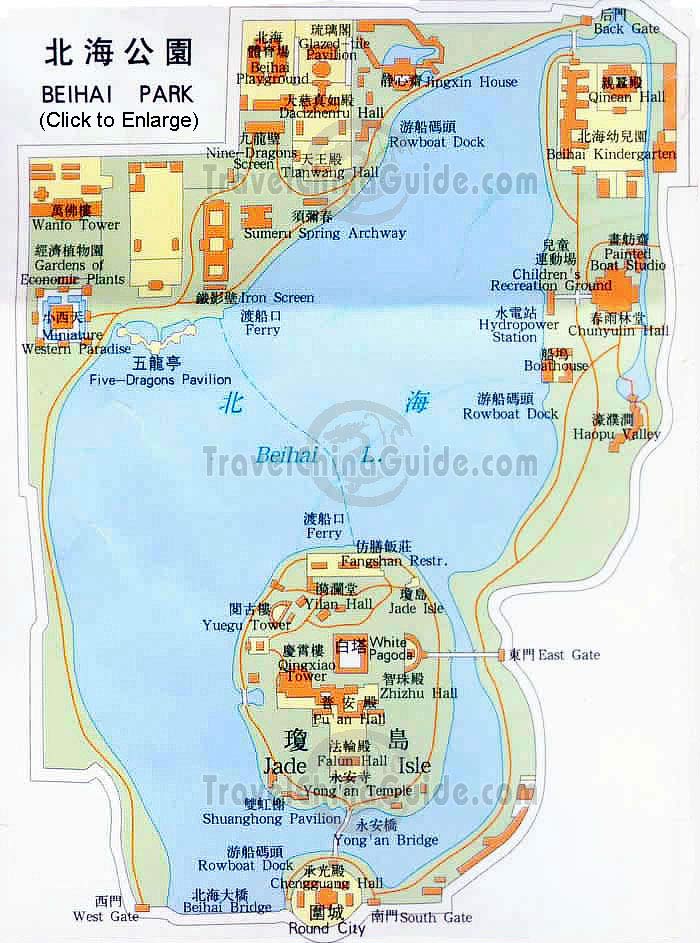 |
Map of Beihai Park Pictures Pictures Video Video |
With the Forbidden City and Jingshan Park to its east, Zhongnanhai (Central and Southern Seas) to its south, Beihai Park, also known as Northern Sea Park, is one of the oldest, largest and best-preserved ancient imperial gardens in China located in center of Beijing. This ancient garden, with over 1,000 years' history, is not only a classic combination of the grandiosity of the northern gardens and the refinement of the southern gardens in China, but also a perfect integration of magnificent imperial palaces and solemn religious constructions.
History
Beihai Park is said to be built according to a traditional Chinese legend. The story is that once upon a time there were three magic mountains called 'Penglai', 'Yingzhou' and 'Fangzhang' located to the east of Bohai Bay (to the east of China). Gods in those mountains had a kind of herbal medicine which would help humans gain immortality.
Consequently, many emperors in the feudal age of China constantly sought those mountains. For example, Emperor Qin Shihuang, the first emperor of the Qin Dynasty (221 - 206 B.C.), wanted to live an eternal life and had sent people to look for the magic mountains but they failed. Then at his palace, he dug a large pool and piled up three earth hills in it to imitate the circumstances described in the legend. Emperor Wudi, the fifth emperor of the Western Han Dynasty (202 B.C. - 8 A.D.) did similar things.
It was believed that different mountain-water combinations in ancient Chinese architecture led to totally different effects. So from then on, almost every emperor during the succeeding dynasties would build a royal garden with one-pool-with-three-hills' layout as a fairyland near his palace. It was surely built after this traditional style: the water of Beihai (Northern Sea) with Zhongnanhai (Central and Southern Seas) is the Taiye Pool; the Jade Flowery (Qionghua) Islet, the island of the Circular City and the Xishantai Island represent the three magic mountains.
Actually, Beihai Park was initially built in the Liao Dynasty (916 - 1125) and was repaired and rebuilt in the following dynasties including Jin, Yuan, Ming and Qing (1115 - 1911). The large-scale rebuilding in the reign of Emperor Qianlong of the Qing Dynasty (1644 - 1911) generally established the present scale and pattern. In 1925, it was first opened to the public, attracting hundreds of thousands of visitors from all over the world every year.
 |
White Dagoba
 |
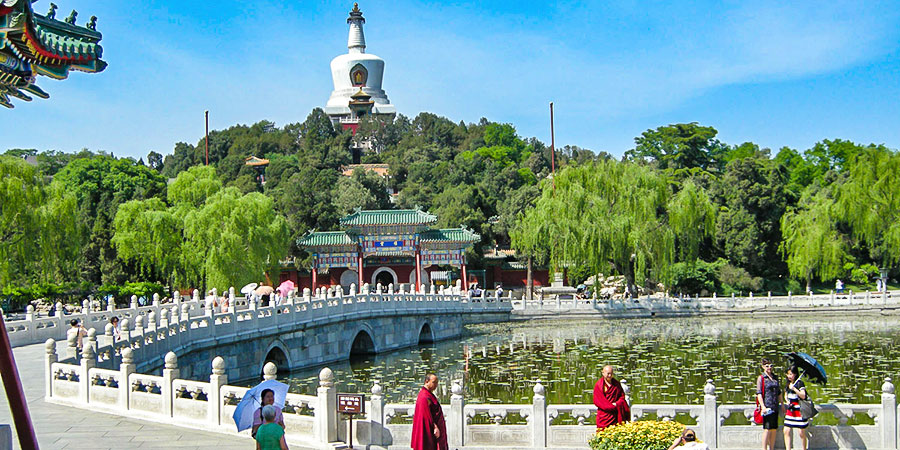
On top of the Jade Flowery Islet, the White Dagoba was built in 1651 on the former site of the Palace in the Moon where Kublai Khan received Marco Polo. At the suggestion of a famous Tibetan lama, Emperor Shunzhi, the first emperor of the Qing Dynasty agreed to build such a Tibetan dagoba to show his belief in Buddhism and his desire for the unification among various Chinese ethnic groups. The White Dagoba was destroyed in an earthquake and reconstructed twice. Now, resting on a huge stone base, it stands 120 feet (37 meters) high and is capped by two bronze umbrella-like canopies, with 14 bronze bells hanging around them. Inside, the dagoba holds the Buddhist Scriptures, the monk's mantle and alms bowl and two pieces of Sarira. Since the White Dagoba is the highest point in it, it served as a vantage point with a beautiful view of the whole scenic spot.
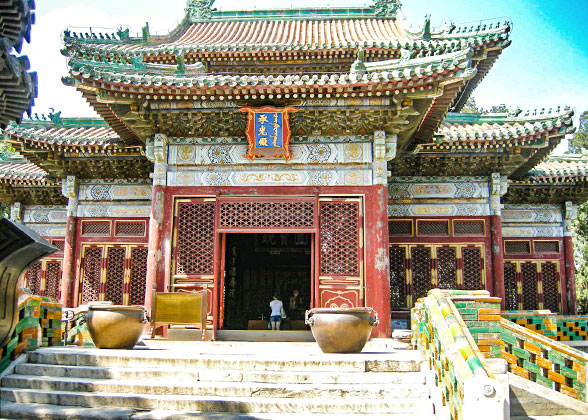
In front of the White Dagoba is the Yong'an Temple. There are several other buildings and halls you could visit if you have enough time. These include Shanyin Hall, Zhengjue Hall, the Bell and Drum Towers, the Stone Tablets of 'Qiongdao Chunyin' (means the beautiful scenery of the Jade Flowery Islet in spring; inscribed by Emperor Qianlong of Qing Dynasty) etc, all scattered on the slope of the Qionghua Islet.
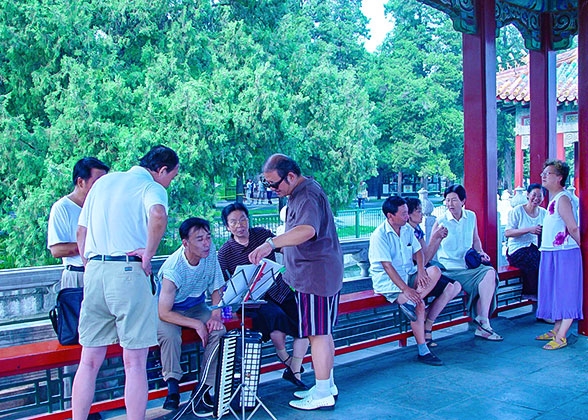 |
| Morning Exercise |
Hao Pu Creek (Haopujian) Garden
After visiting the Qionghua Islet, you can cross the Zhishan Bridge to the Eastern Shore Scenic Area which has many independent gardens within it such as the Painted Boat (Huafang) Studio and the Hao Pu Creek Garden.
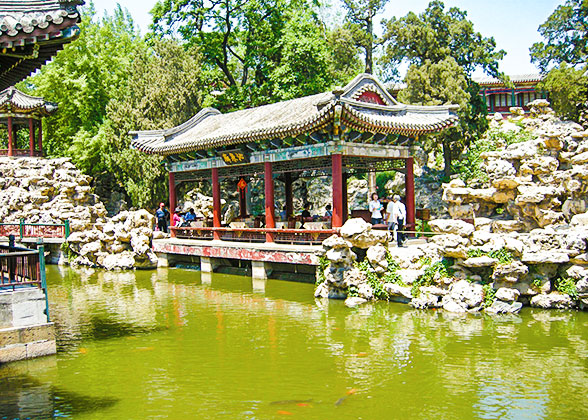
Created in 1757, the Hao Pu Creek Garden is one of the best gardens-within-gardens of the existing imperial gardens in China. 'Hao' and 'Pu' were the ancient names of two rivers in Anhui Province. There is a story that goes like this: in the Warring States Period (475 - 221 B.C.), Zhuangzi and Huizi (two famous philosophers of ancient China) argued with each other on the bridge over the Hao River. Zhuangzi said: 'How happy are the fish in the river!' Huizi responded: 'You are not a fish. Then how can you know whether the fish are happy or not?' Zhuangzi answered: 'You are not me. Then how can you know that I don't know the happiness of the fish?' This story inspired Emperor Qianlong to build the Hao Pu Creek Garden to seek happiness and relaxation as free as fish in the river. So the garden is designed for tranquility and happiness, featuring a special mountain-water structure to give the impression of a deep valley which gives seclusion from society.
Quiet Heart (Jingxin) Studio
|
|
Nine-Dragon Screen
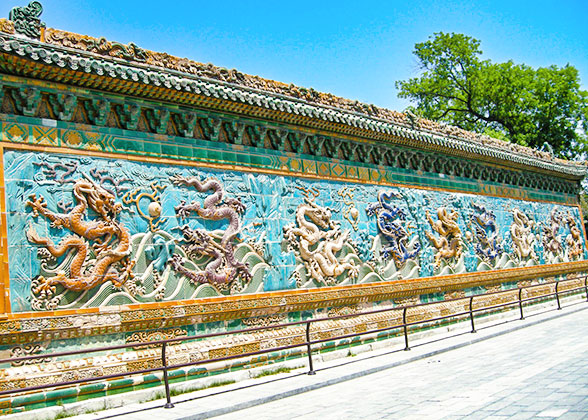
To the northwest lies the well-known Nine-Dragon Screen, which is the only screen having nine huge dragons on both sides among the most famous three Nine-Dragon Screens in China (the other two are respectively in the Forbidden City and Datong, Shanxi Province). Built in 1756, the Nine-Dragon Screen is about 90 feet (27 meters) long, 21.8 feet (6.65 meters) high and 4.7 feet (1.42 meters) thick. It is composed of 424 seven-color glazed tiles that embossing the screen. There are nine huge coiling dragons on each side of the screen and big or small dragons in different postures decorating the two ends and the eaves, making a surprising total of 635 dragons. Even after 200 years, the Nine-Dragon Screen is still bright in color and complete in appearance, showing the high techniques of Chinese arts and crafts in ancient times. Click to see the Nine Dragon Screen in the Forbidden City.
 |
| Night-Dragon Screen |
Five-Dragon Pavilions
 |
| Five-Dragon Pavilions |
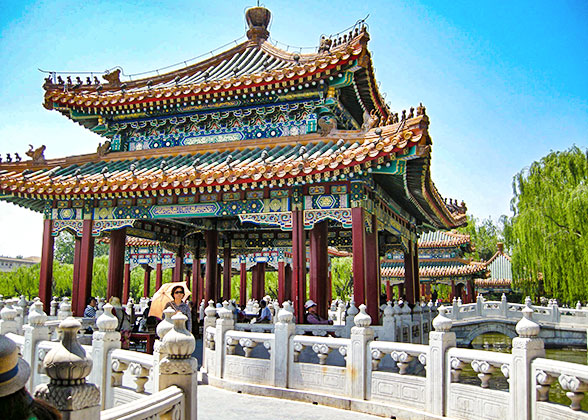
To the southwest of the Nine-Dragon Screen lies the Five-Dragon Pavilions - five connected pavilions with spires and pointed upswept eaves. From a distance, they appear together like a huge dragon. Built first in 1602 and repaired several times in Qing Dynasty, these five pavilions, half over the water, stand on the north bank of the lake opposite the Jade Flowery Islet. There are many exquisite carvings and paintings on the girders and pillars of the pavilions which make the Five-Dragon Pavilions a delightful place for the royal members in ancient China to relax and appreciate the natural beauty.
You can stand in the Five-Dragon Pavilions to see the Jade Flowery Islet with the gleaming White Dagoba standing in the exuberance of trees, flowers and various other plants. There are also many other worthwhile places to visit around the Five-Dragon Pavilions including the Heavenly King Hall, Chengguan Hall and the Temple of Little Western Skies, a famous Buddhist architecture.
Circular City
 |
| Chengguang Hall in Circular City |
While visiting these famous and interesting places in it, you could have a meal and rest in Fangshan Restaurant located at the northern shore of the lake. This restaurant was started in 1925 by a cook who formerly worked in the Qing court, so the food there is said to be of delicious imperial flavor.
Besides these places of interest, there are plenty of exhibitions to see. These include the yearly exhibition of water lilies and other water plants in the Botanical Garden, the exhibition of peonies, and varied picture shows, making it not only the center of history and culture in Beijing, but also the center of ecological and natural beauty. Now, an ancient but modern Beihai park welcomes you from all over the world.
How to get to the Beihai Park
 By Subway:
Take Subway Line 6 and get off at Beihai Bei Station. Go out from Exit B and walk 5 minutes east to get to the north gate of the park.
 By Bus:
1. Take bus 3, 4, 13, 42, 107, 111, 118 or 612 and get off at Beihai Beimen Station (North Gate of Beihai Park). The north gate is on the east.
2. Take bus 103, 101, 109, 124 or 128 to Beihai stop, then the gate is on the south.
Beihai Park Ticket Price
| Entrance Fee | Apr. to Oct.: CNY 10; Nov. to Mar.: CNY 5 |
| Through Ticket | Apr. to Oct.: CNY 20; Nov. to Mar.: CNY 15 Note: The Through Ticket covers the admission fee for the main entrance, Yong'an Temple and Circular City. |
| Opening Hours | Apr. to Oct.: 06:00 to 21:00 (ticket office closed at 20:30) Nov. to Mar.: 06:30 to 20:00 (ticket office closed at 19:30) |
| Recommended Time for a Visit | 2 hours |
Beihai Park Tickets Booking Neighboring attractions:- Jingshan Park
- Shichahai
- Forbidden City
- Beijing Hutongs
- Prince Gong's Mansion
- National Art Museum
- Church of the Saviour
- Dianmen
- Lotus Market
 Recommended Itineraries:
Beijing One Day Tours: 10 options to hot tourist sites like Tiananmen Square, Forbidden City, Great Wall...
Beijing 4 Days Private Tour: to visit the most popular attractions
More Beijing Tours
Further Reading:Top 10 Things to Do in Beijing
Where to Go in Beijing in Spring - Top 10 Destinations
12 Popular Beijing Activities to Beat the Summer Heat
10 Fun Things to Do in Beijing with Family
15 Wonderful Places to See Snow in Beijing
