Jingshan Park
Situated in the center of Beijing, Jingshan Park is a beautiful royal landscape garden located on Beijing Central Axis which has been inscribed on the UNESCO World Heritage List. Covering an area of 57 acres (about 230,000 square meters), the park stands on the central point of the south-north axis of the city and faces the north gate of the Forbidden City. It is found on Jingshan Hill, which was originally named Wansui Hill (Long Live Hill), Zhen Hill or Meishan Hill (Coal Hill). The mid summit of the hill is the highest point in Beijing. Looking from the peak, the visitor is able to get a full and clear view of the Forbidden City.
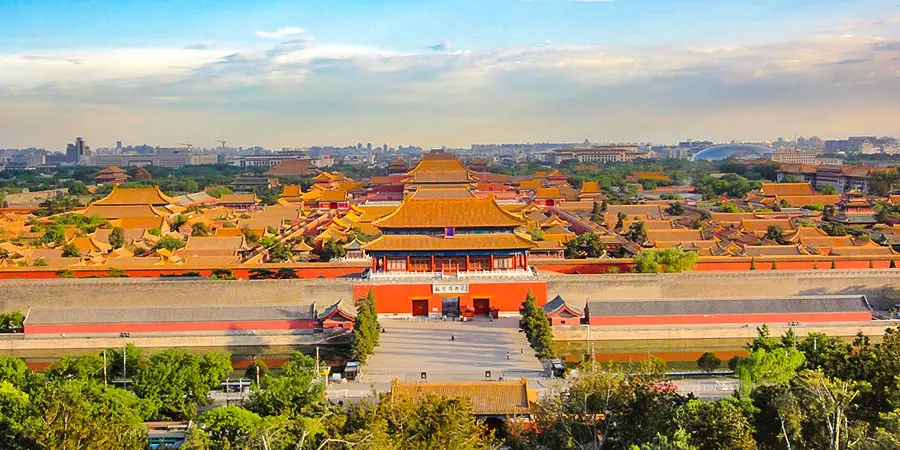 |
| A Full View of Forbidden City |
During the Yuan (1271-1368), Ming (1368-1644) and Qing (1644-1911) dynasties, Jingshan Park served as an imperial garden and was properly laid out under the Ming Dynasty when numerous fruit trees were planted as well as many palaces and pavilions built for the emperor to make sacrifices to his ancestors. As a result, the royal families always enjoyed amusements here, like hunting in the hills. Then, in 1928, it was opened to the public. Later, after 1949, the park was fully rebuilt, with the paths in it paved and most of the buildings renovated. Now, the present is one of the 'AAAA' Scenery Spots in China and a 'must' for visitors to Beijing.
Upon entering the front gate of the park, visitors can see the Qiwang Pavilion, embraced by the vigorous green cypresses. This was originally the place for emperors to worship the memorial tablet of Confucius. Surrounded by white marble balustrades, the two-storied pavilion with its golden-glazed roof appears quite dignified.
|
|
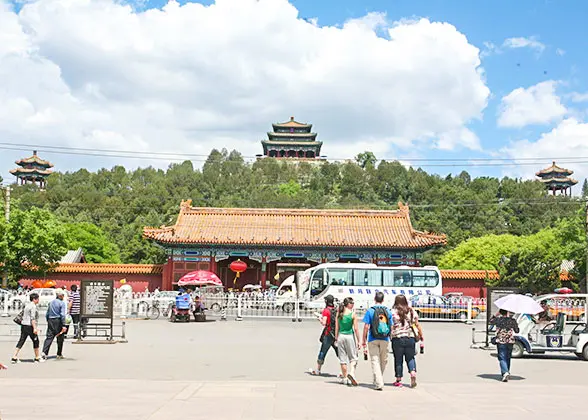
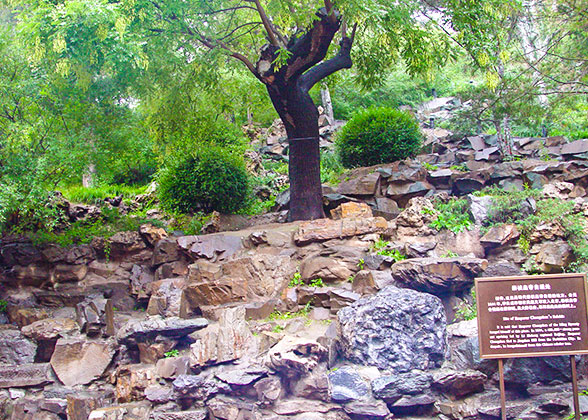
In the north side of the Jingshan hill is found the Shouhuang Hall (Hall of Imperial Longevity), originally the place for the emperors in the Qing dynasty to pay their respects to their ancestors. Some of the emperors' portraits were worshiped in it. To the east of the Shouhuang Hall, stands the Yongsi Hall (Missing Hall), the place for resting the dead bodies of the past emperors and queens.Jingshan Park also boasts some charming natural scenery with a planted area of about 1,300 square yards (about 1,100 square meters). This park is the biggest peony rose garden in Beijing and during May each year, with the 20,000 peony roses of some 200 varieties in full bloom the park displays a wonderful and colorful scene. Visitors who are interested in flowers will find some rare and famous varieties to please them. We hope you enjoy your visit to it.
|
|
How to Get to Jingshan Park:
 By Bus:
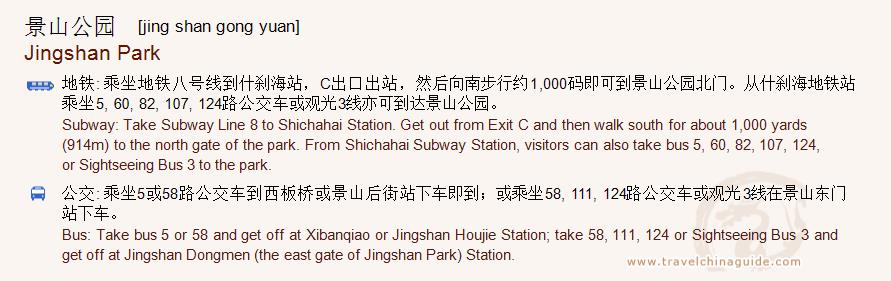
 West Gate: Take bus 5 or 58 and get off at Xibanqiao Station. North Gate: Take bus 5 or 58 and get off at Jingshan Houjie Station. East Gate: Take bus 58, 111, 124 or Sightseeing Bus 3 and get off at Jingshan Dongmen (the east gate of Jingshan Park) Station. South Gate: Take bus 58, 101, 103, 109, 124, 128 or Sightseeing Bus 1, 2, or 3 and get off at Gugong (Forbidden City) Station.
 By Subway:
Take Subway Line 8 to Shichahai Station. Get out from Exit C and then walk south for about 914m (1,000 yards) to the north gate of the park. From Shichahai Subway Station, visitors can also take bus 5, 60, 82, 107, 124, or Sightseeing Bus 3 to the park.
| Entrance Fee | CNY 10 (Fee of exhibitions is not included) |
| Opening Hours | April to October: 06:00 - 21:00, ticket sale ends at 20:30 November to March: 06:30 - 20:00, ticket sale ends at 19:30 |
Jingshan Park Ticket Booking Beijing Top 8 Night Activities Further reading:
 15 Wonderful Places to See Snow in Beijing
- Last updated on Sep. 29, 2026 by Sherry Xia -