Miaoying Temple
Miaoying Temple, also known as the White Stupa Temple or White Dagoba Temple, is located in the Xicheng District of Beijing. There is a tall and spectacular white dagoba standing in it, hence the name. The dagoba is one of two famous white dagobas in Beijing, with the other one standing in Beihai Park.
Miaoying Temple has experienced a long period of uncertainty in Chinese history. In the year 1271, Mongolian leader Kublai Khan united the whole country and started the Yuan Dynasty (1271-1368). The governor of the spacious and mysterious Tibet also began to succumb to the central state at that time. To consolidate the relationship between the empire and the monkish power in Tibet and to gain the agreement of the Tibetan Buddhists among the Yuan officials, Kublai Khan granted imperial permission to build the White Dagoba. When it was completed in the year 1279, a further decree was given to grant the building of yet another temple around the dagoba within an area of 40 acres (16 hectares), which was defined by the landing spots of arrows shot in the four directions by the Emperor from the top of the dagaba. The temple was then obliged to adopt the name of 'Dashengshou Wan'an Temple'. The Dagoba, along with the capital Dadu (present Beijing), was called 'Golden City and Jade Dagoba' by the people then because of their grandiose appearance. Unfortunately, it was burnt to the ground in the year 1368, and amazingly only the White Dagoba remained. In the year 1457 of the Ming Dynasty (1368-1644), Emperor Tianshun commanded the reconstruction of it that covered an area of 3.2 acres (13,000 square meters), much smaller than the original size. It was then renamed 'Miaoying Temple'. The temple has been renewed in more recent times, but not as extensively as before.
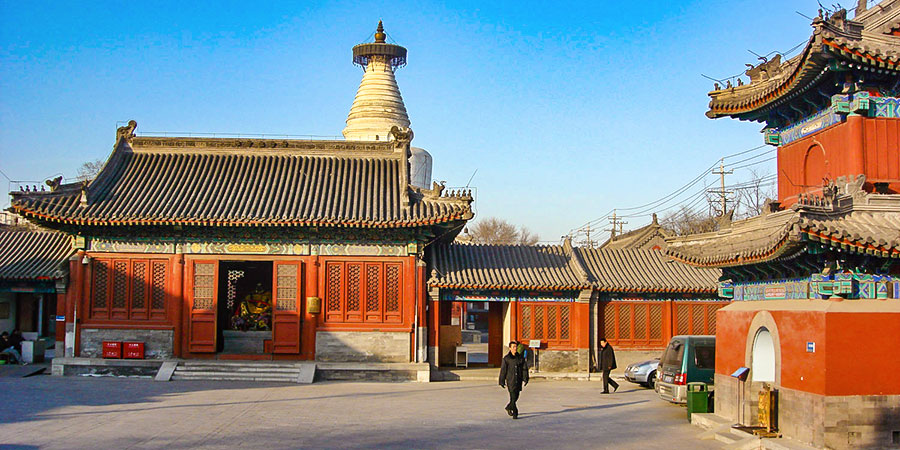 |
| The White Dagoba Temple |
Miaoying Temple mainly functioned as an imperial temple in the Yuan Dynasty. The governor then stipulated that all the important ceremonies should be rehearsed here three days ahead of the actual ritual. The sacrificial ceremony of Kublai Khan was also held here when he died, which proves its importance. In the later days of the Qing Dynasty (1644-1911), the temple became one of the most renowned spots for temple fairs, which formed the popular saying 'August eighth, time to visit the white dagoba'. There was also a custom on the lunar Oct. 25th (the anniversary date of the completion of the dagoba) every year. Many lamas walked around the dagoba, chanting the scriptures and playing music. Even nowadays many devout followers pray for blessings around the dagoba.
White Dagoba
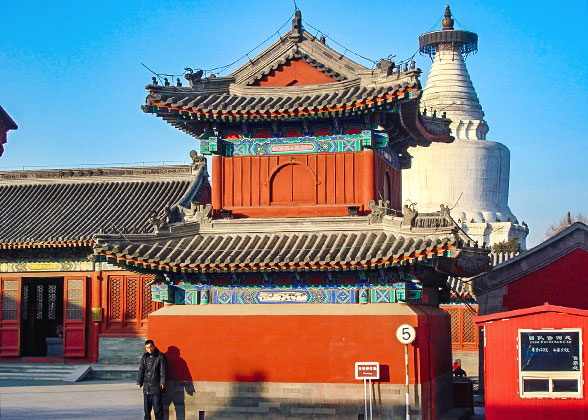 |
| The Elegant White Dagoba |
The dagoba is the earliest and largest Tibetan dagoba that remains as a witness of the once resplendence region of Dadu during the Yuan Dynasty and the friendship that existed between China and Nepal. It has now been listed as a key cultural spot that is now under the protection of the Chinese State Department. With high cultural value and heavenly beauty, Miaoying Temple is bound to amaze you and leave you with a unique and lasting impression.
How to get to Miaoying Temple
 By Bus:
Take bus 3, 7, 13, 42, 47, 101, 102, 103, 409, or 612 and get off at Baitasi (White Dagoba Temple) Station.
 By Subway:
1. Take Subway Line 2 to Fuchengmen Station. Get out from Exit B and walk to the east for about 700 yards (640m).
2. Take Subway Line 4 to Xisi Station. Get out from Exit A and walk to the west for about 900 yards (820m).
Beijing Bus / Subway Search
| Admission Fee | CNY 20 (the first 200 visitors on Wednesday can enter for free) |
| Opening Hours | 9:00 - 16:30 |
 Neighboring Attractions:
 Temple of Ancient Monarchs Muslims Pushou Temple Lu Xun Museum National Political Consultative Hall Beihai Park Geological Museum of China