Prince Gong's Mansion (Prince Kung's Palace Museum)
 |
 Photos Photos |
The mansion was constructed around the year 1777 and was originally the private residence of Heshen. A member of the imperial guard, the handsome and intelligent twenty-five year old Heshen came to the attention of the Qing Dynasty Emperor Qianlong (1736-1796). Before long Heshen was promoted to positions normally occupied by the most experienced officials, including those controlling finance and the appointment of civil servants; thus enabling him to acquire great wealth. The aging Qianlong did nothing to curb Heshen's corruption but his successor, Emperor Jiaqing (1796-1820), had Heshen executed and his property, which was assessed at over 800 million ounces of silver, was confiscated. The mansion was passed to Prince Qing in 1799. Eventually Emperor Xianfeng (1851-1862) transferred the ownership to Prince Gong and it is his name that was to become that of the mansion.
The dwelling is a traditional courtyard mansion of a style that was so popular in imperial Beijing. The complex covers a total area of 60,000 square meters (14.9 acres). Just over half of the Prince Gong Mansion is the residential portion, while the remainder is devoted to an ornamental garden to the rear.
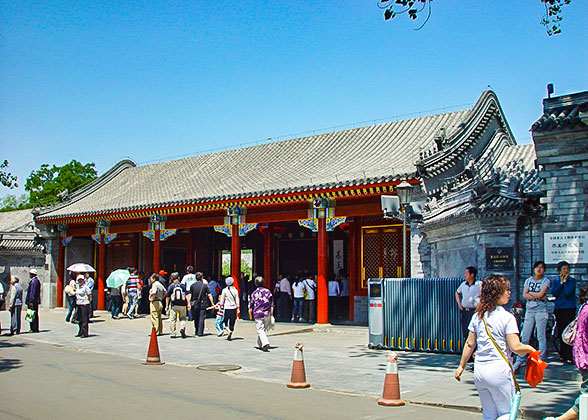
The living quarters stand within three sets of courtyards occupying a central, eastern and western situation. The main, central section comprises the major hall, a rear hall and an extended pavilion that has some 40 rooms. The construction and materials used are similar to those of the Ningshougong (Palace of Tranquil Longevity) in the Forbidden City. Each of the western and eastern sections contains three smaller courtyards. These grand and exquisite buildings are a poignant reminder of the pageantry and splendor that was so much part of China's imperial past.
 |
| Inside Prince Gong's Mansion |
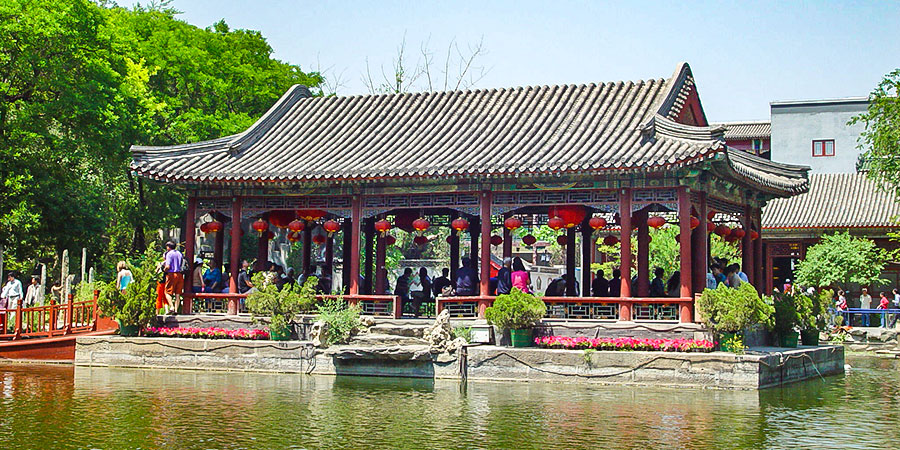
The garden, surrounded by artificial mountains, is known as Jincui Yuan, and is of high standing on account of its layout and distinct design. It covers an area of 28,000 square meters (6.9 acres) and includes twenty scenic spots, each widely different from the others. The entrance via a cavern brings you into a spacious yard. A high but graceful rockery at the center point greets you. There are mountain peaks, ponds, caves, studies and pavilions distributed throughout the garden. The 'Western-Style Gate,' the 'Grand Theater House' and the 'fu' Stele to be found in the garden are referred to as the 'Three Uniqueness in the Prince Gong's Mansion'.
|
|
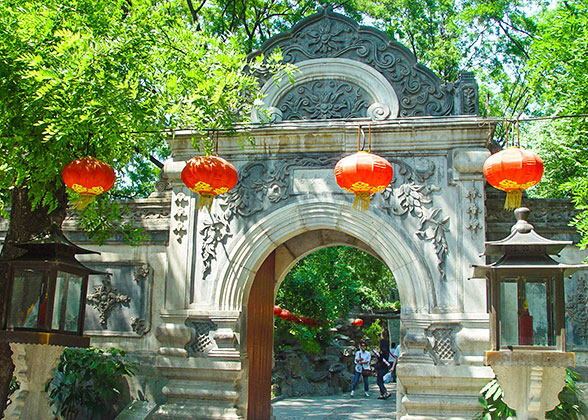
Arriving in the center of the garden, you will be absorbed by the artificial hills. The stele was placed in a cave. The Chinese character 'fu' carved on the about 8-meter-long stele is a copy of the Emperor Kangxi's (1622-1723) handwriting.
Besides, there are other absorbing sightseeing spots such as Liubei Kiosk, Anshan Hall, Dule Peak, and Yaoyue Platform, etc.
As the Palace of Prince Gong, the mansion is a place really worthy of a visit and you can be assured that every aspect puts the culture and life style of the Imperial China's elite into perspective. It has been open to the public as an all-round museum designed to exhibit the royal mansion life in the Qing Dynasty.
How to get to Prince Kung's Palace Museum
 By Bus:
Take bus 3, 13, 42, 107, 111, 118, 612 or 701 and get off at Beihai Bei Men (Beihai North Gate) Station. After that, walk along Sanzuoqiao Hutong on on the east, and walk north for about 5 minutes, you will get to Prince Gong's Mansion.
By Subway:Take Subway Line 6 to Beihai North and leave from Exit B. After that, walk north along Sanzuoqiao Hutong for 5 minutes, you will see it.
| Admission Fee | CNY40; Half-price tickets for the minors aged 7-18 or the old over 60; Free for children under 1.2 meters (3.9 feet) or 6 years old. |
| Audio Guide Fee | CNY30; Languages: English, Mandarin, French, Cantonese, Japanese & Spanish Duration: 2h |
| Opening Hours (Closed on Mondays) | 8:30 – 17:00; stop ticketing at 16:00; stop entering at 16:10 |
| Recommended Time for a Visit | 2 hours |
Prince Gong's Palace Tickets Booking Nearby Attractions:
Lotus Market
Former Residence of Soong Ching Ling
Huoguosi Hutong Snack Street
Suggested Itineraries:Shichahai and Houhai Hutongs: Visit the Hutong area to exprience the traditional local life
More Beijing Tours
Top 10 Places to Visit in Beijing Top 10 Beijing Historical Sites You Should Not Miss