The pits of the Terracotta Army have yielded over 40,000 bronze weapons, including swords, spears, billhooks, crossbows, and bolt heads. Although the soldiers are sculpted from clay, most of these weapons were made from bronze. Buried underground for more than 2,200 years, many of the weapons remain remarkably well-preserved; some even retain their sharp edges and shiny surfaces, showcasing the advanced metallurgical technology of the Qin Dynasty (221 BC - 207 BC).
Short Weapons
1. Sword - A Long, Straight, Double-edged Blade
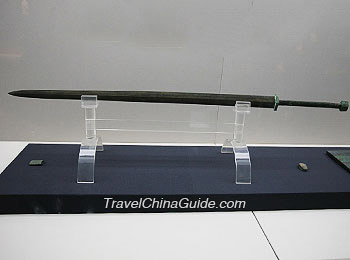
Currently, a total of 25 bronze swords have been discovered in the pits, typically measuring 80 to 95 cm (31 to 37 in) in length. Their willow-leaf shape, with a raised central ridge, gave them better thrusting ability compared to those of earlier dynasties. Remarkably, some swords remain largely free of corrosion and are still sharp today, thanks to a chromium-salt anti-rust treatment applied by Qin craftsmen. In addition, the uniform specifications and minimal signs of wear suggest that these weapons were taken directly from state arsenals and placed in the pits.
Qin Bronze Sword
2. Billhook - With a Sideways-curving, Hook-shaped Blade
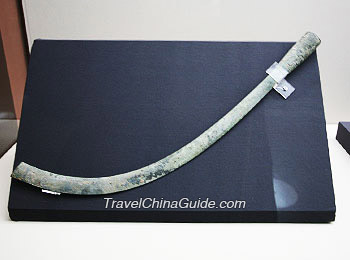
So far, two bronze billhooks have been unearthed. Popular during the Spring and Autumn period (770 - 476 BC), this weapon was designed for close combat, allowing the soldiers to hook, pull, or slash enemies. Shaped like a gently curved sickle, it was cast in one piece with a solid elliptical handle. The blade is relatively blunt and rounded at the tip, making it less effective at a distance. Historically, it was generally used in combination with long-range weapons.
Bronze Billhook
Long Weapons
3. Spear - Long Shaft with a Sharp, Straight, Pointed Head
The spear is one of the oldest and longest-used cold weapons in Chinese history. So far, five bronze spears have been unearthed from the pits, each 15 to 17 cm (6 to 7 in) long, with a flat and straight body, a prominent central ridge flanked by blood grooves. Their smooth, precisely made surfaces and sharp, dark edges indicate they were highly functional combat weapons, ideal for direct stabbing, poking, and picking at opponents.
4. Bayonet - Sword-like Blade Mounted on a Long Pole
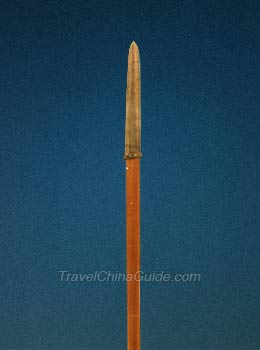
Among the Terracotta Army pits, 16 bronze bayonets have been discovered. It is a formidable long-shafted weapon that evolved from the short sword, consisting of a sword-like bronze head mounted on a long wooden shaft, typically over 3 meters (10 feet) in length. The bronze head itself measures about 35 cm (14 in) long. In appearance, it resembles a short sword, with a sharp tip and wide base, and a distinctive six-sided, flat cross-section and sharpened edges on both sides. This dual-purpose design allowed it to be used effectively for powerful forward thrusting as well as for slashing or cutting attacks from the side.
Bronze Bayonets
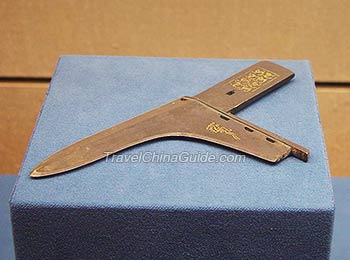
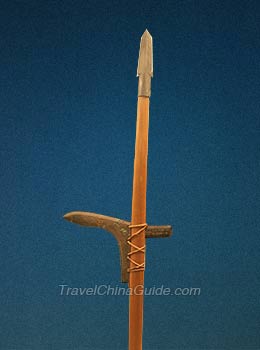
Bronze Dagger-Axe
5. Dagger-Axe - Pole-Mounted Blade with an L-shaped, Hooked Design
Part of Bronze Halberd
One bronze dagger-axe has been recovered from Pit 1. About 26 cm (10 in) long, it features a sideways-projecting blade mounted with a pole, which could be used to pierce like a spike or slash like a sickle, targeting unprotected areas such as the neck or limbs. While commonly used in combat during the Shang and Zhou periods, it remained in service during the Qin dynasty. Specifically, longer versions were used for chariot warfare and shorter ones for infantry.
6. Halberd - Combination of a Spear Point and a Side Axe Blade
Four bronze halberds have been excavated. Though their wooden shafts have decayed, inscriptions on the bronze parts remain clear. By integrating the features of a spear and a dagger-axe, the halberd could thrust and hook, making it more versatile and deadly than either weapon alone. By the Qin era, it had become a primary weapon for both infantry and charioteers.
Long-range Weapons
7. Crossbow - Bow with a Mechanical Trigger
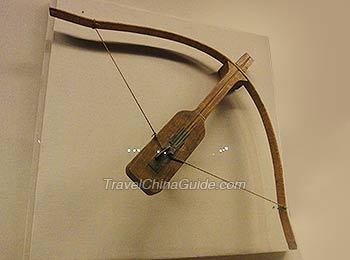
The crossbow, developed from the traditional bow, was a powerful weapon. It comprised a wooden stock to ensure the arrows moved in a straight line, a flexible bamboo or wood bow, and a bronze trigger mechanism. The trigger assembly was the heart of its design, which allowed the archer to draw the string, lock it in place using a catch, and then take careful aim before releasing the shot with a simple press of a lever. This function means the archer did not need to hold the draw manually, showing a major advantage over traditional bows that significantly improved accuracy and reduced physical strain during combat.
Crossbow of Qin Army
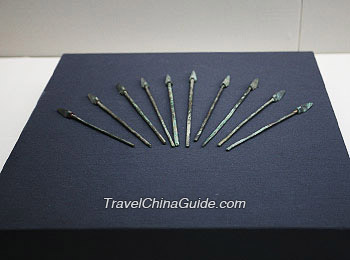
Bronze Bolt Heads
8. Bolt Heads - Small, Sharp, Pyramidal Metal Point for Crossbow
Among all the weapons discovered in the pits, bolt heads are the most numerous finds, with nearly 40,000 examples unearthed. They were projectiles used with the crossbow, falling into two main categories based on size. Most have a streamlined three-sided pyramid shape to reduce air resistance and ensure stable and accurate flight. Some bolt heads were also equipped with sharp barbs designed to lodge firmly in targets, making them difficult to remove and increasing their effectiveness on the battlefield.
Ceremonial Weapons
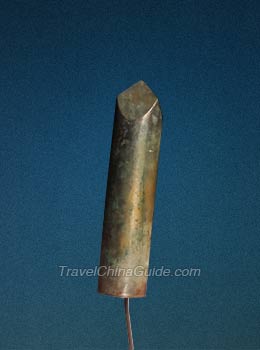
9. Shu - Cylindrical Weapon with a Blunt Tip
To date, a total of 31 bronze Shu have been found in Pit 1 and Pit 3. It's a blunt-edged weapon primarily used for striking and evolved from simple wooden clubs of primitive society. Featuring a cylindrical bronze head, approximately 2 to 3 cm (0.8 to 1.2 in) in diameter, it's topped with a conical tip about 10 cm (4 in) long. Without a sharp edge, this weapon could not be used to stab or slash effectively like other weapons. During the Spring and Autumn Period, it was largely ceremonial and saw limited use in actual combat.
Qin Weapon Bronze Shu
10. Battleaxe - Axe with a Broad, Curved Blade
Evolved from stone axes, the battleaxe has a broad blade. While capable of causing injury, its main role in the Qin military was ceremonial, representing power and royal authority rather than serving as a common combat tool.