The arrangement of the terracotta warriors is far from random. Instead, they are arranged in strict accordance with ancient Chinese military strategy and practical combat requirements. The three main pits represent distinct military units, each with a specialized function. Together, they form a complete, large-scale battle formation. From vanguards to main forces, specialized troops to command centers, the array includes all necessary branches, deployed with precision for both offense and defense, standing as a comprehensive and "three-dimensional military manual" of the Qin Dynasty (221 - 207 BC).
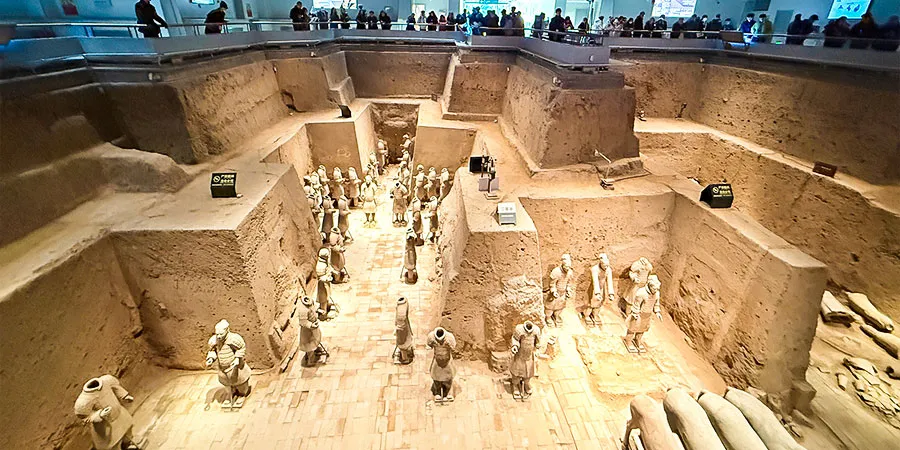
As the largest pit, containing over 6,000 terracotta figures and more than 50 chariots, Pit 1 presents a vast rectangular formation composed primarily of infantry warriors and chariots, vividly recreating the majesty of the Qin army. Structured into four integrated units: the vanguard, main force, flank guard, and rear guard, it reflects a tight organization that integrates attack and defense, making it a defensive formation capable of both holding ground and engaging in combat.
Vanguard
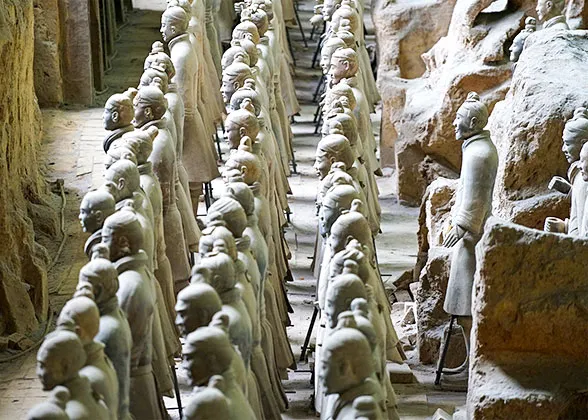
At the front of the formation is the vanguard, consisting of three rows of 68 figures each, totaling 204 lightly equipped infantry warriors. As the troops leading the advance, these agile, unarmored soldiers relied on their mobility to strike swiftly at the onset of battle, launching long-range attacks to deliver the initial blow and create favorable conditions for subsequent engagements.
Vanguard of Pit 1 under Sunshine
Brave Vanguard of Pit 1
Main Force
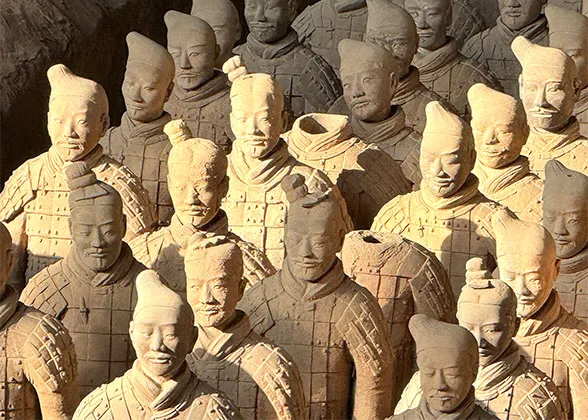
Behind the vanguard lies the whole formation's main force, comprising 38 columns of heavy infantry and chariots alternating. Heavy-armored infantry warriors dominate this section, clad in thick armor and armed with spears, halberds, or bows. They serve as a solid bulwark, providing strong defense and close offensive power as the backbone of the main force. In addition, each chariot unit is precisely coordinated: the right-hand soldier steadies the chariot with his left hand while holding a weapon in his right; the left-hand soldier does the opposite; and the charioteer focuses solely on driving the chariot, together forming a powerful combat unit.
Main Force of Pit 1
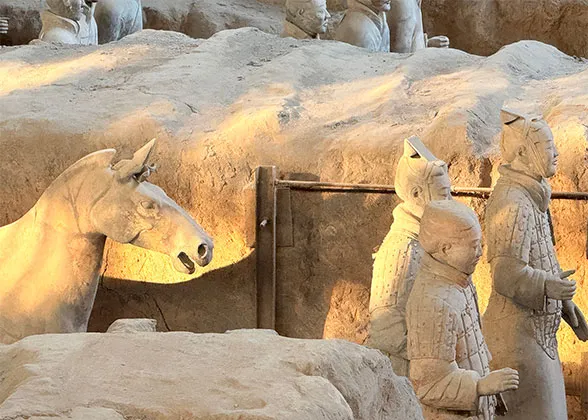
Infantry Figures and Horse in Pit 1
Flank and Rear Guards
A single row of infantry warriors faces outward, respectively on the left and right sides of the formation, forming the flanks. At the western end, three rows of heavy infantry, with two facing east and one facing west, form the rear guard. Like impenetrable walls, these units protect the main force from flanking attacks and rear encirclement, ensuring the stability and integrity of the entire formation.
In a practical battle, the vanguard would initiate combat with long-range strikes, followed by the main body engaging in close combat, while the flank and rear guards maintained defensive positions. All branches worked in coordinated synergy, demonstrating remarkable military effectiveness.
Pit 2 is shaped like an L and contains around 1,300 terracotta figures. Although smaller in scale, it features the most diverse array of military branches, forming an offensive mixed-unit formation of archers, chariots, infantry warriors, and cavalry warriors. This organization allowed for flexible tactical adjustments based on terrain and enemy movements: chariots charged on open ground, cavalry warriors maneuvered through difficult terrain, and archers ambushed in narrow areas.
Archer Array
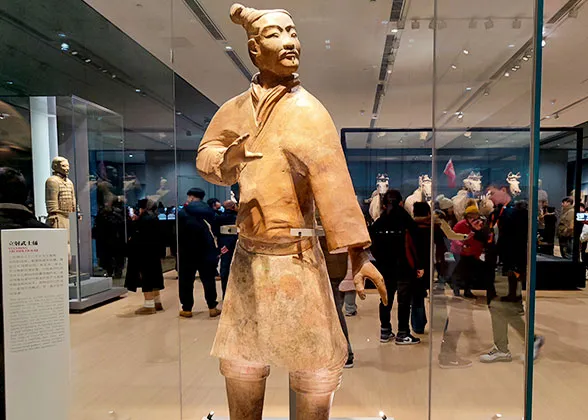
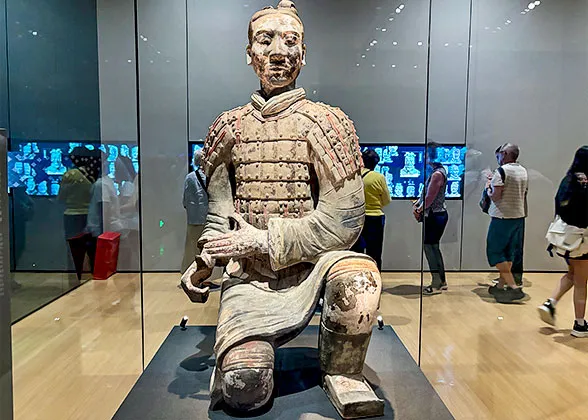
The archer array is positioned at the front corner of the formation. The outer ring consists of 174 standing archers in light gear without armor, while the center has 160 kneeling archers arranged in eight columns of 20 each. These archers could alternate between standing and kneeling to maintain a continuous barrage of arrows, serving as both the opening strike and providing sustained fire cover.
Standing Archer of Pit 2
Kneeling Archer Unearthed from Pit 2
Chariot Array
The chariot array is located in the southern section, comprising 64 chariots arranged in eight columns. Each chariot is drawn by four horses and carries three armored soldiers: a charioteer and two warriors. Notably, these chariots are not followed by infantry warriors, a departure from earlier chariot formations, indicating that chariots had evolved into a more independent shock force at that time, relying on speed and impact to break enemy lines.
Infantry, Cavalry, and Chariot Array
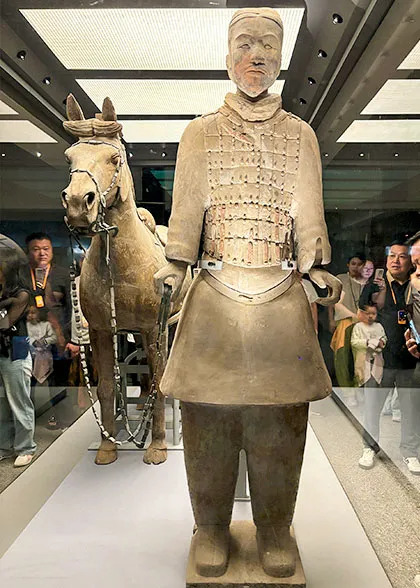
Cavalry Figure and His Horse of Pit 2
This array occupies the center of the formation, with 19 chariots arranged in three columns, six in the first, seven in the second, and six in the third. In this array, chariots, infantry, and cavalry are integrated. Cavalry could support chariot and infantry assaults or operate independently for flanking, pursuit, or reconnaissance, greatly enhancing the array's mobility.
Cavalry Array
Located in the northern section, this rectangular unit comprises six chariots and over 100 cavalry warriors and horses. The cavalry warriors wear short armor and rounded caps, carrying crossbows. Their primary strength was speed, enabling rapid charges on open ground, detours to flank and attack the enemy, or break through the enemy's defensive line, making them the fastest mobile force on the battlefield at that time.
Pit 3, though the smallest in scale, occupies a strategically vital position situated in a sheltered area behind the other two pits. Serving as the "brain" of the entire terracotta army, it functioned as the command center. Evidence of spaces designated for pre-battle divination, ceremonial prayers, and resting quarters for military commanders has been uncovered, all indicating its significant role in directing military strategy and operations.

 Pictures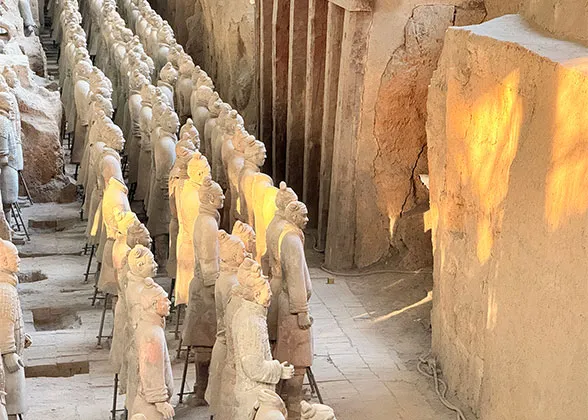
 Further Reading:
  Types of Terracotta Statues