The Yangshao culture that existed during the late Neolithic Age was found mainly in Henan, Shaanxi, Shanxi, southern Hebei and eastern Gansu Provinces, and was especially prominent alongside in the middle reach of the Yellow River. Extant from 5,000 BC to 3,000 BC, its name is derived from the first-known Yangshao Culture site - Yangshao Village in Mianchi County, Henan Province. Over one thousand Yangshao Culture sites have been found including the Banpo Site in Xian, and the Jiangzhai site at Lintong County near Xian. The majority of the Yangshao Culture sites are in Shaanxi, today regarded as the center of Yangshao culture.
Yangshao civilization gives priority to agriculture, and the main crops are millet and chestnuts. They made tools by grinding into useful shapes, including knives, millstone, axes, chisels and arrowheads. Some tools are made of bones, such as harpoons, barbs and other items. Along with agriculture, they engaged in fishing, hunting and gathering, as well as raising pigs and dogs like livestock. During the period of Yangshao Culture, the agriculture and animal husbandry developed tremendously.
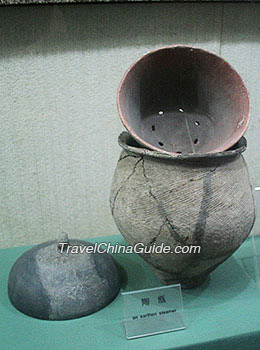 | | An Earthern Steam | | 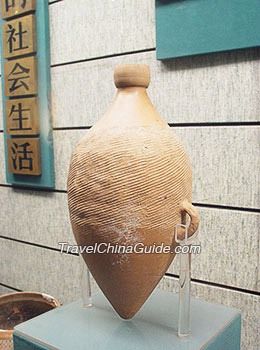 | | A Bottle with Pointed Bottom | |
Yangshao villages were laid out with a furrow surrounding a village. Outside the furrow were public cemetery and kiln. Five clusters of houses were scattered around a central square. The houses were mainly constructed to round and quadrate with half of the house under the ground. The walls of the houses were made from a mixture of clay and grass with wood framework.
The art of pottery was another of the outstanding innovation at that time. The materials, shapes and decorations of the wares were refined in order to make more delicate pottery wares. Red pottery wares including cooking vessels, bowls, cups, and jars were made by hand. The patterns varied from geometrical designs to animal designs. The most vivid patterns were human faces, fish designs, deer designs, bird designs etc. Additionally, the accessory, such as sheep head buttons, bird handles, gecko lids and others made the wares more lifelike. The representative items of Yangshao art include “basin with a human face and fish patterns”, “painted boat-shaped pot”, “painted basin with petal patterns”, “painted bottle with giant salamander patterns”, “jar with marabou and stone axe patterns” and others.
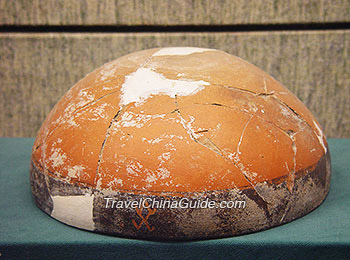 | | Neolithic Age: Pottery fragments | | 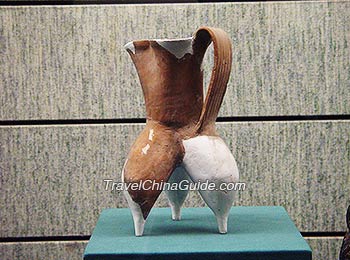 | | Tripod Porcelain | |
Basin with Human Face and Fish Patterns
The famous basin with a human face and fish patterns unearthed at Banpo Village in Xian, Shaanxi Province is a masterpiece of ancient pottery. The 16.5 cm high basin is currently exhibited at the National Museum of China. In the past, the basin was used as a cover for a child’ coffin. The human face on the basin is round with the left side painted black and the right side in semicircle. On both sides of the mouth are the patterns of two fish, whose heads happen to be overlapped. The design shows the fantastic imagination of the creator. The fish on the basin may represent the Yangshao belief in the fish totem.
Painted Boat-Shaped Pot
The painted boat-shaped pot, a typical Yangshao artifact, was unearthed at Baoji, Shaanxi province in 1985. It is also exhibited at the National Museum of China as well. It has boat shape and bottle-shaped pot rim. Both sides of the bulging body are painted with black lines.
- Last updated on Aug. 08, 2025 by Gabby Li -