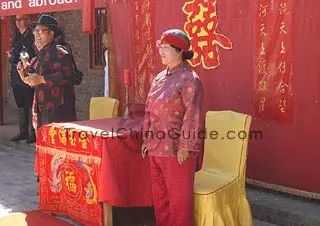
Chinese Marriage Through a Foreigner's Eyes
Ever since ancient times, there has been a saying that the three most delightful moments in one's life come with success in the imperial examination, marriage and the birth of a son. From the Qin (221 BC – 206 BC) to Qing (1644 – 1911) Dynasties, the feudal system dominated over two thousands years. During this period, the importance of getting married was far more than that a person found his better half. For the male side, it determined the prosperity and even the future fame of their family; while for the female side, it meant that parents lost the chance of seeing their daughter for a long time. Thus to choose an ideal partner was vital for both the individual and the family.
In feudal society, a marriage would be decided not by a young couple's love, but by their parents' desires. Only after a matchmaker's introduction and when parents considered the two family conditions were similar and could be matched, would the marriage procedures go forward. Conditions that should be taken into consideration included wealth and social status. If a boy's family was well-off or an official family, his parents would never permit him to marry a girl from a poor family. Essential to the marriage process were the commonly recognized 'three Letters and six etiquettes'.
Three Letters and Six Etiquettes
The three letters were the betrothal letter, the gift letter with a gifts list and the wedding letter used on the day the bridegroom met his bride at her home.
Six etiquettes then led to the final wedding ceremony.
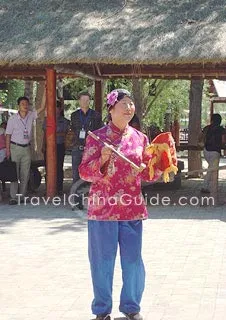
Proposing: when a boy's parents intended to make a match, they would invite a matchmaker to propose with them at the girl's home. It was the custom that the first time matchmaker went as a guest they could not be served tea in order not to 'lighten the marriage'. If the proposal was successful, however, the matchmaker (usually a woman) would be rewarded with profuse gifts and feasts to show the two families' gratitude. Many unmarried young people could not see and were unfamiliar with each other till their wedding day.
Birthday Matching: after knowing the girl's full name and birthday, they would ask a fortune teller to predict whether that could match their son's and whether there would be a happy marriage. The Chinese zodiac would be surely taken into consideration.
Presenting Betrothal Gifts: if the match was predicted to be auspicious, the matchmaker would take gifts to the girl's parents and tell them that the process could continue.
Presenting Wedding Gifts: This was the grandest etiquette of the whole process of engagement. Prolific gifts were presented again to the girl's family, symbolizing respect and kindness towards the girl's family as well as the capability of providing a good life for the girl.
Selecting the Wedding Date: the boy's family asked the fortune-teller to choose a date according to the astrological book when it would be proper and propitious to hold the wedding ceremony.
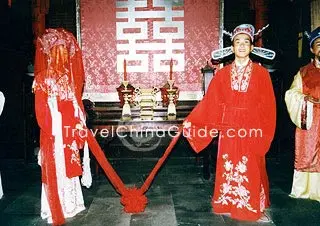
Wedding Ceremony: the wedding ceremony began with the groom and his party meeting the bride in her home. Before this day the bride's dowry would have been sent to the boy's house. The dowry represented her social status and wealth, and would be displayed at the boy's house. The most common dowries included scissors like two butterflies never separating, rulers indicating acres of fields, and vases for peace and wealth.
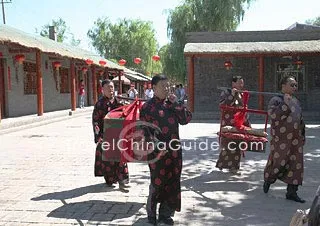
Before the meeting party's arrival, the bride would be helped by a respectable old woman to tie up her hair with colorful cotton threads. She would wear a red skirt as Chinese believed red foreshadowed delight. When the party arrived, the bride, covered by a red head-kerchief, must cry with her mother to show her reluctance to leave home. She would be led or carried by her elder brother to the sedan. In the meeting party the bridegroom would meet a series of difficulties intentionally set in his path. Only after coping with these could he pass to see his wife-to-be.
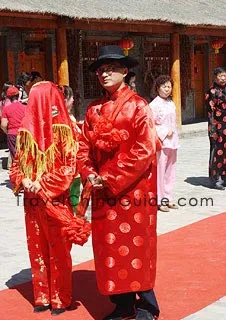
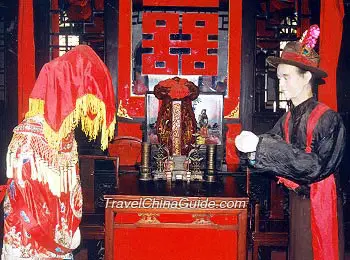
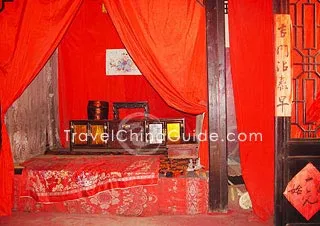
On the arrival of the sedan at the wedding place, there would be music and firecrackers. The bride would be led along the red carpet in a festive atmosphere. The bridegroom, also in a red gown, would kowtow three times to worship the heaven, parents and spouse. Then the new couple would go to their bridal chamber and guests would be treated to a feast. Wine should be poured to the brim of a cup but must not spill over.
On the night of the wedding day, there was a custom in some places for relatives or friends to banter the newlyweds. Though this seemed a little noisy, both of them dropped shyness and got familiar with each other.
On the third day of the marriage, the new couple would go back to the bride's parents' home. They would be received with also a dinner party including relatives.
Of course, marriage customs differed by region, but these were the most common. They have been maintained for thousands of years, but in recent years (especially after the founding of modern China), people have tended to discard some of the details and advocate simplified marriage procedures and wedding ceremonies.
Related Readings:
Procedures and Requirements of International Marriage Registration in China
Please share opinions and tips on how to date and marry Chinese in our International Marriage Forum
Chinese Marriage Through a Foreigner's Eyes
Travelers' Voices on Ancient Chinese Marriage Custom
1.
Oct. 29,2009 15:44 Reply
Ms.Student(USA) said:
I really don't get the chinese marriage consept... i wish i had someone to help me! This research stuff is really killing me....!!!!!
2.
Jun. 30,2009 10:21 Reply
Mr.Swagg(United Kingdom) said:
I think Chinese girls are one of a kind.
Oct. 29,2009 15:41
Ms.Lovely(USA) replied:
Of course you would,but what do you think about mixed girls?
3.
Sep. 22,2009 11:43 Reply
Mrs.Lim(Singapore) said:
Good article but rather incomplete on some small, but important protocols and cultural aspects. To me, the most important part for Chinese wedding ceremony is the tea serving ceremony, especially by the bride at the groom's family. For some, there is also the tea ceremony by the bride to the groom's ancestral altar. If those tea ceremonies don't happen, then it's not a Chinese marriage at all. The Chinese tea serving ceremony is for the bride to honour, respect and be "officially" invited and listed into the groom's family and ancestry as part of the new family tree (branch). That's where the "heaven and earth" spiritual part takes place for the timing and date must be correct (one reason for a fortune teller) where the couple is wedded in "holy" matrimony. The bride joining the groom's ancestry is also a reason why sometimes there's a perspective of the bride being wedded "out" of her family into the groom's family. By the way, pre-nup and registrations (so-called modern culture) are Western cultures and for the Court of Law. There are also some countries in the world where ethnic Chinese marriages are compulsory to be registered as part of the Government's census programme, and for the Court of Law - but means nothing to the ethnic culture itself. For instance having names on a piece of paper as being "registered" doesn't mean you're married in Chinese custom.
4.
Aug. 23,2009 12:44 Reply
Mrs.R.O. Oladepo(United Kingdom) said:
The brief that I have read about Chinese Marriage Custom was thrilling and makes me want more! Is it possible I have coverages on VCD/DVD for all levels of marriages, say: Low-income class, middle-class and high-class weddings/marriages. This is for educating and informing people through a Woman Ministry intending to helping homes, families and feminine gender of the responsibilities laid before womanhood. Appreciate your kind response.
Sep. 20,2009 20:25
Mr.Jane(usa) replied:
Here is part of my essay for my college English class:
In a formal arranged marriage, the groom’s family would give the bride’s family many expensive gifts and treasures to ask for their daughter’s hand in marriage. The bride’s family would send their daughter away on the wedding day with even more gifts and jewelries. Arranged marriage was mainly for upper and middle class families. For lower class people, arranged marriage was altered as purchasing marriages or exchanging marriages. For the poor families, all they had was their daughter and they would loss a laborer after she married so the groom’s family would pay the bride’s family to marry her. That was called a purchasing marriage. For some poor families, if they didn’t have any money to pay for it, but the groom had a sister and the bride had a brother, they would let the groom’s sister marry the bride’s brother to get an even exchange. That was called an exchanging marriage. For the poor villagers it is still happening today in China. I eye-witnessed one exchanging marriage when I was 6 years old in China. That had a happy ending though.
5.
Sep. 16,2009 21:44 Reply
Ms.doris(chima) said:
interesting things, after reading this story, I know a lot about the marriage in ancient times.
6.
Sep. 14,2009 10:14 Reply
Mr.Crowder(USA) said:
I recently visited China, (zhengzhou) where I had been emailing a lady a few months. She talked about marriage a lot, and even called me husband. She met me in Beijing and right off we ended up at the American Embassy, where I understood we were getting a marriage license and the ceremony would be later. we had a language problem, so when we arrived in Zhengzhou, she took me to a place to rent wedding things. I dissagreed and told her with a language translator, not to make any solid plans until I saw a lawyer to get a prenupual agreement. We then went to ma lawyers firm, but the price was too much. I then called my lawyer in USA, and he said not to marry until until I got back in USA, and a prenupual was signed. She claimed we were already married, and that Chinese customs a ceremony was not necessary. Is she right or wrong?
Sep. 15,2009 04:51
Mr.tina(cn) replied:
You are not married. I am sure!
7.
Jun. 16,2009 11:07 Reply
Mrs.Indumathi(India) said:
hi,
Indian weddings are similar to chinese wedding traditions. many aspects are similar though expressed differently.
Jul. 22,2009 21:44
Mrs.help(usa) replied:
i am doing homework to compare and contrast indian nuptial ceremonies and chinese nuptial ceremonies. do you think you could help me?
8.
Jul. 14,2009 12:28 Reply
Ms.hhii(ny) said:
that's cool
9.
Jun. 1,2009 11:28 Reply
Mr.milsap(germany) said:
Chinese girl are fine
Jun. 20,2009 04:12
Ms.Ruth(China) replied:
But I think the taste of the westerners is quite different from the Orientals'. The woman that we Chinese think beautiful is always not liked by the westerners. In China, man like the girls with big eyes, small face and straight nose. But many foreigners like the Chinese girl, who looks like Lucy Liu.
10.
Mar. 26,2009 15:52 Reply
Ms.,michelle(california) said:
are the traditions important in china??
Jun. 20,2009 04:04
Ms.Evelyn(China) replied:
Not all the people attach much importance on these traditions. The conservative families may value them more.