Mount Jiuhua
According to historical records, Buddhism was first introduced to Mount Jiuhua in the year 401. In 719, a Korean monk named Jin Qiaojue arrived and practiced Buddhism here for 75 years. Upon his Nirvana in 794, Jin Qiaojue was respected as the Earth Buddha by the locals, hence it has become the place where religious rituals were held to worship the God of Earth.
|
|
|
|
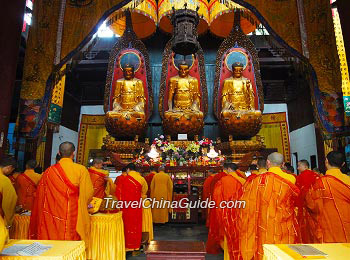
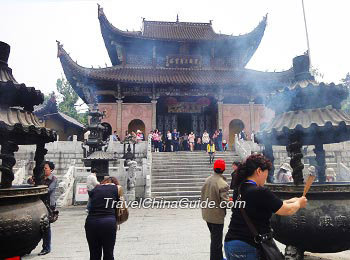
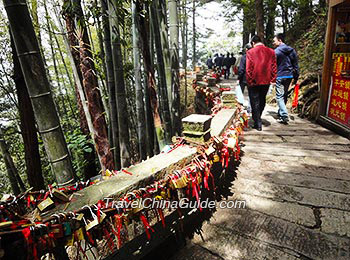
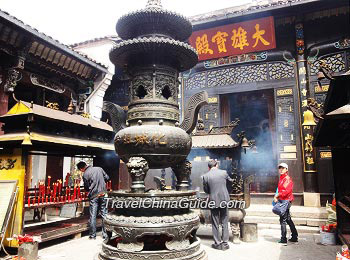
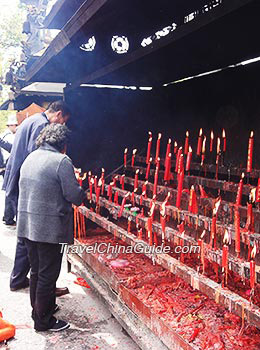
Visitors to the temples on the Mount Jiuhua are always impressed with the exquisite architecture and grand structure. Now there are no more than 90 temples in existence in it, most of them restored in Ming (1368 - 1644) and Qing (1644 - 1911) Dynasties. Among the most well known are the Incarnation Hall, Huacheng Temple, Zhiyuan Temple, Longevity Hall, Zhantanlin Temple, Ganlu Temple and Tiantai Zhending Temple.
 |
| Incarnation Hall |
Huacheng Temple is the oldest and holiest temple on Jiuhuashan. It is located in the center of Jiuhua Street. Though it first appears simple and solemn, the structure and decoration of the building are truly artistic. The engravings on lintels, brackets and roofs reinforce the brightness and liveliness of the building. The picture, 'Nine Dragons Playing with Pearls' on a panel in the Main Shrine Hall is a consummate piece of ancient Chinese art.
Precious sutras and other cultural relics in the temples are displayed in the Historical Relics Museum. The most valuable are the Buddhist canonical literature left from the Tang Dynasty, the Tripitaka left from the Ming Dynasty, and Emperor Kang Xi and Emperor Qian Long's handwritings left from the Qing Dynasty.
It is also worth mentioning the Corporeal Body Hall houses the skeleton of Monk Wu Xia that has been well preserved for more than 350 years. Wu Xia once wrote sutras with a mixture of gold powder and his own blood in a cave of the Mount Jiuhua during Ming Dynasty. After hard practice of sutras for a hundred year in it, Wu Xia passed away at the age of 126-- his body found in the cave three years after his death. Monks on Jiuhuashan believed Wu Xia was the reincarnation of Rinpoche. From then on, Buddhist believers have been keen to visit Jiuhuashan to pay homage to the monk.
Additionally, the Temple Fair on it, also named Hid Puja, is held every year regularly since 1983. With a history of over 1,000 years, it has been regarded as national immateriality cultural heritage. The 30th Temple Fair, from September 1st to 30th in 2012, attracted a large number of tourists and pilgrims home and abroad. During the temple fair period, the newly built Dayuan Cultural Garden was put into trial operation. Its remarkable buildings, the 99-meter tall bronze Ksitigarbha Bodhisattva Statue, and 99-meter diameter Buddha's Light Pool, is another sightseeing and Buddha-worship sites on Jiuhuashan.
How to get to Mount Jiuhua
By Bus
1. Nanjing Bus Station has three buses a day to Jiuhuashan at 7:40, 14:00, and 16:00, which take about 3h; one bus fron Nanjing South Bus Station at 11:30 is also available.
2. Hefei Tourism Bus Station (east of Hefei Railway Station) and Hefei South Bus Station provide regular buses to this mountain. The journey takes about 3 hours.
3. Huangshan Bus Station has only one bus at 13:30.
4. Many buses are avaiable from Chizhou Bus Station to the mountain and it takes about 30mins.
By Train
Take train to Chizhou first. After get out of Chizhou Railway Station, you will see Chizhou Bus Station. There are buses to the mountain and it takes about 30mins.
By Air
Visitors can take a flight to Chizhou Jiuhuashan Airport and then take a taxi to the mountain area.
| Entrance Fee | Jan. 16 - Nov. 14: CNY 160 | Free for children under 1.2m (3.9 ft). | |
|---|---|---|---|
| Cable Car | Bai Sui Gong Cableway | Jan. 16 - Nov. 14: CNY 100 (round-trip); CNY 55 (single-trip). Nov. 15 - Jan. 15: CNY 80 (round-trip); CNY 45 (single-trip). | |
| Tiantai Cableway | Jan. 16 - Nov. 14: CNY 160 (round-trip); CNY 85 (single-trip). Nov. 15 - Jan. 15: CNY 120 (round-trip); CNY 65 (single-trip). | ||
| Huatai Cableway | Mar. - Nov.: CNY 160 (round-trip); CNY 90 (single-trip). Dec. - Feb.: CNY 120 (round-trip); CNY 70 (single-trip). | ||
| Opening Hours | 07:00 - 17:00 | ||
| Recommended Time for a Visit | 1-2 days | ||