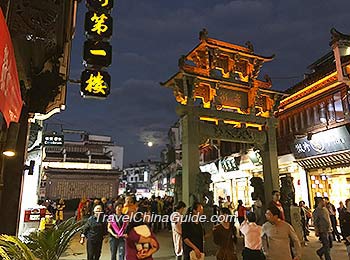
Tunxi Old Street is situated in the center of Tunxi District, the location of Huangshan City Government.
It dates back to the Song Dynasty (960-1279), with centuries-old history. Emperor Huizong (1082-1135) moved his seat of government to Lin'an (now is Hangzhou), when many architects and workmen were conscripted to construct the new capital. After returning to their hometown, they imitated the structural style to build architecture along the street, so Tunxi Ancient Street was formed. At the beginning of the Ming Dynasty (1368-1644), a merchant in Anhui invested money to build 47 stores so as to attract businessmen, which contributed to the communication of it with outside world. Gradually it developed into the distribution center for materials in and out of Anhui in the Qing Dynasty (1644-1911).
Tunxi Old Street is paved with maroon flagstones with a total length of 1,273 meters (about 1,392 yards), of which 895 meters (about 979 yards) is the pedestrian commercial street. Shops standing on both sides are generally of two or three floors, which feature the local Anhui style of stone base, brick construction and tile roof. The layout of these buildings commonly takes on the appearance of shops in front while houses and workshops are to the rear. Once a professor from America was amazed by it and he said he had found an Oriental Ancient Rome. Nowadays Tunxi Ancient Street is also used as a natural studio for films and TV series.
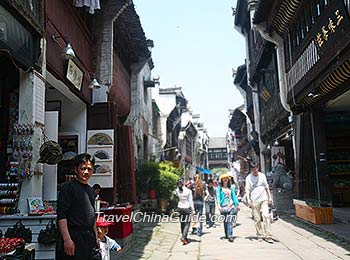 | | Huangshan Tunxi Old Street | | 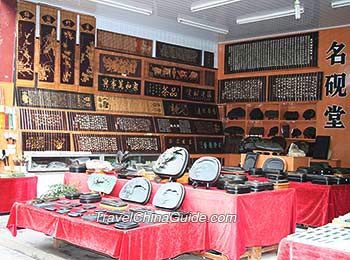 | | Ink Slabs Shop | |
There are two well-known museums in Tunxi Old Street. One is the Tunxi Museum with a display of furniture from the Ming and Qing dynasties on the first floor and an exhibition of calligraphy, paintings and china upstairs. The other is Wancuilou, a four-storey structure which is the first private museum of ancient architectural style. Famous ink stones and the four treasures of study, writing brushes, ink sticks, ink slabs and paper are displayed or for sale on the first floor. Here you can find the biggest inkstone weighing more than 12,500 kilograms (about 27,558 pounds). Cultural relics and other artworks collected by the owner of the museum are exhibited on the second floor.
Along the Tunxi Old Street there are many shops that have existed for over one hundred years. Curios and knick-knacks including inkstones, brushes, local teas, and Mao badges can also be found. It is a paradise for tourists to buy souvenirs rich in Chinese culture with comparatively lower prices and is a must-see when you are traveling in Huangshan City.
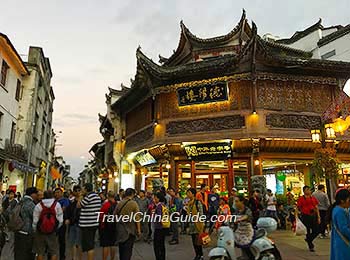 | | Deyanglou Restaurant | | 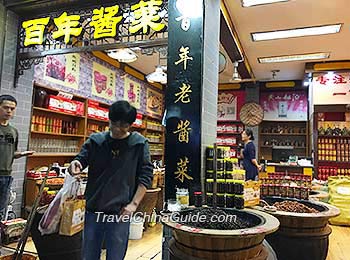 | | Pickles Store | |
How to get to Tunxi Old Street
1. Take bus 1 to Ermalu.
2. Take bus 3, 5, 8, 11, 12, 15, or 21 to Yuzhong Huayuan.
| Entrance Fee | Free |
| Opening Hours | Whole day |
| Recommended Time for a Visit | At least one hour |

Recommended Guided Tours:
 4 Days Huangshan Tour from $539 5 Days Hangzhou - Huangshan Tour from $869
More
Huangshan Tours Top 9 Things to Do in Huangshan- Last updated on Aug. 04, 2025 by Demi Li -
 More Tunxi Old Street Pictures