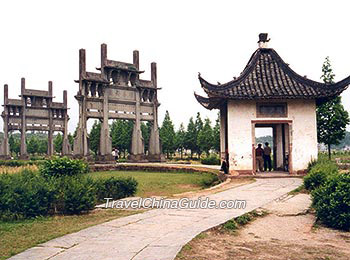
As a complex of seven arches, Tangyue Memorial Archway was listed as a key national cultural protection unit under the approval of the State Council in 1996. Situated in Tangyue Village six kilometers (four miles) west of the renowned Town of Arches -
Shexian County, Huangshan City, it is the biggest existing and best-preserved complex of arches in Anhui Province.
The seven memorial archways were built by the Baos in honor of the merits and virtues of their family members. Tangyue Memorial Archway stands in the main street of the village in order of 'loyalty, filial piety, chastity and charity'. Three were constructed in the
Ming Dynasty (1368-1644), and the other four in the
Qing Dynasty (1644-1911). The most ancient one, which has a long history of over 580 years, can be traced back to 1420 during the reign of Yongle in the Ming Dynasty. The latest one was built in 1820 in the reign of Jiaqing.
Filial Piety Archway
Behind each of them, there is a touching story. The most acknowledged stories are the ones of 'Filial Piety Archway' (Ci Xiao Li Pai Fang) and the 'Chastity Archway' (Jie Jin San Dong Pai Fang) in Tangyue Memorial Archway scenic area. The former was built in honor of Bao Sheyan and Bao Shousun (father and son). According to historical records, father and son were captured by a general, who wanted to execute one of them. Bao Shousun wanted to sacrifice his life to save his father, so he begged the general to behead him instead of his father. Whereas, the father was also a loving and caring father and wanted him to be executed rather than his son. Their action and love moved the general, who finally released them. Later, the court knew the fact and approved the construction in praise of their filial piety and self-sacrificial spirit.
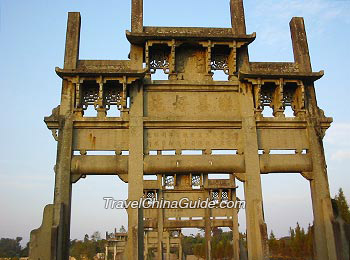
Chastity Archway
The construction of the 'Chastity Archway' was in praise of a stepmother who remained chaste while raising her stepchild after her husband died. According to historical record, a widow with the surname of Wu, who was the second wife of Bao Wen, lost her husband when she was 29. After her husband's death, she remained chaste and treated her stepchild as her own son. Wu died 31 years later. Her action touched the local officials, who made up their minds to erect an archway to honor her in spite of the convention that erecting this for a step-wife was prohibited. This touching story has been passed down from one generation to another in Tangyue Village.
Nüci and Nanci
Near the complex of them stand Nüci and Nanci, respectively also called Qingyi Ancestral Temple and Dunben Ancestral Temple. The ancestral temple was a place to worship the honorable women and men in the family of Baos. Nüci is particularly significant in studying the patriarchal clan system, because in China's feudal society, it was rare for women to have the privilege to be honored in an ancestral temple.
How to get to Tangyue Memorial Archway
Tangyue Memorial Archway is close to
Bao's Family Garden. To get to the archway, visitors need to go to Shexian County first: Take a bus from Huangshan Bus Station to Shexian at 7:10 or take a train from
Huangshan Railway Station/
Huangshan North Railway Station to Shexian/ Shexian North. After arrival, visitors can take a taxi to the Tangyue Memorial Archway.
Entrance Fee
(including Bao's Family Garden) | CNY100;
CNY 50 for children between 1.2 and 1.5m (3.9 - 4.9 feet);
Free for children under 1.2m. |
| Opening Hours | 07:30-17:30 |
- Last updated on Aug. 07, 2025 by Demi Li -
 International visitors enjoy a half-price discount on the entrance ticket to Tangyue Memorial Archway in the entire year of 2024.