Mogao Caves
Mogao Caves Facts
Location: 25 km (15.5miles) from downtown Dunhuang on the eastern slope of Echoing-Sand Mountain (Mingsha Shan)
When was the Mogao Caves built: in the year of 366 in Five Hus and Sixteen States (304 - 439)
Number of the caves: 735
 |
Mogao Caves, Dunhuang More Pictures More Pictures |
Mogao Caves is a shrine of Buddhist art treasures. A network of plank reinforced roads plying north to south 1,600 meters (5,249 feet) long lead to the cave openings, which are stacked five stories high some reaching up to 50 meters (164 feet). By the way, Mogao means high up in the desert.
 |
According to Tang Dynasty (618 - 907) records, a monk lived in Five Hus and Sixteen States had witnessed onsite a vision of thousand Buddhas under showers of golden rays. Thus inspired, he started the caves construction work that spanned ten dynasties. Mogao Caves are commonly known as the Caves of a Thousand Buddhas.
 |
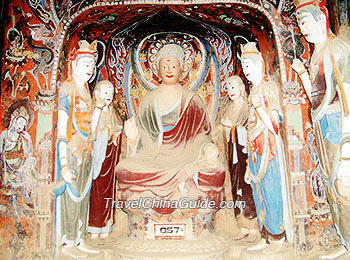
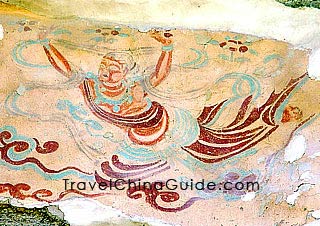
Buddhist art has its origins in India. Mogao sculptors improvised where the rock surface did not work well under their chisels. They placed clay statues in front of the cave walls, carved relief murals as backdrops, and painted the sidewalls and ceilings with art decors. The largest statue is 34.5 meters (113 feet) high and the smallest a mere 2 centimeters (0.79inches) high.
 |
The traveler will note traces of Indian Buddhist art in the earlier works. More recent works depict all walks of life and activities in a local setting. You will relive the daily routines and special events as captured by the artists while you are exploring the 735 caves. There are also ups and downs in the artistic quality over the centuries, depending on the fortunes of Buddhism with available art patronage. Artists in each dynasty painted with their distinctive palette. The visitor can tell the works in the Tang Dynasty from those in the Song Dynasty (960 - 1279).
 For detailed information on Dynasties, please refer to History of China. People believe it possible to fill 25 kilometers (15.5miles) of gallery space with the works of art from Mogao. There are 50,000 manuscripts written in many languages apart from artifacts. The Mogao Caves are a depository of historical and cultural exchanges over more than a thousand years between China and other nations.
|
|
Note:
2. Within Mogao Caves, no photo! An electronic torch maybe necessary to see inside Mogao Caves.
Reservation Procedure
From July 20, 2015, individual visitors who reserve the entrance tickets are required to provide their valid ID documents used for reservation to get their tickets. Foreign visitors can use their passports. All visitors should get tickets from the ticket office in downtown (No. 102, Building 15, North District of Yingbing Garden Community, East Yangguan Road; close to Yingbing Grand Hotel) or the ticket office in the Digital Exhibition Center.
Those who don't reserve the entrance tickets in advance can buy tickets at the above two ticket offices.
If visitors have any question, they can call (+86) 400-833-3715(7:00-00:00).
 Notice to visitors in July and August
Every year, supplementary tickets at the price of CNY 100 will be issued for odd-numbered days in July and even-numbered days in August. The limit for supplementary tickets is 12,000 per day. Different from regular tickets, they only allow visitors to visit four caves and the museums. The Digital Exhibition Center is excluded.
How to get to Mogao Caves
2. Take a taxi to Mogao Caves and it takes about 30mins.
| Mogao Caves Tickets | ||||
| Apr. - Nov.: CNY 258 for foreign visitors Dec. - Mar.: CNY 160 for foreign visitors Note:The admission fee includes Mogao Caves, Digital Exhibition Center, shuttle bus service between the Exhibition Center and the caves and foreign language interpreting service. | ||||
| Opening Hours | May - Oct.: 08:00 – 18:00 Nov. - Apr.: 09:00 – 17:30 | |||
| Recommended Time for a Visit | 3-5 hours | |||
Read More: Top 10 China Tourist Places for Culture Lovers
- Last updated on Aug. 05, 2025 by Demi Li -