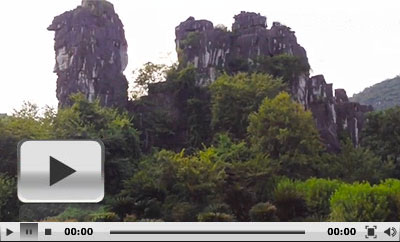
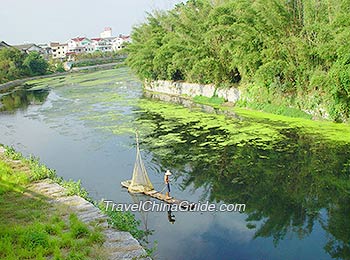
Seven Stars Park, covering an area of more than 120 hectares (297 acres), is the largest comprehensive park with mass scenery in Guilin City. Located at the east bank of Li River, the park is 1.5 kilometers (0.9 mile) from the downtown area of Guilin. It was so named because of the seven peaks, the four peaks of Putuo Mountain and three of Crescent Mountain, inside resemble the form of the Big Dipper constellation.
The Seven Stars Park is endowed with elegant mountains, clear water, miraculous stone forest, deep and serene valleys, plentiful animals and plants and valued cultural relics. It has been popular since the Sui (581-618) and Tang (618-907) Dynasties. The main sights contain Flower Bridge, Putuo Mountain, Seven Stars Cave, Guilin Zoo, Camel Hill, Crescent Mountain, Guihai Stele Forest and Light of China Square.
Flower Bridge
Flower Bridge, built in the Song Dynasty (960-1279), is the oldest bridge in Guilin. Every spring and summer, it is set off with blooming flowers and the streams, hence the name Flower Bridge. The larruping point of the bridge lies in that the arch's inverted reflection in water always looks like a full moon. It never changes even though the quantity of water changes.
Putuo Mountain
Putuo Mountain, where Avalokitesvara Bodhisattva is worshiped, is the main body of the Seven Stars Park. It abounds with caves and pavilions. At the southwestern foot of the mountain lies the natural air condition Xuanfeng Cave. At halfway up the mountain, you will see Putuo Jingshe (a two-storied pavilion). At the west belly of the mountain, you will see the renowned Seven Stars Cave, which is also called Qixia Cave or Bixu Cave. With the multifarious stalactites, stalagmites and stone pillars formed by the dissolved limestone, the cave was called 'Residence of the Immortals'. Turning right and go on climbing the mountain, you will see the Tomb of the Three Generals and the Tombs of 800 Heroes. On the top of the mountain, there are Putuo Stone Forest, Xuanwu Pavilion and Zhaixing Pavilion. In addition, there are numerous valuable tablets on the mountain.
 | | The Stalactite in Seven Stars Cave | | 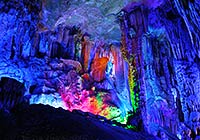 | | Interior Scene of the Cave | |
Camel Hill
Camel Hill inside Seven Stars Park, looking like a life-like squat camel, lies behind Putuo Mountain. It was once called Hu Shan because it is shaped like a flagon. A hermit in the Ming Dynasty once lived here and grew large numbers of plum trees. In spring, the full-blown plum blossom, together with the rays of the sunrises or sunsets drapes the hill with a gorgeous glow. This is one of the Ten Scenes of Guilin. Around the hill are bonsai gardens, the Guilin Zoo and teahouses.
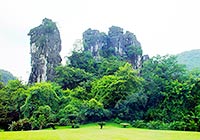 | | Camel Hill | |  | | Cormorants in Seven Stars Park | |
Crescent Mountain
Crescent Mountain is to the south of Putuo Mountain. It was given this name due to the crescent-shaped stone at its belly. The mountain is reputed for its maigre food, which has a history of more than 100 years. The Nun Noodles are really worth tasting. Walking along the stone steps, you can see Banyue Pavilion, Crescent Rock and Guanghan Pavilion. Standing here, the sights of Guilin City even come into sight! At the southwestern foot, there is Guihai Stele Forest, which consists of Longyin Cave, Longyin Rock. The stele forest has more than 220 tablets, referring to politics, economy, culture and military affairs in forms of poems, posies, couplets and images. The characters in the tablets are inscribed in regular script, cursive script, seal characters and clerical script.
Light of China Square
Light of China Square is between Putuo Mountain and Crescent Mountain. It boasts of two craftworks, one is the stone carving murals and the other is Shi Ji Bao Ding (the precious Ding of the century). The mural, made up of more than 100 stone carvings, epitomizes 5000-year Chinese civilization. Shi Ji Bao Ding, a four-legged Ding at a height of 4.6 meters (15 feet), symbolizes that the country flourishes and people live in peace.
Thanks to the pleasant climate here, you can pay a visit to Seven Stars Park at any time of year.
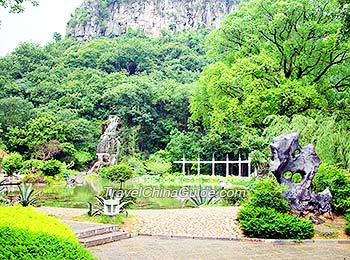 | | Leisure Time in Seven Stars Park | | 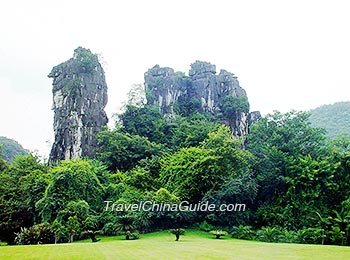 | | Reading in Seven Stars Park | |
How to get to Seven Stars Park
Take bus 10, 11, 14, 18, 21, 24, 25, 30, 204, 206, 207 or sightseeing bus line 1, and get off at Seven Stars Park.
| Seven Stars Park | Seven Stars Cave |
| Entrance Fee | CNY 55 for adults
CNY 27.5 for minors aged 6-18 and seniors aged 60-65
Free for children under 6 or below 1.2m (3.9 ft) and seniors over 65. | CNY 45
CNY 22.5 for minors aged 6-18 and seniors aged over 70
Free for children under 6. |
| Combo Ticket | CNY 95
CNY 50 for minors aged 6-18 and seniors aged 60-65 |
| Opening Hours | 08:00 - 18:00 | 8:30 – 17:00 |
| Best Time to Visit | Apr. – Oct. |
Note: To visit Seven Stars Cave, you must enter Seven Stars Park first, so you also need to pay for the park.
 Top 10 Things to Do in Guilin
 - Last updated on Jul. 24, 2026 by Sherry Xia -